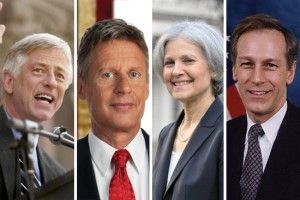
In October 2012, four presidential candidates who had been excluded from the official debates between Barack Obama and Mitt Romney gathered in Chicago for an alternative forum that highlighted the structural barriers facing third-party campaigns in American politics. The event, hosted by the Free and Equal Elections Foundation and moderated by veteran broadcaster Larry King, featured substantive policy discussions that rarely surfaced in the two-party debates.
The Candidates and Their Platforms
The four participants represented a range of political perspectives rarely heard on a national stage. Rocky Anderson, the former mayor of Salt Lake City, ran on the Justice Party ticket. Virgil Goode, a former Virginia congressman, represented the Constitution Party. Gary Johnson, the former governor of New Mexico, carried the Libertarian Party nomination. Jill Stein, the Green Party nominee, had previously run against Romney for governor of Massachusetts in 2002.
Both Obama and Romney were invited to participate but declined. King noted the irony of the situation, observing that while the United States operated as a two-party system in practice, this arrangement existed by convention rather than by law.
Military Spending and Foreign Policy
When the debate turned to Pentagon spending, all four candidates agreed that military expenditures should be reduced, a position that neither major party candidate was willing to endorse during the official debates.
Johnson proposed the most specific figure, calling for a 43 percent reduction in military spending, which he noted would return defense expenditures to 2003 levels. He framed the issue primarily in economic terms, arguing that the greatest threat to national security was the country’s fiscal insolvency.
Goode, who had voted to authorize the Iraq War in 2003, took a more moderate position, acknowledging that defense cuts were necessary while emphasizing his support for a strong military. He argued against the approach advocated by Romney and his running mate Paul Ryan, contending that the United States needed to retrench rather than continue serving as the global policeman.
Stein offered the most comprehensive critique of American foreign policy, arguing that a militarism-based approach was making the country less secure rather than more. She called for bringing troops home and fundamentally restructuring defense priorities.
The 15 Percent Threshold and Debate Access
Since 1988, the Commission on Presidential Debates had required candidates to demonstrate at least 15 percent support in national polls to qualify for inclusion in the official debates. Only one non-major-party candidate had ever met this threshold: billionaire Ross Perot, who debated Bill Clinton and George H.W. Bush in 1992.
George Farah, author of a book examining how the Republican and Democratic parties controlled the presidential debate process, characterized the 15 percent requirement as substantially too high and fundamentally arbitrary. He pointed out the inconsistency with federal election financing rules, which required parties to receive only five percent of the vote in the previous election to qualify for matching funds.
Alternative debates for excluded candidates had been organized since 1996, but the 2012 event attracted unusual attention, partly due to King’s involvement as moderator.
Structural Barriers to Third-Party Candidacies
Beyond debate exclusion, third-party candidates faced what Farah described as Herculean structural barriers at every stage of the electoral process.
Fundraising presented an inherent disadvantage compared to Republican and Democratic candidates who had access to established donor networks and party infrastructure. Ballot access requirements varied dramatically across all 50 states, with each jurisdiction imposing different signature collection thresholds for non-major-party candidates to appear on the ballot.
States like North Carolina and Oklahoma were notoriously difficult for third-party candidates to gain ballot access, while others like Louisiana had more permissive requirements. Only Obama and Romney appeared on ballots in all 50 states and Washington, D.C., though Johnson came close with access in 48 states.
The winner-take-all electoral structure compounded these difficulties. Political science research consistently showed that third-party candidates performed better in countries with proportional representation or instant runoff voting systems, which allowed voters to express preferences without the fear of wasting their vote or inadvertently helping elect their least preferred candidate.
The 2012 Third-Party Landscape
Richard Winger, who tracked ballot access issues through his publication Ballot Access News, predicted that third-party candidates would collectively receive a higher share of the vote in 2012 than in 2008, when the enthusiasm surrounding Obama’s historic candidacy had drawn voters who might otherwise have supported minor parties. In that election, less than 1.5 percent of the total vote went to non-major-party candidates.
The 2012 cycle set at least one record: 27 individuals appeared on at least one state ballot, surpassing the previous record of 23 set during the three-way 1992 race that included Perot.
Winger identified Alaska and New Mexico as states likely to produce the highest third-party vote shares. Alaska’s position four time zones behind the East Coast meant many voters already knew the national outcome before casting their ballots. New Mexico’s connection to Johnson, who remained popular as a former governor, gave the Libertarian candidate an unusually strong regional base.
A Gallup survey from September 2012 found that three percent of voters nationally planned to support either Stein, Johnson, or Goode, a figure that understated actual support since most major polls did not even include third-party candidates as options.
Media Coverage and Democratic Implications
The debate was broadcast by Al Jazeera and Russia Today but carried by no major American cable news networks, a fact that underscored the circular nature of the problem facing third-party candidates. Without major media coverage, they struggled to build the name recognition needed to meet polling thresholds, and without meeting those thresholds, they were excluded from the events that generated the most media attention.
A second third-party debate was scheduled for October 30, 2012, but the fundamental structural issues that marginalized these candidates, from ballot access laws to debate requirements to media coverage patterns, remained deeply embedded in the American electoral system, raising persistent questions about whether the country’s democratic process genuinely offered voters the range of choices it claimed to provide.