Wikileaks Statement, Anonymous Responds – A parting of ways..?
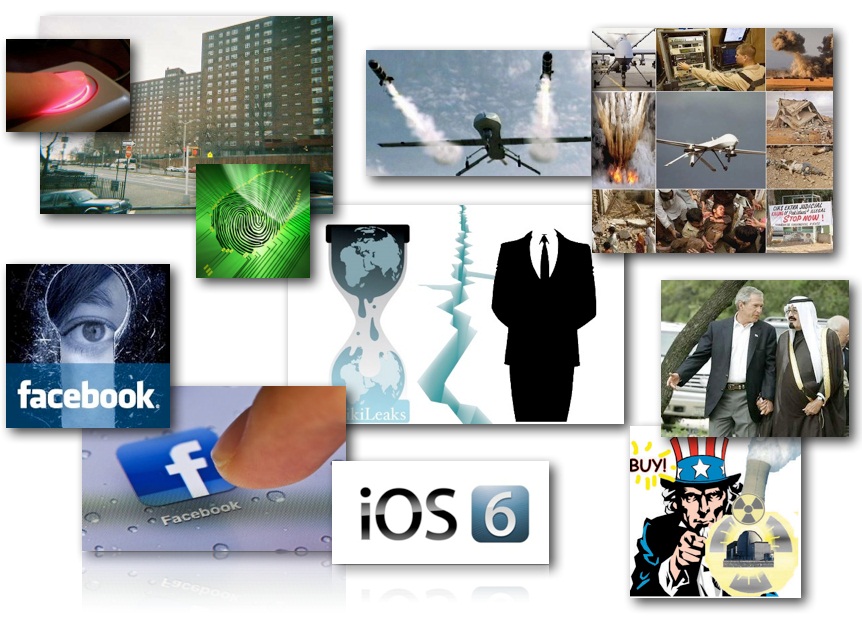
Fact of the Day – Bin Laden family makes millions on defense industry Boom!
Facebook Spying Methods, Secrecy
Apples new i06 includes new (ad?)tracking
Drone Strikes Super Tech Double-Tap
Biomentric Privacy invasion – now being forced in low-income programs
Show Transcript
Introduction: WikiLeaks, Anonymous, and the Tech Surveillance State
Welcome everyone to the Decrypted Matrix on Revealing Talk Radio. This is Max. Hope everyone had a great weekend. On today’s show we have loads of technology to talk about. There’s a lot going on in the world of technology, so that’s really the focus today.
First up, information about how Apple has quietly started tracking iPhone users again. Then we’ll get into the WikiLeaks and Anonymous feud that continues. WikiLeaks is drawing fire from the community. Anonymous is upset and starting to distance themselves from the collective. What started as a visible leak organization has now put up a pay wall, and they’re not releasing the full archive. This is due to the new WikiLeaks release, the Global Intelligence Files, that came from the Stratfor hack by Anonymous.
WikiLeaks is now controlling the release of these documents. Why this control? The pay wall is what’s iffy about this. We’ll dive into a statement by Julian Assange and the statement by the loose collective that calls itself Anonymous. It should be pretty interesting to hear right from the horse’s mouth what this dispute is all about.
We’re also talking about creepy technology. Facebook’s tracking methods that they use to track your activity are pretty sneaky. They even track you after you delete your cookies. Even if you’re religious about clearing your cookies, they’ve got their own tricks. You should be aware of this. You might want to use other browsers. One browser for Facebook, one for your other web activity.
Then there’s technology and data mining now being used in lower-income parts of the country. Data mining is now affecting children with fingerprinting requirements in Jackson, Mississippi. For some time, programs and funding for biometrics have been rolling out nationwide at state and local levels. Fingerprint readers for police departments, face recognition systems, the whole TrapWire thing we found out about recently. Biometrics is huge right now. This technology can even read your fingerprints from a distance and identify who you are. The cameras are high enough resolution now that they can actually do this.
Fact of the day: the modern royal family has owned stocks in the defense company Lockheed Martin, stocks which have tripled since the dawn of the War on Terror. The Carlyle Group is another one. These families are running with it. They’re in the business of various high-tech weaponry that’s sold to both sides, and ultimately it’s a perpetual war. War is a business, and it’s a business that we need to bring to an end.
The WikiLeaks and Anonymous Feud: Julian Assange’s Statement
There’s a real upheaval in the community right now with regards to the hacking and Anonymous community. There was so much support for WikiLeaks initially amidst all the scandal, corruption, and arrests. But WikiLeaks is interesting in that it’s still in pursuit of putting out information, and the idea that information should be free, that information should be widely distributed.
The WikiLeaks fundraising campaign is controversial because they want money to put up a pay wall for this new release, and it just goes against the idea of what Anonymous represents. Anonymous is a loosely organized, often chaotic movement of cyber activists. Their profile grew dramatically after the arrest of Bradley Manning and the profile of Julian Assange. They’re trying to link the two together.
In the case of Bradley Manning, there’s speculation that they’re trying to break his will, keeping him in solitary confinement to break his will so that he comes willing to testify against Assange. The only explanation for this repeated torture and inhumane treatment is to make him stand for twenty-three hours a day, giving him one hour outside for exercise. He’s not allowed to do push-ups or any real exercise. Limited amount of reading material. This is horrific treatment.
WikiLeaks’ website recently disappeared behind a screen asking users to make a donation. It’s a tactic similar to the pay walls of some newspapers online, where they give you the headline and first paragraph and then you have to sign up to read more. Anonymous is now saying that their friends at WikiLeaks will lose their allies if they stay on this path.
The scale of the annoyance among Anonymous supporters is difficult to gauge because it’s a leaderless movement by its nature. But there are several closely watched Twitter accounts associated with Anonymous that have expressed anger and unhappiness with this move. Because of the sheer number of followers, these accounts have credible influence on the community.
Here is Julian Assange’s statement. He says that Anonymous is a loose collective, and he essentially challenges them, saying they’re not really doing anything productive. He says to get together, do something productive. Anonymous took issue with that. Assange also made some recommendations about certain websites, promoting certain sites and servers that are insecure, which Anonymous says is bad practice.
So the WikiLeaks founder insulted Anonymous a little bit, saying many of you do nothing, you’re causing more destruction than being productive, you should pull your act together and stop advising people to use insecure websites.
Julian Assange’s Full Statement on Solidarity and Unity
Here is the substance of Julian Assange’s statement, in which he addresses Anonymous directly. He writes:
“Freedom isn’t free. Justice isn’t free. And solidarity isn’t free. They require generosity, self-discipline, courage, and a sense of perspective. Groups with unity flourish, and those without unity are destroyed, replaced by those who have it. A traditional army achieves unity through isolation, obedience, and coercive measures applied to dissenters, including death. Groups that do not have techniques of unity are dominated by groups of cohesive units. The coercive unity in the end dominates. Unified groups grow and multiply. Groups which lack unity imperil themselves and their allies. It doesn’t matter what principles a group espouses if it is not able to demonstrate basic solidarity, because it will be dominated by alliances that do.”
“Where does the public press fit in? The press becomes a medium through which the group talks to itself. This gives the press influence over the group. So wherever the public press has influence, so do the insiders who speak to it. For large groups, those insiders who interface with the public press are able to leverage themselves into a position of internal influence through press influence.”
“Because Anonymous is anonymous, those who obtain infamous or other forms of leadership influence can be secretly co-opted and replaced by other interests. This is exactly what happened with Sabu. The important part is that Anonymous ended up being controlled by the FBI through its most visible figure. Sabu was then used to attract others. FBI agents or informers subsequently ran entrapment operations against WikiLeaks, presenting as figures from Anonymous.”
“According to FBI indictments, the FBI has at various times controlled Anonymous servers. We must assume that currently a substantial number of Anonymous servers and leadership figures are compromised. This doesn’t mean Anonymous should be paralyzed, but it does recognize the reality of infiltration. The promotion of non-vetted hosting and similar assets, which are indistinguishable from an entrapment operation, must not be tolerated.”
“The strength of Anonymous was not having leadership or other tangible targets. No one person has influence over the whole, and no assets of special significance. This makes compromise operations expensive and ineffective. WikiLeaks, in contrast, has an organization with a well-tested public leadership structure in order to prevent covert leadership replacement. This includes virtual assets such as servers, Twitter accounts, and IRC channels.”
“The question Anonymous must ask is: does it want to be a gang, an ‘expect us’ movement, or a movement of solidarity? Solidarity requires unity, common values, rather than a disjointed collection of individuals whose actions merely strive towards common virtues.”
Anonymous Responds to Julian Assange
Now here is the Anonymous response to WikiLeaks. They wrote:
“We would have preferred to let this rest, as we think it is distracting from more important issues. However, some allegations in Julian’s statement should be addressed. First off, thank you for making the statement. At least we’re communicating. Please note that this response was written quite abruptly. This is not one voice but many.”
“Moving on to your statement that ‘because Anonymous is anonymous, those who obtain this or other forms of leadership influence can be secretly decapitated and replaced by other interests’: we are amazed how you of all people would talk about leadership in Anonymous. We would have thought you understood. Sabu was never a leader or an influence over more than a handful of people who chose to work with him. He wasn’t even a leader among the small secluded group. Among those, he was one of the most vocal, and it comes as no surprise that the media and public mistook him as a leader. The world is always easier to understand if you put labels on things.”
“You should know that even during the LulzSec era, there were quite a number of unknowns who neither trusted Sabu nor accepted him as a leader. Anonymous is far more complex and versatile than you seem to think. There will never be any single leader or spokesperson for us all. And of course there are some channels and big Twitter accounts that are more visible than others, and thus it can be argued that they have more influence. But that doesn’t make them leaders. It does, however, leave us with a certain amount of responsibility, which is why we take the time to write this down. But in the end, we always urge everyone to make up their own mind, to validate facts, and not jump to conclusions based on assumptions.”
“Regarding your statement that ‘according to FBI indictments, the FBI has at various times controlled Anonymous servers, and we must assume that currently a substantial number of Anonymous servers and leadership figures are compromised’: checking the facts, we find exactly one case where the FBI actually controlled an Anonymous server. This is referenced in Jeremy Hammond’s complaint, where a server in New York was provided by the FBI to Hammond and his co-conspirators. This indictment is well documented and occurred in an ongoing investigation where one of the key figures was actively working for the FBI. We don’t know of any situation where anything even remotely similar has happened since. If you have evidence to show otherwise, please do so, as we would be most interested. Either way, there’s nothing that allows the conclusion that a substantial number of Anonymous servers and leadership figures are compromised. This is speculation with no facts to back it.”
“Regarding the promotion of hosting and assets which you claim are indistinguishable from an entrapment operation: thank you for finally letting us know what server you were referring to this whole time. It does surprise us, however, as that hosting service was never considered for WikiLeaks materials or any other operation. The site contained an image board and some platforms on which to share pictures and videos. It hardly matters, as the site only existed for a few weeks and was never finished before the person running it decided to discontinue it. The Anonymous accounts on Twitter distribute links from the Anonymous community, and that is quite different from promoting assets for entrapment operations. This is a ridiculous notion that makes us wonder who is becoming paralyzed by paranoia.”
“Finally, as for our solidarity and support: those who have read our initial statement as hurtful should know that we are by no means calling for actions against WikiLeaks or Julian Assange, nor do we condone such actions. We do, however, feel that WikiLeaks has strayed from its original mission. It was not our intention to throw mud at each other. We stated our reservations against WikiLeaks clearly, because these are based not on assumptions but on past experiences and facts.”
“We should not need to remind you how closely we have cooperated with each other on occasion. Nor do we need to explain the risk that many of our people took upon themselves while enabling you to make those leaks available. But maybe we should, for those who were not aware of the full history. Two years ago, Anonymous declared solidarity with WikiLeaks, bringing attention to the financial boycott of WikiLeaks. Websites were brought down, not really to sabotage their business, but simply to bring attention to the fact of the boycott.”
“One year ago, the same incidents you reference as compromised actually revealed information in their entirety that ultimately ended up on WikiLeaks, or was released as a trickle of information, much the same as with the diplomatic cables before the whole stash got released. In all cases, WikiLeaks was handed the leaks they published because the sources trusted them to be the best possible option. But we do not think that is true anymore.”
“To be honest, we had better reasons to cut ties with you before, especially when you blindsided us with the statements regarding Anonymous servers and leadership being compromised and the implication that we would promote assets to entrap people. But we always held back because we believed in the mission.”
“We understand that WikiLeaks relies on donations. We fail to understand where it is spending the amounts of money it receives. WikiLeaks takes in hundreds of thousands of dollars each year to operate, and when we observe other platforms doing similar work for a fraction of that, we remain silent because we believe in the mission. But now you show the audacity to barricade content with a JavaScript pop-up, forcing the majority of visitors to your domain to spam via Facebook or Twitter. This is a blatant violation of what WikiLeaks should stand for. We will not stand for this anymore.”
“That being said, it is time we move forward. There’s far too much at stake for these petty disagreements. We do not want to see anyone feel torn between WikiLeaks and Anonymous. That is not fair to those people. Anyone has the choice to support Anonymous, WikiLeaks, neither, or both.”
Apple iPhone Tracking in iOS 6
Apple quietly started tracking iPhone users again after the launch of the iPhone 5 in September, which came with iOS 6. You may have seen the commercials, but what Apple didn’t shout quite so loud about was an enhancement to its new mobile operating system iOS 6. The company has started asking users to allow advertisements to target them again.
Previously, Apple had disabled tracking of iPhone users by advertisers when it stopped allowing the use of the Apple mobile device UDID, the unique permanent serial number that previously identified every Apple device. Every device has that serial number, a long string of characters and digits. It was used initially by advertisers to track specific devices and behavior patterns. They claimed that your personal data was not associated with it, but then there was some kind of breach and Apple had to come clean.
Steve Jobs said in an interview that Apple does not track its users personally. Whether you believe that or not, having a unique identifier certainly helps the corporate guys. For the last few months, iPhone users have largely been unable to be tracked in a meaningful way. But with iOS 6, tracking is most definitely back on. It’s more active than ever, according to multiple mobile advertising executives.
Here’s how it works. Apple introduced the IDFA, which stands for Identifier for Advertisers. It’s a random, anonymous number assigned to a user and device that’s temporary. It can be blocked like a cookie. When you browse the web, your presence generates a call for an ad. The publisher’s site passes your IDFA to the ad server, so advertisers are able to know that a specific iPhone user is looking at a specific publication at a certain time. It becomes particularly useful when, for instance, they notice a user is looking at a lot of different cars. It’s likely that the user is interested in buying a new car, and they would start seeing a lot of car ads on their iPhone.
For app developers, this is a powerful tracking tool. Previously, advertisers had no idea whether their ads actually drove people to download apps or buy things. Now the IDFA tells them. They say they don’t identify you personally, wink wink wink, but it merely provides a window into their target audience.
By default, the new iPhone operating system comes with three things that make tracking easier for advertisers and reduce the likelihood that you opt out. First, iOS 6 comes with full tracking in the on position. You have to affirmatively switch it off. Second, the tracking control in iPhone settings is not contained where you might expect it in the Privacy menu. Instead, it’s buried under General, then About, then Advertising. Third, the tracking control is titled “Limit Ad Tracking” and must be turned to “on” to disable tracking, not “off.” That’s slightly confusing. “On” actually means limiting the tracking, so a large number of people will likely get this wrong.
Those three factors combined mean a huge proportion of iPhone users are unlikely to ever opt out of tracking. Mobile ad companies are excited because it’s on by default, so they expect most people will stay opted in.
Facebook Tracking Your Internet Activity
Facebook has been watching your every move online. Whether you’re using a Facebook account or not, they’re probing as much as possible. While testing out a new diagnostic tool called DNT+, researchers noticed that Facebook has more than two hundred trackers watching your internet activity.
Let’s define what trackers are. A tracker is a request that a web page tries to make your browser perform, intended to record or profile your online activity. They come in the shape of cookies, JavaScript, one-pixel beacons, and iFrames. For example, cookies are tiny bits of software that web pages drop onto your device that identify you anonymously but nonetheless signal useful behavior about your background and interests to advertisers. Facebook uses these types of cookies to track “Like” buttons on other websites. Critics call this invasive.
In addition to invading your privacy, these tracking requests can consume large amounts of data transfer, and it takes time. Generally, the more trackers on a website, the slower the website loads. These trackers were found to reduce surfing speed to twenty-five percent of normal speed and consume ninety percent of the bandwidth.
Facebook’s page on the subject cautions that technologies like cookies, pixel tags, and local storage are used to deliver, secure, and understand products and services on and off Facebook. They say if you block these technologies, you may not be able to use some features on Facebook. Some cookies are used for tracking and others for storing information for later use. But the broader scope of requests they send presents a much larger picture. When you navigate to a website, your browser constructs that site by communicating back and forth with the server. These communications are the requests. But many of these requests go to third parties on your computer. You can’t see them without privacy software and probably wouldn’t expect them to be present. You probably don’t intend to share information with them, but they’re requesting information like your geographic location, which other sites you visited, and what you click on.
Biometric Data Mining of Low-Income Families
When it comes to data mining, governments are going all in. For some time, the government has been funding biometrics projects and massive data mining operations. They want to know everything they possibly can about you. This is about control.
In Mississippi, the Department of Human Services is using 1.7 million dollars in federal stimulus funds to purchase over a thousand fingerprint readers for childcare centers that serve low-income children. Their parents receive government vouchers to offset the cost of their child care, and the government claims the system will detect fraud and abuse. Parents scan their fingers on the biometric machines when they pick up and drop off their kids. Parents are not pleased about this and have been staging demonstrations to stop the practice.
The government says that fingerprint scanners will reduce the cost of childcare, enabling the state to provide more assistance to low-income families. But the system doesn’t actually save the government any money. In fact, it may cost more. According to the Hattiesburg newspaper, the Unisys Corporation will receive about twelve million dollars over five years for the contract. Based on the number of children served, the amount saved is likely to be less than ten million. So the program won’t save any money and may actually cost the state an additional two million dollars, all while violating the privacy of low-income families. Worse, childcare providers also said they feel the system is stigmatizing for subsidy recipients, segregating poor children.
Low-income and marginalized groups, including people of color and LGBTQ people, are more likely to end up profiled and monitored by the government. All interactions with government social safety net services, from food stamps to prison, require extremely personal information about aid recipients. People who receive these services naturally fall on the lower end of the income spectrum. Higher rates of homelessness and substance abuse problems lead them to engage with government service offices that are heavy on data collection and retention. Additionally, any kind of interaction with the criminal justice system contributes to growing record files. We all know about unequal arrest rates in the United States. Class and race disproportionately affect arrest, prosecution, and conviction rates.
All levels of government are increasingly gathering and cross-referencing data to build comprehensive profiles about all of us, but the databases are not equal. Those forced into government-provided programs will need to surrender more and more personal freedoms, and now specifically biometrics. This is not cool at all.
Drone Strikes and the Double-Tap Tactic
Now let’s talk about drone strikes. These are high-tech hunter-killer robots killing people from twenty to forty thousand feet up. It doesn’t get much more high-tech than that.
According to the Daily Mail, a new study has found that America’s deadly double-tap drone strikes are killing forty-nine people for every one known terrorist in Pakistan. The study found that strikes in Pakistan’s tribal areas are increasingly deadly. Researchers blame a common tactic now being used called the “double tap,” in which a drone hits a location a second time after the initial strike, intentionally targeting the rescue workers who come back to help recover victims from the rubble and possibly save anyone who might still be alive.
This is causing people to retreat and not save anybody anymore. They’re waiting hours and hours to come back to the site, and even then sometimes they’re still being hit. Only one in fifty victims of America’s double-tap drone strikes in Pakistan are terrorists. All the rest are innocent civilians, according to a new report.
A joint study by Stanford and New York University concludes that men, women, and children are being terrorized by these operations twenty-four hours a day. The authors lay much of the blame on the use of double-tap strikes, where the drone hits a target and then strikes again as rescuers try to pull victims from the rubble. One aid agency reported they now have a six-hour delay before going to the scene. The tactic casts such a shadow over strike zones that people often wait hours before daring to visit the scene of an attack.
Investigators also discovered that communities living in fear of the drones are suffering severe stress and related illnesses. Many parents had to take their children out of school because they were so afraid of a missile strike. The United States is not at war with Pakistan, yet there have been over three hundred and forty-five drone strikes that have hit Pakistani tribal areas in the past eight years, leaving hundreds, maybe even thousands, dead.
Campaigners call the use of drones destructive to the entire way of life in these regions. Clive Stafford Smith, director of the charity Reprieve, which helped interview people for the report, says this shows that drone strikes do far more harm than good, simply killing innocent civilians. An entire region is being terrorized by the constant threat of death from the sky.
The strikes are becoming more and more common. In the past, the double-tap was used only every now and then. Now almost every other attack is a double-tap. There is no justification for this. The study is the product of nine months of research and more than one hundred and thirty interviews. It is one of the most exhaustive attempts by academics to understand and evaluate Washington’s secretive drone wars.
Both presidential candidates right now agree on continuing the drone strikes. They’re both all for it. Weapons of war fueling the military-industrial complex. It’s disgusting. Thank you for tuning in. We talked as much tech as possible and covered WikiLeaks, Anonymous, and more. This has been the Decrypted Matrix on Revealing Talk Radio.