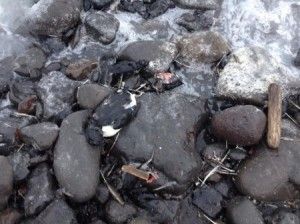
In late 2013, a disturbing pattern of mass animal deaths emerged along the coastlines of Alaska and the broader Pacific Northwest. Dead birds washed ashore with carcasses that were broken open and bleeding. Marine mammals developed mysterious skin lesions. Fish populations collapsed to historic lows. While authorities attributed these events to disease or harsh weather, many residents and independent researchers pointed to a more alarming potential cause: the ongoing Fukushima nuclear disaster.
Hundreds of Dead Birds Wash Ashore on St. Lawrence Island
Toward the end of November 2013, hundreds of dead birds washed up on the shores of St. Lawrence Island in the Bering Sea. Alaska Public Media reported that scientists could not determine the cause of the die-off. The rapid response to the incident highlighted growing capacity for handling unexpected environmental events in the region, but the underlying cause remained unexplained. Some researchers suggested harsh weather as a factor, though the scale of mortality was unusual for typical seasonal conditions.
Marine Mammals Suffering Hair Loss and Open Sores
Seals and walruses along the Alaska coastline began exhibiting alarming symptoms including hair loss, lethargy, oozing sores, bloody mucous, and congested lungs. Despite extensive testing for viral and radiological causes, no definitive explanation was identified. Researchers expanded their investigation to consider toxins, environmental factors such as harmful algae blooms and thermal burns, and potential allergic, hormonal, or nutritional triggers.
Polar bears were experiencing similar afflictions. Of 33 bears spotted near Barrow, Alaska during routine survey work along the Arctic coastline, nine exhibited alopecia (fur loss) and other skin lesions. The U.S. Geological Survey confirmed the findings but could not determine whether the condition in bears was related to the similar symptoms observed in seals and walruses.
Sockeye Salmon Populations Plunge to Historic Lows
Sockeye salmon returns in the Skeena River system plummeted to levels not seen in 50 years, forcing the closure of all commercial and recreational sockeye fisheries. Only 453,000 sockeye were expected to return, compared to approximately 2.4 million the previous year, representing a decline of more than 80 percent in a single season.
Aboriginal communities in British Columbia who depended on the Skeena River sockeye faced unprecedented decisions about whether to shut down their food fishery entirely. The Department of Fisheries and Oceans confirmed the monitoring data showed one of the lowest runs in half a century, but could not explain the dramatic collapse.
Pacific Herring Bleeding From Eyes and Gills
Independent fisheries scientist Alexandra Morton raised alarms about a disease spreading through Pacific herring populations that caused the fish to hemorrhage from their fins, bellies, chins, and eyeballs. Morton documented approximately 100 herring collected near Malcolm Island on northern Vancouver Island, all displaying severe bleeding symptoms. She warned the condition could trigger large-scale herring kills and potentially infect wild salmon populations that feed heavily on herring.
Killer Whale Deaths Spike Off British Columbia
Vancouver Aquarium researcher Dr. Lance Barrett-Lennard reported puzzling behavioral changes and an unusually high mortality rate among killer whale pods living in the Salish Sea between Vancouver Island and the British Columbia mainland. The southern resident orca pod lost seven matriarchs over a two-year period, and researchers noticed a marked reduction in vocalizations from the normally communicative mammals. Barrett-Lennard suggested that changes in the ocean environment were driving both the behavioral shifts and the elevated death rate.
Mass Bird Deaths Extend South Along the Pacific Coast
The pattern of unexplained wildlife deaths extended beyond Alaska. In Oregon, thousands of barn and violet-green swallows were found dead or dying in barns and around other perching structures. Residents reported groups ranging from 10 to 200 dead birds at various locations, with the worst mortality occurring near rivers and standing water. The Oregon Department of Fish and Wildlife described the event as unprecedented and rare, noting that the effect on overall bird populations was unknown.
Ocean Currents and the Fukushima Connection
Alaskan residents concerned about Fukushima’s potential role pointed to the mechanics of Pacific Ocean circulation. Two major surface currents, the Kuroshio from the south and the Oyashio from the north, converge near the coast of Japan at approximately 40 degrees north latitude, close to the Fukushima plant at 37 degrees north. These currents merge into the North Pacific Current and flow eastward across the ocean.
Upon reaching the western coast of North America, the combined current splits. The Alaska Current turns northward toward British Columbia and Southeast Alaska, while the California Current flows south along the U.S. West Coast. Pacific salmon migration patterns follow the Alaska Current past Sitka, Yakutat, Kodiak, and the Aleutian Islands, with chinook, coho, and sockeye species ranging farthest into the Pacific before returning to their home rivers on the same North Pacific Current carrying material from Japan.
Radioactive isotopes such as cesium-137 and strontium-90 accumulate in fish tissue by depositing in bones and muscle permanently, raising concerns about bioaccumulation throughout the marine food chain.
An Australian Sailor Reports a Dead Ocean
An experienced Australian sailor traveling from Osaka to San Francisco described conditions that reinforced the severity of the situation. Over 3,000 nautical miles of Pacific Ocean, he reported seeing almost no living creatures, a stark contrast to the turtles, dolphins, sharks, and feeding birds he had regularly observed on previous voyages. The single whale he spotted appeared to be rolling helplessly on the surface with what looked like a large tumor on its head.
In place of marine life, the ocean was filled with enormous volumes of floating debris, much of it from the 2011 tsunami that swept across Japan’s coastal areas and carried vast quantities of material out to sea.
Fukushima Radiation Levels Continue to Rise
While these wildlife events unfolded, radiation levels at the Fukushima plant itself continued increasing. TEPCO, the plant operator, detected record outdoor radiation levels near a duct connecting reactor buildings to the 120-meter ventilation pipe. Measurements at two locations registered 25 Sieverts per hour and approximately 15 Sieverts per hour, levels capable of delivering a lethal dose to an exposed person within 20 minutes. These represented the highest radiation levels ever detected outside the reactor buildings.
Every day, approximately 400 tons of highly radioactive water continued flowing into the Pacific Ocean. Because many of the radioactive particles involved have half-lives of 30 years or longer, the contamination represented a persistent and growing environmental burden that would remain in the ocean ecosystem for decades.
Questions That Demand Answers
The convergence of mass animal deaths, collapsing fish populations, mysterious wildlife diseases, and an ongoing nuclear catastrophe dumping radioactive material into the same ocean currents that feed Alaska’s coastlines demands serious investigation rather than dismissive attributions to weather or unidentified disease.
Whether Fukushima is the primary cause, a contributing factor, or coincidental to these events, the scale of wildlife mortality across the Pacific ecosystem represents one of the most significant environmental concerns of the modern era. The pattern of official uncertainty combined with reluctance to investigate the nuclear connection left communities along the Pacific coast with more questions than answers about the safety of their marine environment and food supply.