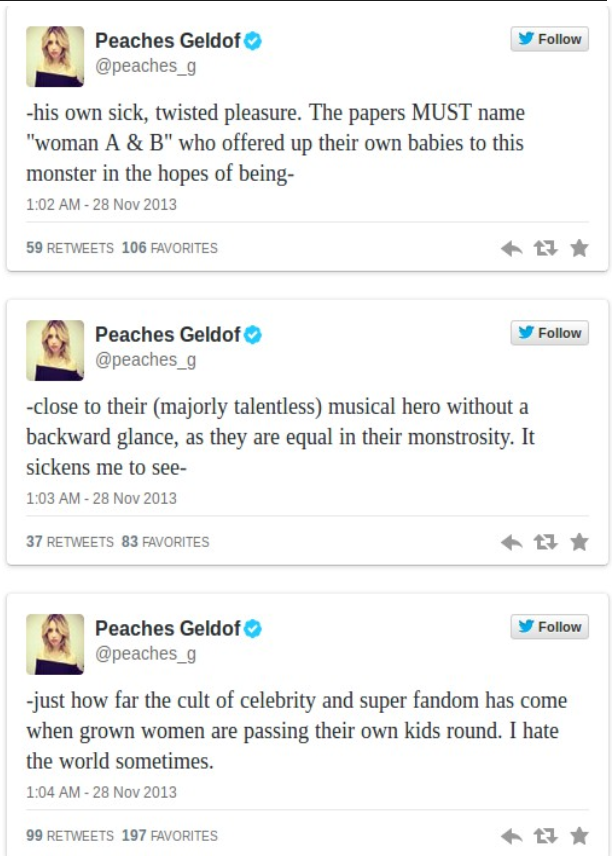
 Was Peaches Geldof murdered by the illuminati and the Knights of Malta for exposing pedophiles just months ago? Peaches, daughter of legendary rocker Bob Geldof, had recently tweeted the names of two mothers who had offered their babies to be raped by an alleged illuminati member who later admitted to the crimes after being outed by Geldof.
For those who don’t know Geldof, she was considered the ‘Paris Hilton’ of the UK, and she was highly involved in exposing pedophilia in the illuminati realm. She also faced charges for exposing a prominent UK pedophile on Twitter as shared in the videos as screenshots below. BeforeItsNews videographer pressResetEarth clearly proves in the first video below that Peaches untimely death has all the tell tale signs of being an ‘illuminati hit’.
Was Peaches Geldof murdered by the illuminati and the Knights of Malta for exposing pedophiles just months ago? Peaches, daughter of legendary rocker Bob Geldof, had recently tweeted the names of two mothers who had offered their babies to be raped by an alleged illuminati member who later admitted to the crimes after being outed by Geldof.
For those who don’t know Geldof, she was considered the ‘Paris Hilton’ of the UK, and she was highly involved in exposing pedophilia in the illuminati realm. She also faced charges for exposing a prominent UK pedophile on Twitter as shared in the videos as screenshots below. BeforeItsNews videographer pressResetEarth clearly proves in the first video below that Peaches untimely death has all the tell tale signs of being an ‘illuminati hit’.

Ian Watkins, UK Rockstar
The video accompanying this post delves into the highly controversial circumstances surrounding the death of Peaches Geldof, the daughter of rock musician Bob Geldof and Paula Yates. While official reports concluded her death in 2014 was due to a heroin overdose, the analysis presented in the video posits a far more sinister explanation: murder. Central to this claim is the assertion that Geldof was silenced for allegedly uncovering and preparing to expose an elite pedophile network, drawing chilling parallels to the death of her mother, Paula Yates, from a heroin overdose years prior.
According to the video’s narrative, the alleged perpetrators are identified as the Illuminati and the Knights of Malta. In the realm of conspiracy theories, the Illuminati is frequently portrayed as a shadowy secret society manipulating global events from behind the scenes, often associated with powerful individuals and institutions. The Knights of Malta, an ancient Catholic military order, are similarly implicated in certain alternative narratives as an influential, covert organization with ties to global power structures. The video suggests Geldof’s investigative efforts into child sex trafficking and exploitation within these purported circles led directly to her demise, portraying it as a deliberate act to prevent her from bringing this alleged criminality to light.
This perspective challenges the mainstream media’s reporting, which largely accepted the official toxicology findings and the narrative of a tragic overdose. Proponents of this theory often point to perceived inconsistencies, unanswered questions, or suppressed information, urging viewers to critically examine official accounts. The video positions Geldof not as a victim of addiction alone, but as a courageous figure who stumbled upon deeply unsettling truths about a powerful cabal, ultimately paying the highest price for her pursuit of justice.
For readers unfamiliar with the broader context, allegations of elite involvement in pedophilia and child trafficking are not new. Such claims have gained significant traction in recent years, particularly with cases like Jeffrey Epstein, which, regardless of their direct connection to Geldof’s situation, have fueled public skepticism about the accountability of powerful figures. This video, therefore, taps into a growing distrust of established narratives and an independent media landscape where alternative explanations for high-profile deaths, especially those involving figures who hint at deeper societal corruption, are explored and debated.