The Occupy Wall Street movement had been going strong for over a week in September 2011, and its profile was rising rapidly across both independent and mainstream media. Despite early skepticism — including my own — about whether a small group of demonstrators could sustain meaningful momentum, the protesters made several strategic decisions that transformed what could have been a forgettable gathering into something genuinely significant.
My initial doubts centered on the relatively narrow base of early participants and the absence of the kind of broad coalition-building that had made previous progressive mobilizations so powerful. The 2011 Wisconsin protests in Madison, for example, drew together labor unions, environmental advocates, faith organizations, community groups, students, and anarchist collectives into a unified front. That diversity of participation created something far greater than the sum of its parts. Occupy Wall Street, by contrast, initially attracted primarily anarchist and student activist circles, with first-day estimates of roughly a thousand attendees and only a few hundred committed to camping overnight.
Yet this modest contingent held firm — and as their message spread, interest surged. By late September, prominent public intellectual Cornel West had visited the encampment at Zuccotti Park and addressed an audience estimated at around 2,000 people.
Here are five strategic choices that helped the movement punch far above its weight:
1. Targeting Wall Street Was a Powerful and Intuitive Choice
Critics — including a widely mocked column in the New York Times by Ginia Bellafante — dismissed the protesters as unfocused and naive. Media commentators recycled the tired argument that anyone who owned consumer electronics forfeited the right to critique capitalism.
While having more precisely defined demands at the outset would have strengthened the movement’s endgame positioning, the protesters compensated by selecting a target that required almost no explanation. For anyone who had experienced the 2008 financial collapse, the foreclosure epidemic, and persistent unemployment, the question of why people were protesting on Wall Street essentially answered itself.
The original call to action, promoted by the activist publication Adbusters, hammered the theme of removing corporate money from democratic governance — demanding what organizers called “democracy, not corporatocracy.” Participants amplified this message through the now-iconic framing of the 99 percent versus the wealthiest 1 percent.
As journalist Glenn Greenwald observed in Salon at the time, the movement’s core message was unmistakable: Wall Street had become a nexus of corruption and unchecked political influence through crony capitalism and institutional capture, systematically eroding financial stability for everyone else. He argued that the early participants, despite lacking polished media strategies or organizational hierarchies, were among the rare voices channeling widespread public fury into action rather than passive acceptance.
Young demonstrators were especially effective at communicating the sense that their generation had been fundamentally betrayed by the economic system. Commentary on MarketWatch — hardly a bastion of radical politics — underscored this point with striking directness, noting that unemployment among Americans under 25 ranged from 13 to 25 percent, student loan defaults had reached roughly 15 percent, and yet Goldman Sachs CEO Lloyd Blankfein had collected $13.2 million in compensation the previous year, including a $3.2 million raise.
2. Compelling Visual Branding Captured Public Imagination
There is an old joke among labor organizers that spending all your energy perfecting promotional materials instead of talking to actual people is a sign your campaign is in trouble. But Occupy Wall Street operated under different conditions — it was not mobilizing an existing membership base but rather trying to spark the imagination of unaffiliated individuals. Under those circumstances, the quality of promotional imagery made a genuine difference.
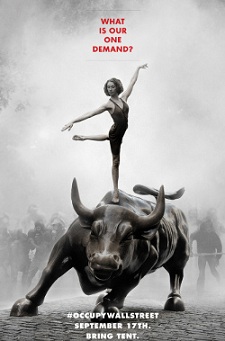
The movement’s signature visual — a graceful ballerina poised atop the famous Wall Street charging bull statue, created by the design team at Adbusters — became one of the most recognizable protest images in years. Its simple accompanying text read: “#OccupyWallStreet. September 17th. Bring tent.”
That single image communicated everything potential participants needed to know: this would be creative, audacious, and rooted in the tradition of culture jamming and dissident art.
3. The Extended Timeline Let Momentum Compound
Most demonstrations last a single afternoon and are forgotten by the following news cycle. Had Occupy Wall Street followed the same playbook, it would have vanished without a trace.
Instead, organizers framed the action as an open-ended occupation from the very beginning, telling participants to prepare for an extended stay. This proved to be a critical strategic decision. It took several days for independent media outlets like Democracy Now to pick up the story, but the sustained physical presence in lower Manhattan gave journalists a reason to keep coming back. Each passing day without eviction added another layer to the narrative.
4. The Encampment Created Natural Dramatic Tension
By establishing a physical camp in Zuccotti Park — also known as Liberty Plaza — the protesters constructed a scenario that generated suspense organically. If authorities allowed the occupation to continue, demonstrators could claim their experiment in liberated public space was working. If police moved in to clear the camp, the resulting confrontation would demonstrate that ordinary citizens were willing to accept real personal consequences to challenge Wall Street’s dominance.
Participants drew inspiration from the occupation of Tahrir Square in Cairo earlier that year. While the scale and stakes were obviously different, the broader cultural moment — in which claiming physical space had taken on heightened symbolic significance worldwide — made the tactic resonate.
Instances of disproportionate police response, including one widely circulated incident in which an officer pepper-sprayed women who were already corralled behind mesh barriers and posing no physical threat, only reinforced public sympathy for the demonstrators. The ongoing uncertainty about when authorities would ultimately clear the encampment kept the story alive and helped the protest build rather than dissipate.
5. Growing Attention Fueled Deliberate Escalation
Perhaps most importantly, Occupy Wall Street used its rising profile as a launching pad for expansion rather than treating early success as a reason to declare victory and go home. Solidarity encampments — Occupy Boston, Occupy LA, and dozens of others — began springing up across the country. The original participants encouraged new arrivals and prepared growing numbers of demonstrators for potential arrest or other consequences.
This willingness to escalate when conditions favored it set Occupy Wall Street apart from more established progressive organizations, which tend to pull back at the first sign of legal exposure, resource strain, or unfavorable media coverage. Such caution is fundamentally incompatible with the logic of nonviolent direct action, which depends on participants being willing to raise the stakes in response to growing support.
In this regard, the movement’s independence from institutional backers turned out to be an advantage. Unburdened by organizational risk calculations, individual participants drew energy from the expanding public conversation about economic inequality and were prepared to sacrifice more as the spotlight intensified.
The longer Americans debated why citizens felt compelled to camp out in the heart of the nation’s financial district, the more the movement achieved its purpose. On that measure, the Occupy Wall Street organizers got it exactly right.
Originally published January 27, 2012, on DecryptedMatrix.com. Analysis based on contemporaneous reporting from the first weeks of the Occupy Wall Street movement in September-October 2011.