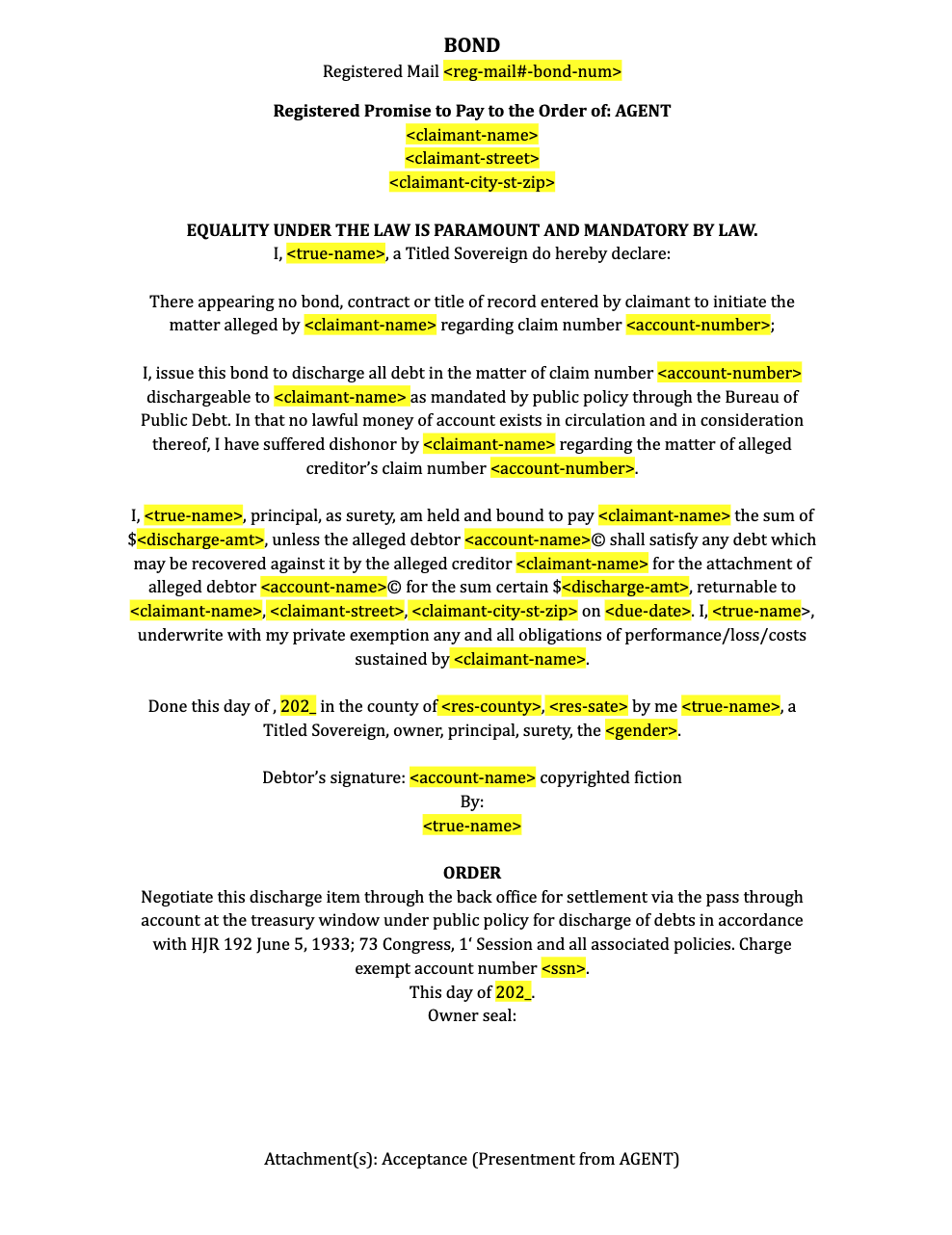
SUMMARIZED:
The provided text describes the concept and application of a “Court Bond,” presented as a special type of bond under Rule E of the Supplemental Admiralty Rules in the Federal Rules of Civil Procedure. This document explains that filing a Court Bond is intended to remove an individual from a legal controversy by discharging any perceived obligations, asserting that all legal matters operate within an admiralty/maritime jurisdiction, which governs all commerce.
The text suggests that court cases create “public funds” linked to an individual’s “strawman” (a legal fiction representing the individual’s all-caps name), which is then used by the court as a form of “original money” or security. By filing a Court Bond backed by an individual’s “unlimited exemption,” the goal is to balance private and public ledgers, thus ending the dispute and potentially leading to the release of incarcerated individuals. The document also provides strategic advice, such as notarizing documents, avoiding certain responses in court, and using postage stamps on legal filings to assert a higher jurisdictional authority.
The Court Bond – Why It Works
(5 minute read)
FAQ on The Court Bond and its Underlying Principles
1. What is the “Court Bond” and how does it differ from other legal documents?
The “Court Bond” is presented as a specialized financial instrument, not a typical legal pleading, motion, argument, or negotiation. It is described as a “special bond” applicable under Rule E of the Supplemental Admiralty Rules in the Federal Rules of Civil Procedure. The document asserts that any matter involving bonding, including bail bonds, falls under admiralty or maritime jurisdiction, which is seen as encompassing all international and domestic commercial legal matters. Unlike a motion seeking a court’s determination, the Court Bond simply exists as a bond, intended to become a permanent part of the court record. Its purpose is to discharge obligations and remove the filer from the “controversy” by covering potential losses or costs.
2. How does the concept of “Admiralty Jurisdiction” relate to everyday legal cases, according to the source?
The source posits that all commerce is international, and international commerce operates under admiralty/maritime jurisdiction. Consequently, it claims that “every legal matter is commercial,” implying that all court cases, regardless of their apparent nature, ultimately fall under some degree of admiralty jurisdiction. This broad interpretation suggests that the principles of admiralty law, including the requirement for bonds, are universally applicable in legal proceedings. Therefore, the source advises filing a bond in “any court case in which you are involved.”
3. What is the significance of the “strawman” concept in relation to the Court Bond?
The “strawman” refers to the all-caps legal name (e.g., JOHN DOE SMITH) used in court documents, which the source distinguishes from the “real being” (the living individual, typically represented by a proper English name like John Doe Smith). The source claims that public funds are created by charges against the “strawman,” with the “real being” being held liable as the surety unless this presumption is explicitly rebutted. The Court Bond aims to separate the “real being” from the “strawman,” thereby preventing the “real being” from being held accountable for the “strawman’s” alleged obligations. The act of going to prison is described as an “amalgamation” of the all-caps name and the physical body, and the discharge from prison signifies the fulfillment of a “contract” linked to the “strawman.”
4. How does filing the Court Bond supposedly resolve a legal dispute and remove the individual from liability?
The source argues that filing the Court Bond, backed by the individual’s “unlimited exemption,” covers all potential losses or costs, effectively ending the controversy and discharging any obligation. It asserts that a court exists to resolve disputes between “adverse parties,” and by providing the bond, the individual is removed from this adversarial position. The act of filing the bond is said to balance the “private books” (which deal with the “body/John Doe Smith” and are held by the trial judge), making it impossible for the “public side” (the all-caps name and the public record) to have anything to “mirror.” This discharge on the private side, using one’s “exemption,” is claimed to terminate the dispute and establish the individual as the “owner of the transaction,” including any court where the matter might seemingly remain.
5. What is the alleged “scam” or “dynamic dance” involving the “Defendant” in court proceedings?
The source claims that a “dynamic scam” exists where the entity prosecuted in court is initially the “all-caps name strawman/Defendant.” However, at sentencing, to enforce a judgment, the “real you” is required to “contractually unite” with the “fictitious you” (the strawman), effectively “marrying” the two. This “marriage” then allows the system to fine or imprison the “real you” for the “strawman’s” alleged actions. The term “the defendant” (lower-case ‘t’) is distinguished from “Defendant” (upper-case ‘D’), with “the defendant” only being identified when someone pleads guilty or is subjected to a fine/incarceration, thereby fulfilling the terms of the “bond” initiated by the prosecuting attorney’s complaint. The source suggests that the prosecuting attorney’s complaint itself is a “firm offer” and a “bond,” with the attorney’s Bar Number acting as a guarantee.
6. What are the suggested strategic actions and document markings for using the Court Bond effectively?
The source advises filing the bond at the last minute before court to prevent the opposition from having enough time to devise countermeasures. It emphasizes the importance of using a notary and autographing/stamping the document, and sending copies to various officials (court administrator, mayor, risk management, Army Corps of Engineers) to make dishonoring the bond more difficult. Crucially, the source stresses the importance of never giving one’s name in court or saying “yes” when asked “Are you so-and-so?” It also recommends notarizing documents with a “jurat” (containing “subscribed and sworn”), as this is considered a strong oath and ensures mandatory admissibility. Finally, it suggests placing postage stamps on the back of every page, autographing diagonally across them in purple or blue ink, and stamping with a “bullet stamp” in gold ink, to place the document under the Universal Postal Union (UPU) jurisdiction, which is claimed to be higher and untouchable by the courts.
7. How does the “private side” and “public side” accounting system work according to this source, and how does the Court Bond disrupt it?
The source describes a dual accounting system: a “private side” (dealing with the “body/John Doe Smith”) held by the trial judge, and a “public side” (mirroring the private, dealing with the all-caps name). It claims that no one can be jailed or fined until these “private accounting books” conform to the public record. By filing the Court Bond and using one’s “private exemption” to discharge the obligation, the “private books” are balanced, filling in both asset and liability sides. This action effectively “splits the account into two disjoined halves” by removing the proper English name from their title and precluding the public side from having anything to mirror. The lack of a complete account (both private and public) prevents them from “taking the body” or admitting “JOHN DOE SMITH/body” to jail.
8. What are the alleged consequences for the legal system and the individual if the Court Bond is successfully filed?
If the Court Bond is successfully filed, the source claims that the proper English name must be removed from the system’s title, as the individual has “paid for everything with [their] private exemption.” This action discharges the obligation on the private side, ending the controversy and the possibility for public dispute resolution. The source states that the legal system then has 72 hours to either dismiss the case, find another “Defendant/body” to fulfill the original bond, or hold the prosecuting attorneys liable. Anecdotal evidence is provided, suggesting that incarcerated individuals who filed the Court Bond were released, though only those who also filed additional documents clarifying the distinction between the “real being” and the “strawman” (e.g., UCC Financing Statements, Employer Identification with jurat) remained permanently free.

Need Help?
Check out Bill of Exchange AI
Generate Notes, Bonds and Bills of Exchange!