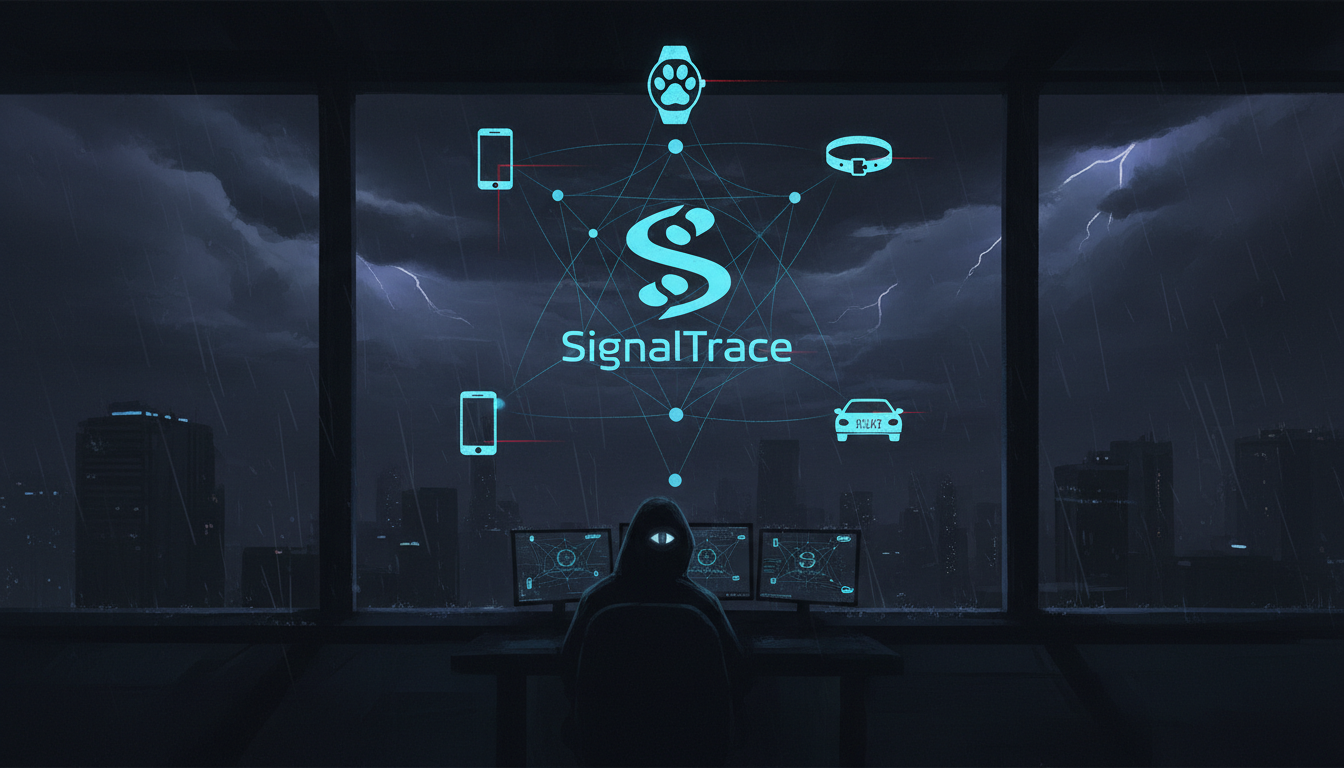
For years, the public was told that license plate readers existed for one purpose: catching stolen vehicles, locating fugitives, and stopping dangerous criminals. That was the sales pitch. A surveillance platform called SignalTrace, developed by Leonardo’s ELSAG division and marketed to law enforcement and government agencies, reveals how dramatically that scope has expanded. The system does not simply read license plates. It collects identifying signals from smartphones, smartwatches, Bluetooth devices, vehicle infotainment systems, Wi-Fi hotspots, RFID tags, tire pressure sensors, AirTags, and pet microchips. The car was never the target. You were.
What SignalTrace Actually Does
According to Leonardo’s own product documentation, SignalTrace is described as “a groundbreaking software system for law enforcement, designed to identify suspect people or vehicles, even when a license plate number is not known.” The system uses strategically placed sensors to collect electronic communication patterns and device identities from consumer electronics as they pass through monitored areas. Those signals are then correlated, with or without license plate reader data, to build what the company calls an electronic fingerprint.
The product literature offers a revealing example: while 70 cars in 100 may contain iPhones, only one will carry the specific combination of an iPhone 13rev2, an Audi radio, a pair of Bose headphones, a Garmin sports watch, a key finder, and the license plate ABC-1234. That precise cluster of signals constitutes a unique electronic signature that can be tracked across locations and time. The stated goal, in the company’s own framing, is to “bridge the gap between vehicle and occupant”, to know not just where a car traveled, but who was inside it, where they went, and who they traveled alongside.
SignalTrace’s product features, as listed by Leonardo, include the ability to identify movements of electronic devices, individuals, and vehicles; store data on a server where it can be queried and analyzed; reveal signatures frequently traveling together, which can lead to the discovery of convoys and travel patterns; and operate in off-road areas such as subways and malls. The company notes the system does not decrypt or read the content of communications, drawing a comparison to how license plate readers capture plate numbers without capturing driver information directly.
From Crime Tool to Pattern-of-Life Intelligence
The evolution of Automated License Plate Reader (ALPR) technology has been tracked closely by legal and civil liberties researchers. According to a July 2025 Congressional Research Service report on ALPRs, these systems capture not only license plate data but also vehicle type and color, GPS location data, and date and time, and carry the potential to identify individuals through facial recognition technology. The Department of Homeland Security has acknowledged that “ALPR systems now can read much more than license plates,” including dents on cars, specific bumper stickers, specialty tags, and rideshare logos.
Fixed ALPR systems are mounted on infrastructure such as traffic lights, telephone poles, and bridges. Mobile versions are deployed on police vehicles, commercial vehicles, and drones. Law enforcement agencies use these tools for both proactive and reactive policing, gathering intelligence, identifying potential suspects, and conducting crime scene analysis, according to the CRS report. At the same time, law enforcement agencies have been seeking nationwide access to license plate reader networks that provide near real-time tracking capabilities across the United States.
A March 2026 analysis published by the Boston Bar Journal noted that civil liberties organizations have raised alarms about AI-enhanced ALPR technologies that can flag so-called “suspicious” travel patterns for use by state and federal agencies. The ACLU has specifically warned that border patrol and similar agencies are expanding their use of ALPR dragnet systems in ways that critics describe as functioning like an internal intelligence apparatus. The Boston Bar Journal analysis also observed that ALPR systems have effectively created a nationwide surveillance infrastructure in which massive amounts of information about individuals can be accessible to both law enforcement and private parties.
The Legal Gray Zone
Courts have generally found that the initial reading of a license plate by an ALPR system does not constitute a Fourth Amendment search, since observing an object in plain view does not typically trigger constitutional protections. However, the related question, whether law enforcement queries of databases containing aggregated ALPR data amount to a Fourth Amendment search, remains legally unsettled. According to the Congressional Research Service, no federal appellate court has definitively decided that question. A number of federal trial courts and some state courts have upheld law enforcement access to such databases, while cautioning that warrantless surveillance through ALPRs could violate the Fourth Amendment in certain circumstances.
SignalTrace pushes this legal ambiguity into new territory. When a system can correlate a person’s smartphone, wearable fitness tracker, pet microchip, and vehicle infotainment data into a single searchable profile, tracked across subways, malls, highways, and neighborhoods, the question of what constitutes a search becomes considerably more complex. Leonardo’s product documentation states the system “respects individuals’ privacy rights” by not decrypting device content, but privacy researchers have long distinguished between content and metadata, arguing that location patterns and associations can be more revealing than the content of individual communications.
The Architecture of Incremental Expansion
The pattern described across these sources follows a recognizable trajectory. ALPR technology has existed for over two decades, initially deployed with a limited, publicly acceptable purpose: recovering stolen vehicles and alerting officers to vehicles associated with criminal activity. Over time, the systems grew into databases of vehicle movements. Now, with platforms like SignalTrace, they are evolving into tools capable of reconstructing an individual’s entire pattern of life, where they work, where they worship, where they seek medical treatment, and who they associate with.
Privacy advocates have specifically raised the concern that once this information exists in a searchable database, access tends to spread beyond its original intended users. The Boston Bar Journal noted that immigrant rights groups and civil rights organizations have flagged how these systems can be turned against communities that are not engaged in any criminal activity. The ACLU has documented how Customs and Border Protection has expanded ALPR use in ways that critics argue reflect a repressive internal intelligence function rather than a targeted law enforcement tool.
Leonardo’s SignalTrace documentation notes that the system “stores data on the SignalTrace server where it can be queried and analyzed,” and that it “allows an electronic signature to be alerted on once it has been identified in the process of an investigation, and only in a case where a crime occurred.” The company frames this as a constraint. Critics would note it is a policy commitment, not a technical limitation, and policies change.
What the Electronic Fingerprint Means for Ordinary Life
Consider what SignalTrace is capable of detecting as you move through a city: your phone’s Wi-Fi probe signals, your smartwatch’s Bluetooth identifier, your car’s tire pressure sensor transmissions, your AirTag, your pet’s RFID microchip. Each of these emits a signal. Each signal, individually, may seem trivial. Correlated together across dozens of fixed sensor locations, in transit stations, at intersections, outside hospitals, near houses of worship, they produce a granular record of daily life that no single camera could capture.
The Congressional Research Service confirmed that ALPR systems contain both real-time alerts and historical data, allowing users to enter and search for driver information in a database and receive notifications about new hits. SignalTrace extends this principle from the vehicle level to the individual level, making a person’s constellation of consumer electronics the identifier rather than their car’s registration number.
Conclusion
The introduction of SignalTrace into the law enforcement technology market represents a qualitative shift in the scope of public surveillance infrastructure in the United States. What began as optical readers capturing license plate numbers has evolved, step by documented step, into a signal intelligence platform capable of identifying and tracking individuals through the devices they carry, and the devices their pets carry. Legal frameworks have not kept pace with the technology. Meaningful federal court rulings on the Fourth Amendment implications of aggregated ALPR databases do not yet exist. And the infrastructure, once built, has historically proven resistant to rollback.
The question worth asking is not whether these tools can catch criminals. They likely can. The question is what else they can do, and who decides.
This article draws on reporting from Activist Post, product documentation from Leonardo / ELSAG SignalTrace, legal analysis published by the Boston Bar Journal, and the Congressional Research Service report on Automated License Plate Readers.