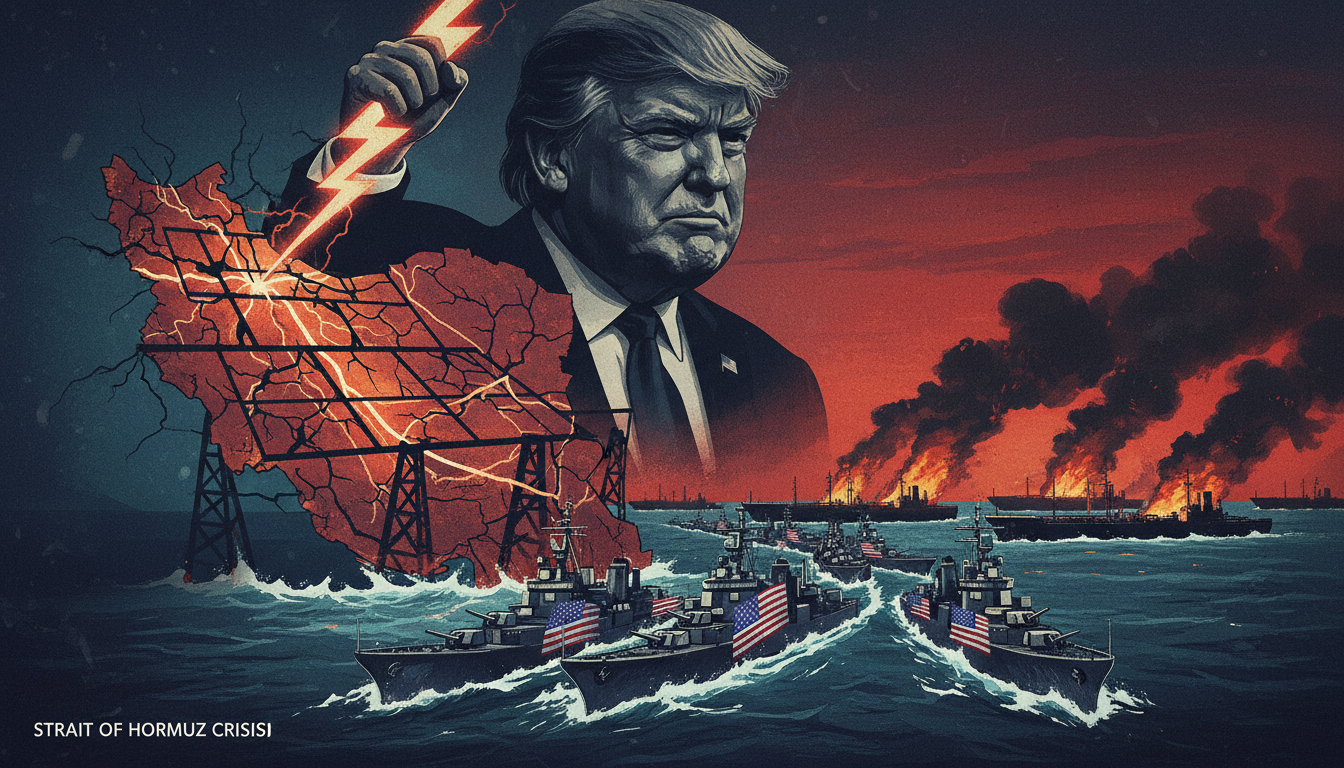
For the second time in three months, the United States has reimposed a naval blockade on Iranian ports, and President Donald Trump has placed the civilian infrastructure of a nation of 90 million people squarely in his crosshairs. What began as a dispute over commercial shipping fees through one of the world’s most critical maritime chokepoints has escalated into a cycle of strikes, counter-strikes, and threats that analysts warn could push the entire Middle East region back into full-scale war.
A Blockade Renewed, a Deal Unraveling
The US Navy-led Joint Maritime Information Center announced that a renewed blockade covering all of Iran’s ports, oil terminals, and coastal areas took effect at 20:00 GMT on July 14, 2026. The advisory stated that any vessel suspected of entering or departing the blockaded area without authorization is “subject to interception, diversion and capture” and that “non-compliant vessels may be legally compelled with force.”
This marks the second such blockade. The first ran from April 13 to June 18, 2026, and was lifted as part of a sixty-day Memorandum of Understanding (MOU) signed on June 17. That interim deal, brokered at the NATO summit in Ankara, was designed to reopen the Strait of Hormuz and lay groundwork for a permanent end to the conflict. It lasted barely three weeks before unraveling under the weight of renewed US strikes and reimposed sanctions on Iranian oil sales.
According to the Council on Foreign Relations, the MOU stipulated that Iran would allow ships to pass “with no charge for 60 days only” and that it would work with Oman to “define the future administration and maritime services in the Strait of Hormuz.” Tehran seized on that language to assert an ongoing role in regulating traffic through the waterway — a claim Washington has consistently rejected.
Trump’s Escalation: Power Plants and Bridges
Speaking in a Fox News interview on Tuesday, July 15, Trump issued explicit threats against Iran’s civilian infrastructure. “Next week it gets really bad for them because next week comes the power plants. Next week comes the bridges,” he said. “We’re going to knock out all their power plants. We’re going to knock out all their bridges unless they get to the table and negotiate.”
These were not the first such threats. In March 2026, Trump similarly threatened to “obliterate” Iran’s power stations and freshwater plants if Tehran did not agree to peace terms. Legal experts and international observers have consistently noted that deliberately targeting civilian infrastructure such as power and water facilities constitutes a violation of international humanitarian law and would likely constitute a war crime under the Geneva Conventions.
At the same time, Trump’s administration briefly floated a demand for a 20% tariff on all cargo shipped through the strait, declaring the waterway “open” while simultaneously suggesting the US should be recognized as the “Guardian of the Strait of Hormuz.” That position created an immediate contradiction with prior US policy. Secretary of State Marco Rubio had stated as recently as last month: “No country is allowed to charge tolls or fees on an international waterway. That’s existing international law.” Trump subsequently backtracked from the tariff demand, replacing it with what he described as investment and trade deals with Gulf Arab states.
The International Maritime Organization, the UN agency overseeing international shipping safety, weighed in directly: “IMO stands firmly against charging fees for passage through straits used for international navigation. There is no legal basis through which to introduce mandatory tolls simply to transit through a strait.”
Iran’s Warning: Energy for Everyone or No One
Iran has not absorbed the escalation passively. The Islamic Revolutionary Guard Corps (IRGC) issued a stark warning that if Washington sought to block the region’s oil and gas exports by controlling maritime routes, other export routes serving US and allied interests could also be closed. The IRGC framed its position directly: regional energy exports would be “for everyone or for no one.”
IRGC spokesperson Hossein Mohebi accused the US of having “seriously endangered the security of the world’s oil and gas supply” and stated that Tehran would “continue to exercise sovereignty over and management of the strait of Hormuz.”
In concrete military terms, Iran’s response has extended well beyond the strait itself. The IRGC said it targeted what it described as command-and-control, logistics, fuel, and military equipment facilities belonging to the US Fifth Fleet in Bahrain. Kuwait also came under Iranian attack. Jordan’s army reported that its air defenses intercepted and shot down three ballistic missiles that entered its airspace. Iranian state media reported that Iranian forces launched a drone attack on a military base in Jordan that hosts American warplanes. Iran also struck two ships in Omani waters in the Strait of Hormuz, killing a crew member according to the United Arab Emirates.
Four Consecutive Days of US Strikes
US Central Command confirmed it had carried out strikes against Iran for a fourth consecutive day, stating the attacks were aimed at “degrading Iranian capabilities used to attack commercial shipping” in the strait. Iranian state media reported explosions near the port city of Bandar Abbas, on the Gulf island of Qeshm near the Strait of Hormuz, and other locations.
Earlier strikes had hit the city of Abadan — home to the oldest oil refinery in the Middle East — as well as the port city of Mahshahr, Qeshm Island, and Kish Island. US strikes on prior nights had targeted Iranian air defense systems, coastal radar sites, missile and drone capabilities, and small patrol boats using aircraft, naval vessels, and drones.
Al Jazeera’s correspondent reporting from Tehran described the situation plainly: “This is a low-intensity war that is becoming persistent. And, of course, there are concerns if things escalate further, there might be a return to a full-scale war.”
The Global Energy Stakes
The strategic weight of this confrontation cannot be overstated. During peacetime, approximately 20 percent of the world’s oil and liquefied natural gas (LNG) transits through the Strait of Hormuz. Iran’s monthslong closure of the waterway in earlier phases of the conflict had already rapidly depleted oil stockpiles around the world, and the Council on Foreign Relations noted that analysts warned of a sharp spike in prices unless traffic through the strait resumed.
Even the June MOU — signed to reopen the strait and provide a framework for peace — faced formidable obstacles beyond the nominal ceasefire: continued military aggression between both sides, unresolved questions over transit fees, unmapped sea mines, significant infrastructure damage, and what CFR analysts described as “deep mistrust in the region.” With that deal now effectively collapsed and the blockade reimposed, those obstacles have only multiplied.
CFR’s Edward Fishman, writing on July 8 — days before the current escalation — observed that Iran had “no intention of restoring the Strait of Hormuz to the status quo ante, when it functioned as a free and open international waterway.” Tehran’s behavior since has borne that assessment out.
A Crisis With No Visible Exit
The current trajectory places multiple US-allied Gulf states directly in the line of fire, complicates global energy supply chains that are still recovering from months of disruption, and raises unresolved legal questions about the legitimacy of the US blockade under international maritime law. Trump’s public statements about NATO allies and Gulf partners receiving investment deals in exchange for alignment sit uneasily alongside a naval posture that has drawn Iran into striking Bahrain, Kuwait, and Jordan — all US partners or hosts to American military assets.
At the NATO summit in Ankara, Trump stated plainly about the MOU: “To me, I think it’s over.” Whether that collapse leads to a negotiated reset or to the infrastructure strikes Trump has repeatedly threatened will determine not only the fate of the strait, but the stability of global energy markets and the security of a region already strained by years of cascading conflict.
This article draws on reporting from The Guardian, Al Jazeera, and analysis from the Council on Foreign Relations.