When a 25-year-old Colombian father named Johan Sebastián Durán Guerrero was shot and killed by an Immigration and Customs Enforcement officer in Biddeford, Maine on July 13, 2026, the public was told no body camera footage existed. The reason given: ICE officers weren’t wearing body cameras. That explanation, it now appears, requires significant qualification.
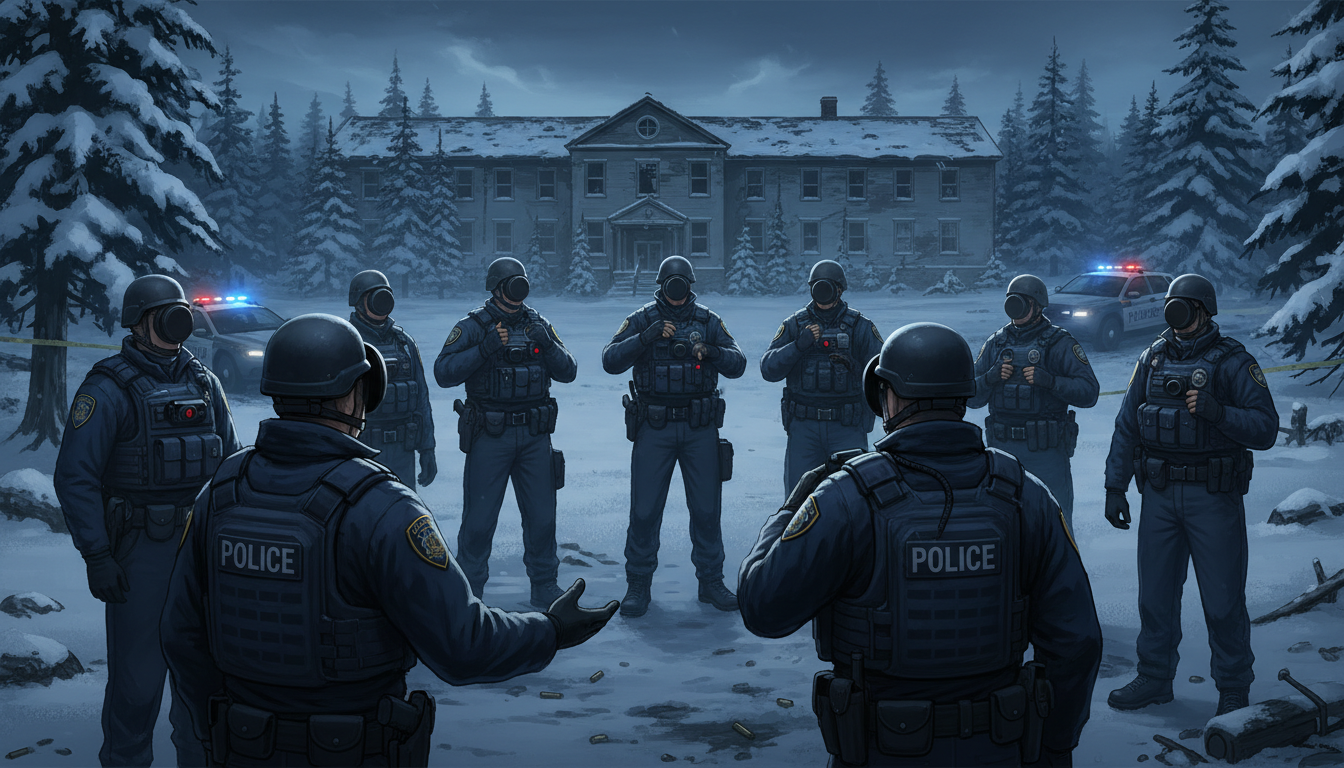
Four ICE officials who reviewed images from the scene told The Intercept that officers present were, in fact, wearing devices equipped with cameras. The cameras were not recording. According to those officials — all of whom requested anonymity to protect their employment — the devices’ camera functions had been deliberately left inactive, their lenses covered.
What the Officers Were Actually Wearing
The devices in question are Motorola SVX Video Remote Speaker Microphones — multi-function accessories that serve primarily as wireless radio microphones for ICE officers’ field communications. They also contain a built-in camera capable of storing over 100 hours of standard-definition video internally, according to Motorola promotional materials and the company’s technical support documentation.
ICE officers have been deploying these devices in the field. However, as one ICE official explained to The Intercept: “They have multiple functionalities. However, we are currently only using them as mics because of the AXON contract.”
The Department of Homeland Security procures its dedicated body-worn cameras through a separate contract with Axon, a law enforcement technology firm. The existence of that contract appears to have effectively sidelined the camera functionality built into the Motorola SVX units already in officers’ hands — and already attached to their vests at the scene of a fatal shooting.
A second ICE official demonstrated to The Intercept exactly how the camera function is rendered inoperative in the field, showing where a physical cover clips directly over the camera lens on their own Motorola SVX unit. “Since the cameras don’t work they just leave the cover on,” the official said.
What the Secretary of Homeland Security Told a U.S. Senator
Secretary of Homeland Security Markwayne Mullin reportedly informed Senator Angus King, Independent of Maine, that officers involved in the shooting were not wearing body cameras. The statement, as relayed through officials who spoke to The Intercept, is technically narrow: the Motorola SVX units are classified primarily as radio microphones, not body cameras. Yet those same devices contain camera hardware that was present at the scene and physically capable of capturing video — hardware rendered inactive by a policy decision tied to a competing vendor contract.
ICE did not respond to The Intercept’s request for comment. Motorola also did not respond to a request for comment. Axon similarly did not respond.
The Recording Capability That Went Unused
According to Motorola’s own promotional materials and a technical support line, the SVX mic’s video-recording function requires a subscription to activate. That subscription, apparently, has not been obtained — leaving ICE officers in the field wearing camera-equipped devices that cannot record because the relevant software access was never purchased, while a separate body camera program through Axon remains the official channel for video capture.
The result, in practical terms: officers at the scene of a fatal shooting carried hardware capable of producing video evidence. No video evidence from those devices exists. The camera lenses were covered.
In the immediate aftermath of the two ICE fatal shootings — Durán Guerrero in Maine and Lorenzo Salgado Araujo in Houston on July 7, 2026 — the Department of Homeland Security pledged to “rapidly” deploy body cameras to ICE officers nationally. Border Czar Tom Homan stated the agency was working on equipping agents with body cameras. President Trump, meanwhile, urged ICE to resume traffic stops, which had been briefly paused following the two killings.
What Surveillance Video Did Capture
In the absence of body camera footage, the public record of the Biddeford shooting rests largely on civilian surveillance video reviewed by CNN. That footage, captured by doorbell cameras and nearby security systems, shows the sequence of events beginning at 7:17 a.m., when gunshots — five in just over a second — are audible in the distance.
Subsequent footage shows Durán Guerrero’s white Kia entering an intersection and moving slowly in circles for over a minute, making at least four and a half revolutions. Federal law enforcement vehicles are visible in the background with lights flashing. Agents are then seen using one of their vehicles to stop the car, which was ultimately pinned. Four bullet holes are visible in the windshield on the driver’s side. Officers are seen pulling Durán Guerrero from the vehicle — he appears limp, and his head strikes the ground. Officers then appear to handcuff him. Local police arrived at 7:21 a.m. Medical care began around 7:23 a.m., approximately six minutes after the shots were fired.
ICE stated it had been conducting “targeted surveillance on the last known address of an illegal alien with a final order of removal” when the shooting occurred. Senator King was told by Secretary Mullin that Durán Guerrero was not the intended target of the operation.
A Family Left With Questions
Johan Sebastián Durán Guerrero was 25 years old. He had a 3-year-old daughter and a wife, Karolina Rojas, who described him at a press conference on July 16 as a devoted father and partner. “My soul is broken; he was everything to me,” Rojas said.
The family’s attorney, Benjamin Gideon, stated that Durán Guerrero “had been accused of committing no crime” and was “in this country lawfully,” noting that he had been issued a work permit and a social security number under the Trump administration. The Department of Homeland Security has acknowledged that neither Durán Guerrero nor Lorenzo Salgado Araujo — killed in Houston — were the intended targets of ICE on the days they were fatally shot.
“Do we accept the idea that innocent, loving partners and loving and devoted fathers of 3-year-olds can be collateral damage to this government’s policies?” Gideon asked at the press conference. “We truly believe that people need to understand what the real costs are.”
The Accountability Gap
The revelation about the Motorola SVX devices places the body camera question in a more complex light. ICE officers were not, in the strictest contractual sense, equipped with activated body cameras at the scene. But they were wearing devices that contained camera hardware — hardware covered by a physical lens cap, inactive due to the absence of a software subscription, and sidelined by the existence of a separate vendor arrangement with Axon.
Whether those distinctions satisfy the public interest in understanding what happened on a street in Biddeford, Maine on the morning of July 13 is a question the available footage — doorbell cameras, security systems, bystander recordings — cannot fully answer. The devices worn by the officers present were capable of recording from their own vantage point. They did not.
The FBI is conducting a review of the shooting. No body camera footage from ICE officers has been released, because none was recorded.
This article draws on reporting from The Intercept, CNN, and NBC News.