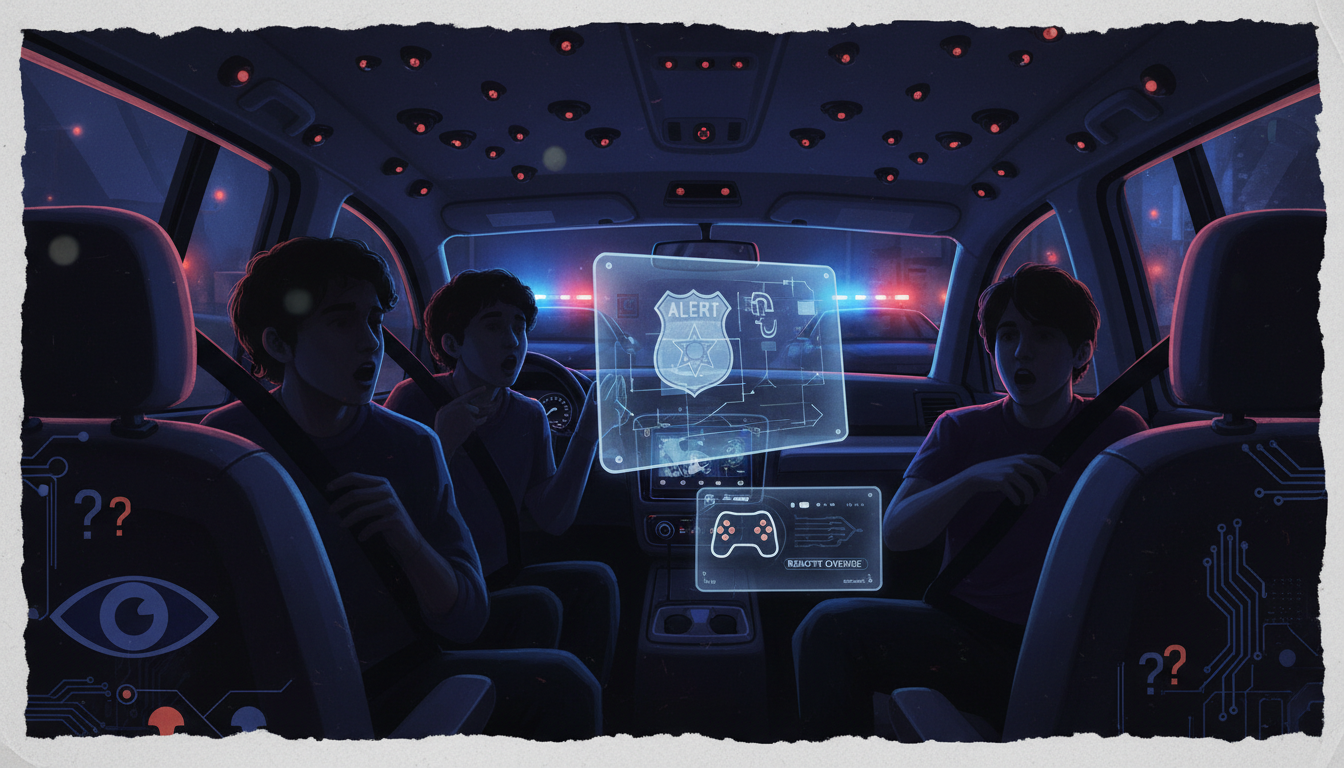
A routine ride in a self-driving Waymo robotaxi ended in a parking lot surrounded by armed officers for two 15-year-olds in San Mateo, California, after the vehicle itself reported their behavior, remotely steered itself to a stop, and waited for law enforcement to arrive. The July 2026 incident offers a concrete, real-world demonstration of what privacy researchers have warned about for years: autonomous vehicles are not merely transportation. They are mobile surveillance platforms capable of monitoring passengers and coordinating directly with police.
What Happened in San Mateo
According to a Facebook post published by the San Mateo Police Department, officers detained two 15-year-olds after Waymo reported they were “drinking and shooting from the vehicle.” After alerting police, Waymo remotely steered the robotaxi into a parking lot, where officers surrounded the vehicle and took the teenagers into custody. Video released by the department shows several officers, some carrying rifles, approaching and searching the car.
Police later determined the suspected weapon was an Orbeez toy gun, a device that fires water-absorbent polymer beads. The San Mateo Police Department noted that toy, water, and BB guns can easily be mistaken for real firearms, creating potentially dangerous situations for both the public and those carrying them. The distinction, however, came only after the encounter had already escalated to a multi-officer response with long guns drawn.
How Waymo’s Interior Monitoring Works
Waymo operates fully autonomous ride-hailing services in several U.S. cities. Its robotaxis are equipped with both interior and exterior cameras. According to the company, cabin cameras are used to help keep vehicles clean, recover lost property, and assist in emergencies. In urgent situations, the system allows support staff to access a live video feed of the cabin’s interior.
That technical capability, live remote video access combined with the ability to override vehicle navigation, is precisely what allowed the sequence of events in San Mateo to unfold the way it did. The vehicle did not simply record what was happening. It assessed the situation, contacted law enforcement, and physically delivered the passengers to a location of its choosing, where it held position until police arrived.
A Capability That Has Been Building Quietly
The San Mateo incident did not emerge from nowhere. Privacy and civil liberties organizations have been tracking the surveillance infrastructure embedded in autonomous vehicles for several years. The Electronic Frontier Foundation (EFF) has noted that autonomous vehicles rely on more than a dozen cameras and sensors situated around the car in order to detect other vehicles, traffic signs, obstructions, and pedestrians.
The EFF has also raised pointed questions about the data these vehicles generate: how detailed is the footage of pedestrians on the street, whether that footage is run through image recognition software, what capabilities these vehicles have to collect audio, how long footage is stored, who has access to it, and what protections are in place to keep the footage private and safe.
Perhaps most directly relevant to the San Mateo case, the EFF warned that people’s aggregate movements, their commutes, visits to friends or loved ones, and trips to the doctor’s office or an attorney, could be compiled over time by a fleet of driverless vehicles, which pedestrians and passengers alike do not suspect can be deputized by police.
Law Enforcement Access: Already Established Practice
The relationship between autonomous vehicle companies and law enforcement is not hypothetical. Bloomberg previously identified at least nine warrants served to self-driving car companies in both San Francisco and Maricopa County, Arizona. A training document obtained by Vice in 2022 showed the San Francisco Police Department writing internally: “Autonomous vehicles are recording their surroundings continuously and have potential to help with investigative leads… investigations has already done this several times.”
What the San Mateo incident adds to that picture is something qualitatively different from a post-hoc warrant for stored footage. This was real-time monitoring, real-time communication with law enforcement, and real-time physical intervention, the vehicle itself becoming an instrument of detention.
The Data Architecture Underneath
Legal analysts and privacy scholars have examined the broader data collection framework that makes incidents like this possible. A professional perspective published through Bloomberg Law, contributed by attorneys at Norton Rose Fulbright, noted that autonomous vehicles collect an enormous amount of personal information about passengers, and that some of the information collected may be shared with third parties that use the data for secondary purposes. The analysis also noted that while no federal law directly addresses these concerns, several state laws apply to the types of personal information autonomous vehicles collect, including California’s Consumer Privacy Act.
For passengers using a ridesharing autonomous vehicle, the data environment is particularly layered. The vehicle knows where you were picked up, where you are going, and everything that happens inside the cabin during the ride. That data exists within a private company’s infrastructure, accessible to its support staff, and, as the San Mateo case confirms, transferable to law enforcement in real time under circumstances the company determines warrant intervention.
Questions the Incident Leaves Open
The San Mateo case raises a series of questions that go beyond the specific behavior of two teenagers. What threshold triggers a Waymo support team member to access a live cabin video feed? What internal policy governs the decision to contact police versus simply ending a ride? Is there a documented standard for what constitutes an “urgent situation” sufficient to activate real-time monitoring? Are passengers informed at the time of booking that their ride may be monitored live and reported to law enforcement?
The EFF has framed these questions in terms of civil liberties. When a private company operates a fleet of camera-equipped vehicles that can coordinate with police in real time, the question of what legal framework governs that coordination becomes pressing, particularly for passengers who may not fully understand the terms under which they are being transported.
The Broader Trajectory
It is worth noting that the Los Angeles Times, in its own reporting on the San Mateo incident, opened with a pointed observation: “Robotaxis could be turning into robocops.” That framing captures something significant. The technology’s capacity for passive surveillance, cameras recording continuously, has always been present. What the San Mateo case makes visible is the active dimension: the system’s capacity to assess passenger behavior, make a judgment, contact authorities, and physically intercept occupants.
Whether the two teenagers in San Mateo were behaving badly is not in dispute. What is worth examining carefully is the architecture that caught them, and what that same architecture is capable of in other contexts, with other passengers, under other circumstances. The vehicle that delivered them to police is the same vehicle that anyone books through an app, in any city where Waymo operates, on any given day.
The infrastructure is in place. The policies governing its use are set by private companies. The legal frameworks are still catching up. And the cameras are always on.
This article draws on reporting from RT World News and Los Angeles Times, as well as analysis from the Electronic Frontier Foundation and a professional legal perspective published via Bloomberg Law.