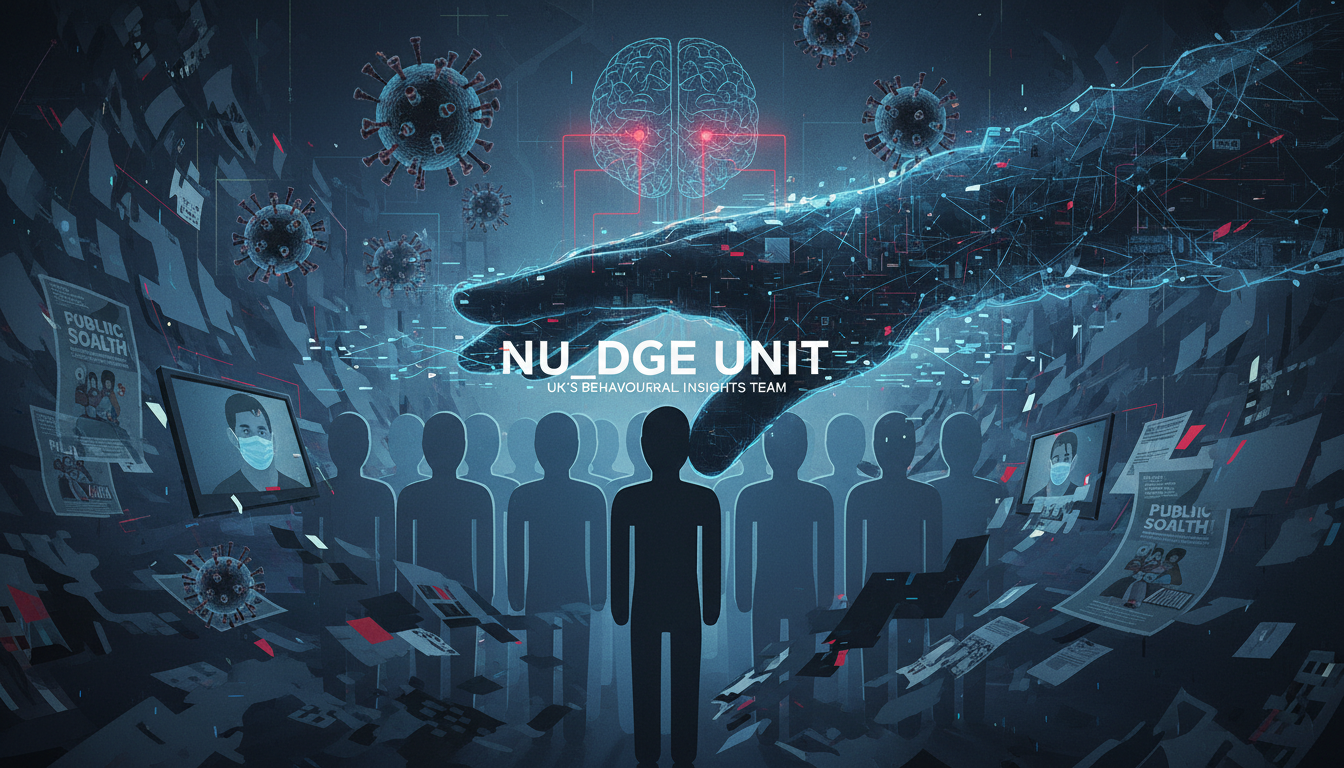
In the annals of modern governance, few revelations cut as close to the bone of democratic accountability as the documented role of the United Kingdom’s Behavioural Insights Team, known informally as the “Nudge Unit”, in engineering public compliance during the COVID-19 pandemic. This was not persuasion through transparent argument. It was, by the unit’s own operational design, the application of psychological techniques to alter behaviour without the population being fully aware that such techniques were being deployed against them.
What Is the Behavioural Insights Team?
The Behavioural Insights Team (BIT) was established inside 10 Downing Street and tasked with applying behavioural science, the study of cognitive biases, emotional triggers, and decision-making shortcuts, to government policy. The unit’s mandate, as described by its critics and analysts alike, involved developing psychological approaches to alter public behaviour. This is the organisation that became known unofficially as the “Nudge Unit,” a reference to the nudge theory of behavioural economics popularised by academics Richard Thaler and Cass Sunstein.
The BIT’s own public-facing website documents an extensive portfolio of COVID-19 interventions, from vaccine uptake strategies to messaging compliance research across multiple countries. The scope of this work was global, with BIT operating across the United Kingdom, the United States, Argentina, Colombia, Slovakia, Bangladesh, and beyond. In Argentina alone, the BIT reports that a behaviourally-informed chatbot it designed and evaluated tripled COVID-19 vaccination rates compared to what it describes as the status quo.
“Stay Home, Protect the NHS, Save Lives”: Engineered Compliance
Among the most recognisable outputs attributed to the Nudge Unit’s influence during the pandemic is the iconic UK government slogan: “Stay Home, Protect the NHS, Save Lives.” According to the Macroaggressions podcast hosted by Charlie Robinson, this message was not an organic public communication, it was, in Robinson’s framing, “astroturfed into existence at the behest of 10 Downing.” The slogan was constructed using the precise principles of behavioural messaging: short, emotionally resonant, and socially reinforcing.
Academic scrutiny of the UK’s early pandemic response gives this framing additional weight. A peer-reviewed paper published in the European Journal of Risk Regulation, authored by Professor Anne-Lise Sibony of UCLouvain, examined what she described as a “behavioural irony” in the UK’s COVID-19 response. Sibony’s analysis, published in April 2020, noted that the UK’s initial pandemic strategy was strikingly distinct from other nations, and situated that distinctiveness within the framework of behavioural science governance, a system in which public choices are shaped rather than mandated, through the deliberate design of information environments.
The Consent Problem: Nudging Without Disclosure
At the heart of the Nudge Unit controversy lies a fundamental democratic tension. Behavioural interventions, by their nature, are most effective when the target population is unaware they are being influenced. Transparency about the mechanism would undermine the mechanism itself. This places behavioural governance in direct conflict with principles of informed consent and transparent public communication.
A paper published in Economics & Philosophy by researchers Keith Dowding of the Australian National University and Alexandra Oprea of the University at Buffalo examined precisely this tension under the title “Manipulation in Politics and Public Policy.” Published in March 2024, the paper grapples with the philosophical conditions under which political influence crosses the line into manipulation, and when, if ever, such manipulation might be considered morally justified. The paper distinguishes between communicative influence, which operates through open and honest engagement with citizens’ rational faculties, and situational influence, which operates by altering the environment in which decisions are made. Nudge techniques, by design, occupy the latter category.
The question the paper raises, and which the existence of the Nudge Unit makes concrete, is whether citizens of a democracy can meaningfully be said to be self-governing when the choice architecture they navigate has been deliberately engineered by state actors to produce predetermined outcomes.
Behavioural Influence: A Tool With No Geographic Limits
The BIT’s COVID-19 portfolio makes plain that the application of behavioural science to public health was not a one-off emergency measure but a coordinated, multinational operation. Research into vaccine uptake, message framing, community advocacy, and physical distancing compliance spanned every inhabited continent. The BIT published guidance on “four messages that can increase uptake of the COVID-19 vaccines,” produced analysis on “holding up our behavioural guard long enough for the vaccine to take hold,” and conducted experiments with thousands of adults to test messaging compliance.
What distinguishes this from conventional public health communication is the explicit application of psychological frameworks designed not to inform but to steer. The BIT’s own language across its COVID-19 case studies consistently foregrounds behavioural outcomes, changes in what people do, rather than changes in what people understand or believe based on evidence presented to them.
Precedents: When Governments Use Psychology Against Their Own Citizens
The UK Nudge Unit did not emerge in a vacuum. Governments using psychological operations against their own populations have a documented history that predates the pandemic by decades. In March 2011, the American Civil Liberties Union raised the alarm after Rolling Stone reported that Lt. Gen. William Caldwell, a three-star U.S. Army general overseeing Afghan troop training, ordered his Information Operations cell to target visiting U.S. senators and congressional delegations with psychological operations, a practice the ACLU described as potentially illegal under U.S. law and Department of Defense policy.
The ACLU noted in its reporting that this was not an isolated incident, citing a separate report from Information Week revealing that the U.S. Air Force had sought a contractor to deploy false online identities across social media platforms to disseminate propaganda to civilian populations in Iraq and Afghanistan, with no technical firewall preventing American citizens from being exposed to the same content. The ACLU called on Congress to investigate all intelligence operations that might target or impact Americans, framing the issue as a matter of civilian control over military and intelligence activities.
That call for accountability in 2011 went largely unanswered. By 2020, behavioural manipulation of civilian populations had migrated from military black sites to government offices inside 10 Downing Street, rebranded, institutionalised, and celebrated as evidence-based policymaking.
The Longer Arc: Television, Culture, and Social Engineering
Charlie Robinson’s Macroaggressions podcast episode on the Nudge Unit situates the BIT within a broader observation about the use of popular culture to shift social norms over generational timescales. Robinson draws a line from the UK government’s behavioural team back to the cultural products of Hollywood in the 1990s, arguing that television content was used to normalise disposable relationships, consumption over creation, and social atomisation. In Robinson’s reading, the celebrated apathy and disconnection of characters in shows like Seinfeld was not incidental to the culture but instrumental to it, a long-form nudge toward demographics and social outcomes preferred by those with interests in population-level behavioural change.
This claim is more difficult to document through institutional records than the Nudge Unit’s own published case studies. But the underlying mechanism Robinson describes, using trusted cultural channels to shift norms without explicit argument, is structurally identical to what the Behavioural Insights Team openly acknowledges doing in the realm of public health policy. The difference is one of visibility, not of kind.
What Accountability Looks Like, And What It Doesn’t
The Behavioural Insights Team is not a secret organisation. Its website is publicly accessible, its case studies are published, and its leadership engages openly with academic and policy communities. In one sense, this transparency is exactly what distinguishes it from covert psychological operations. In another sense, the transparency is itself a kind of misdirection, the BIT’s methods are disclosed to policymakers and researchers while the populations those methods are applied to remain largely unaware that the information environments shaping their choices have been deliberately constructed.
The philosophical paper by Dowding and Oprea frames the question precisely: if influence operates not through the rational faculties of citizens but by structuring the situations in which they make decisions, does the fact that the influencer publishes academic papers about what they are doing constitute meaningful disclosure? Or does disclosure to an academic audience, while the general public remains uninformed, preserve the operational advantage the technique depends on?
These are not abstract questions. They are the questions that democratic accountability in the age of behavioural governance requires citizens, journalists, and legislators to answer, before the next emergency arrives and the nudges begin again.
This article draws on reporting and research from Activist Post / Macroaggressions Podcast, PMC / European Journal of Risk Regulation (Sibony, 2020), The Behavioural Insights Team, Cambridge University Press / Economics & Philosophy (Dowding & Oprea, 2024), and ACLU.