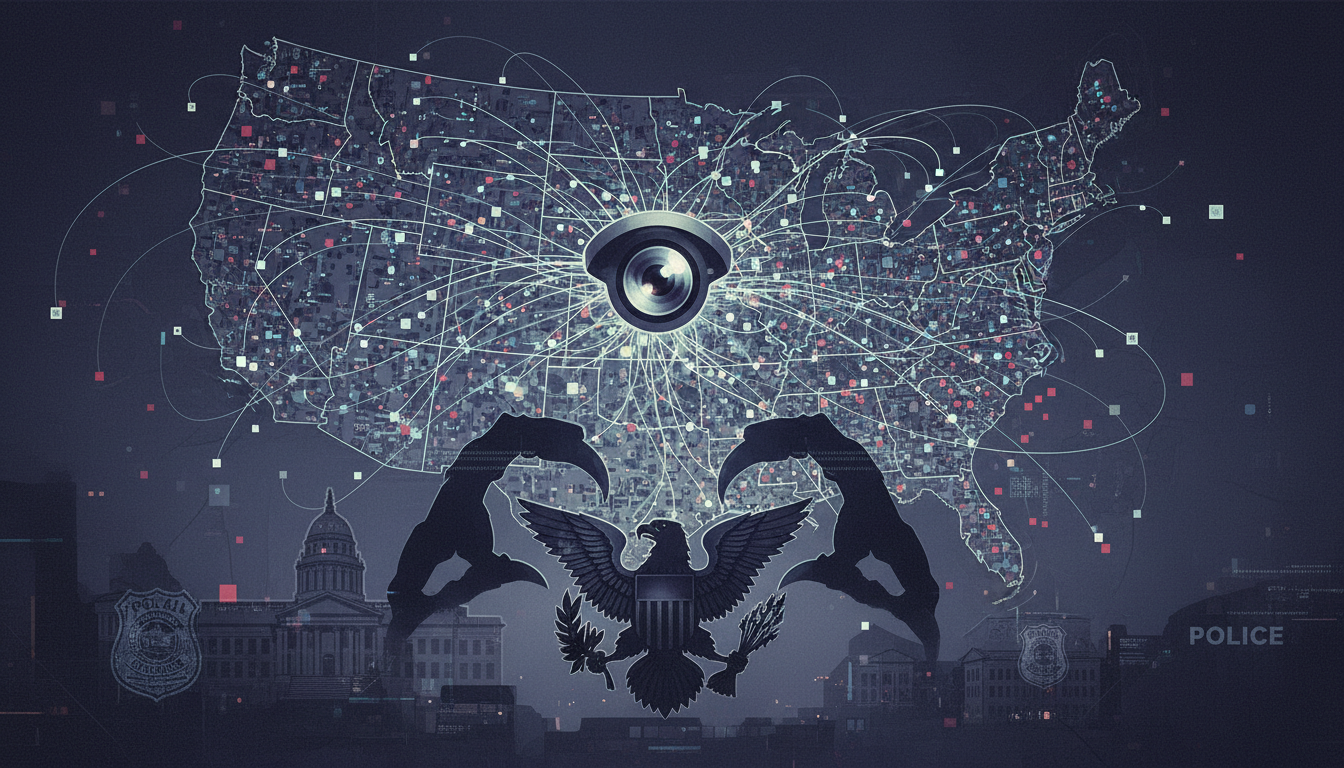
More than 100,000 AI-powered license plate reader cameras, manufactured by a company called Flock Safety, now operate across American streets—quietly logging the movements of ordinary drivers, cataloguing vehicle details, and feeding that data into a searchable nationwide database accessible to federal law enforcement agencies including the FBI, ICE, ATF, and CBP. Civil liberties organizations have documented a growing body of evidence showing this infrastructure is being used not merely to solve crimes, but to monitor protesters, target minority communities, and track individuals seeking constitutionally protected services. This is not a warning about a future surveillance state. It is a description of the one already operating.
How Flock Safety Works
Flock Safety’s cameras are automated license plate readers (ALPRs)—fixed devices mounted on infrastructure such as light poles and road signs that photograph passing vehicles, extract license plate numbers using algorithmic recognition, and log the associated time, date, GPS location, vehicle type, and color. According to a Congressional Research Service report published in August 2024, ALPR technology has become broadly normalized across American policing: nearly 90% of sheriffs’ offices with 500 or more sworn deputies reported using ALPR technology, and 100% of police departments serving populations over one million residents used it.
What distinguishes Flock Safety’s model from legacy ALPR systems is the scale of data sharing. Local police departments that purchase Flock cameras contribute their data to a pooled nationwide network. Law enforcement agencies across state lines can search this shared database, often without the knowledge or approval of the local communities where the cameras are installed, according to reporting by Press For Truth’s Dan Dicks covered by Activist Post.
Federal Agencies Mining Local Camera Data
The architecture of the Flock network allows federal agencies—including immigration enforcement—to query data collected by local police departments, a dynamic that critics argue extends the surveillance reach of federal authorities far beyond what local communities may have authorized when approving camera contracts. The CRS report notes that federal law neither directs nor prohibits specific tools used by federal law enforcement, leaving a regulatory vacuum that companies like Flock Safety have effectively filled with their own terms of service.
The ACLU has long documented the risks inherent in this kind of data pooling. In a foundational investigation drawing on 26,000 pages of documents obtained from nearly 600 law enforcement agencies, the ACLU found that enormous databases of innocent motorists’ location information were growing rapidly, often retained for years or indefinitely, with few or no restrictions to protect privacy rights. The organization noted that license plate readers have the potential to create permanent records of virtually everywhere any person has driven—information that can reveal the doctors, political events, protests, or religious institutions a person visits.
EFF Documents Surveillance of Protesters and Minorities
The Electronic Frontier Foundation conducted some of the most granular investigations into Flock Safety’s operations throughout 2025, and what its researchers uncovered went well beyond traffic enforcement.
After obtaining datasets representing more than 12 million searches logged by more than 3,900 agencies between December 2024 and October 2025, EFF found unmistakable patterns. Law enforcement agencies logged hundreds of searches tied to specific political demonstrations—including the 50501 protests in February, Hands Off protests in April, and No Kings protests in June and October. Nineteen agencies conducted dozens of searches specifically connected to No Kings protests alone. EFF noted that sometimes searches explicitly referenced protest activity, while other times agencies used vague terminology that obscured the fact that constitutionally protected speech was being monitored.
The surveillance was not limited to mass demonstrations. Three agencies used Flock’s system to target individual activists affiliated with Direct Action Everywhere, an animal-rights organization that uses civil disobedience to expose factory farm conditions. Delaware State Police queried the Flock network nine times in March 2025 in connection with Direct Action Everywhere actions, according to EFF’s analysis.
Discriminatory Search Patterns Against Romani People
EFF’s November 2025 analysis revealed a separate category of abuse. More than 80 law enforcement agencies used language perpetuating harmful stereotypes against Romani people when searching the Flock ALPR network. Between June 2024 and October 2025, police performed hundreds of searches using terms such as “roma” and racial slurs—often without referencing any suspected crime. Audit logs reviewed by EFF included search terms such as “roma traveler,” demonstrating that the platform was being used to conduct ethnicity-based surveillance with no apparent criminal predicate.
Wrongful Accusations and Human Costs
The consequences of errors and abuses in this system are not abstract. Reporting covered by Activist Post documents cases in which innocent people have been wrongly accused, confronted at their homes, and treated as criminal suspects based on faulty camera matches. The CRS report acknowledges that there are no publicly available data on the accuracy rates of ALPR systems at various phases of the criminal justice process, from generating leads to serving as courtroom evidence—a transparency gap that leaves affected individuals with little recourse when errors occur.
The ACLU has noted that tracking people’s location constitutes a significant invasion of privacy capable of revealing intimate details about a person’s life, including medical appointments, political associations, and religious practice. When that data is fed into a system accessible to dozens of federal agencies without clear legal standards, the potential for chilling effects on lawful behavior becomes difficult to overstate.
Expansion Beyond Cameras: Always-On Audio
EFF’s 2025 investigations also documented Flock Safety’s push into voice detection technology—devices designed to continuously listen in public spaces. This expansion moves the company’s surveillance portfolio beyond passive visual capture into active audio monitoring, raising a distinct set of constitutional questions that existing ALPR regulations, already considered inadequate by civil liberties organizations, do not address at all.
Community Resistance and Canceled Contracts
Opposition to Flock Safety’s expansion has not been passive. According to Activist Post’s coverage of Dan Dicks’ reporting, residents in various jurisdictions have physically removed cameras, compiled public maps of camera locations, constructed anti-surveillance countermeasures, and organized campaigns that have successfully pressured cities to cancel their Flock Safety contracts. The EFF’s investigations have contributed to this pushback by providing documented evidence that sparked state and federal investigations and drove litigation.
The ACLU has outlined a framework for what adequate regulation would require: limiting ALPR use to law enforcement agencies with clear legal authority, prohibiting long-term retention of data on innocent individuals, allowing citizens to determine whether their vehicle data has been collected, and restricting inter-agency data sharing. As of the available reporting, none of these principles have been codified into comprehensive federal law governing commercial ALPR networks like Flock Safety’s.
The Architecture of Accountability—or Its Absence
What makes the Flock Safety network qualitatively different from earlier surveillance technologies is the combination of scale, interconnection, and the absence of uniform legal oversight. Over 100,000 fixed cameras feeding a shared database searchable by thousands of agencies across state lines represents an infrastructure capable of reconstructing the daily movements of virtually any driver in America. The CRS report notes that federal law does not direct or prohibit specific tools used by law enforcement, and policies governing how long location data is retained vary widely across jurisdictions.
EFF’s research sparked state and federal investigations in 2025, but legislative responses have lagged behind the technology’s deployment. The cameras continue to multiply. The database continues to grow. And the legal frameworks that would define the boundaries of legitimate use remain incomplete.
For residents and local officials evaluating whether to adopt or renew Flock Safety contracts, the documented record now includes surveillance of political protests, ethnicity-based searches, monitoring of reproductive healthcare access, and federal agency access to locally collected data. That record is public. What communities choose to do with it remains to be seen.
This article draws on reporting from Activist Post / Press For Truth (Dan Dicks), Electronic Frontier Foundation, the Congressional Research Service (R48160), and the American Civil Liberties Union.