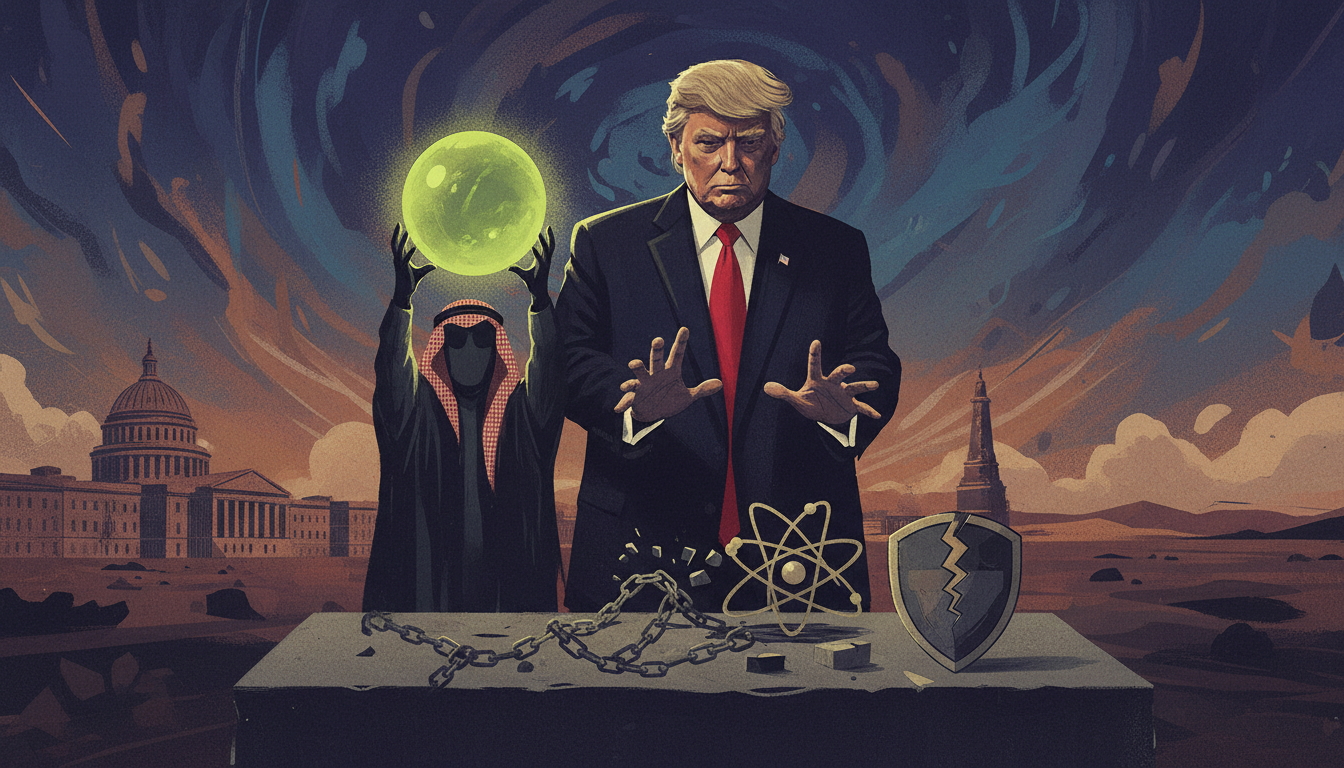
A draft nuclear cooperation agreement between the United States and Saudi Arabia, one that would permit Riyadh to enrich uranium on its own soil, has been negotiated and is awaiting President Donald Trump’s signature, CNN reported on July 19, 2026, citing draft documents and sources familiar with the negotiations. If confirmed, the deal would represent one of the most significant departures from decades of U.S. nuclear nonproliferation policy in the Middle East.
What the Draft Agreement Contains
According to CNN’s reporting, the proposed agreement would grant Saudi Arabia access to uranium enrichment technology, the same technology that has been the focal point of the West’s prolonged dispute with Iran. Critically, the draft deal would not require Saudi Arabia to adhere to the enhanced International Atomic Energy Agency (IAEA) safeguards known as the Additional Protocol, which gives inspectors broader access to nuclear facilities and is specifically designed to help detect undeclared nuclear activities.
The agreement falls under Section 123 of the Atomic Energy Act of 1954, which governs all U.S. civilian nuclear cooperation agreements. If signed by Trump, it would be submitted to Congress for a mandatory 90-day review period, during which lawmakers could pass a joint resolution of disapproval to block the deal, provided that resolution became law.
The Congressional Research Service (CRS), in a report updated May 26, 2026, noted that the Trump Administration stated President Trump was reviewing a draft bilateral civil nuclear cooperation agreement and described the planned bilateral safeguards arrangement as reflecting a “firm commitment to nonproliferation” while saying it is “not about enrichment.”
The Gold Standard, and Why This Breaks It
For years, the benchmark for U.S. civilian nuclear cooperation deals in the Middle East has been the 2009 agreement with the United Arab Emirates. Under that arrangement, the UAE permanently renounced uranium enrichment and plutonium reprocessing in exchange for American nuclear partnership. Successive U.S. administrations promoted the UAE model as the “gold standard” for regional nuclear partnerships.
The reported Saudi deal would mark a clear departure from that standard. Arms-control experts cited by CNN warned that permitting Saudi Arabia to pursue enrichment could weaken the gold standard framework and encourage other nations in the region to seek similar capabilities. Their core concern: domestic enrichment provides a country with latent weapons capability, since the same centrifuge technology used to produce low-enriched reactor fuel can also produce weapons-grade uranium if the enrichment process is extended to higher levels.
The CRS report is explicit on this point, noting that both highly enriched uranium and plutonium can fuel certain reactors but are also used as fissile material in nuclear weapons, meaning a civilian enrichment program and a weapons-capable one can share the same infrastructure.
Saudi Arabia’s Nuclear Ambitions: A Decade in the Making
Saudi Arabia’s pursuit of a domestic nuclear capability is not new. In July 2017, the kingdom approved a National Project for Atomic Energy, targeting large and small reactors for electricity production and water desalination. The economic rationale is straightforward: in 2023, oil generated roughly 41 percent of Saudi electricity while natural gas generated approximately 58 percent. Burning those fuels domestically is costly when they can be exported at premium prices.
Saudi Arabia holds 16 percent of the world’s proven crude oil reserves and has the fourth-largest natural gas reserves globally. Freeing up more of those resources for export, while meeting a rapidly growing domestic electricity demand, is a core national economic priority.
The kingdom has steadily built out a regulatory infrastructure to support its nuclear ambitions, establishing a Nuclear and Radiological Regulatory Commission in March 2018 and creating the Saudi Nuclear Energy Holding Company in March 2022. International bids for two 1.4 gigawatt electric reactors at the coastal site of Khor Duweihin have drawn interest from China National Nuclear Corporation, Électricité de France, Korea Electric Power Corporation, and Russia’s Rosatom.
Saudi Energy Minister Khalid Al-Falih stated in 2019 that the kingdom wants “the full cycle, from producing uranium, to enriching the uranium, to using the uranium.” He reiterated in January 2023 that Saudi Arabia intends to use its domestic uranium resources to produce low-enriched uranium fuel.
The Safeguards Question
Saudi Arabia acceded to the Nuclear Non-Proliferation Treaty (NPT) in 1988 and has maintained a Comprehensive Safeguards Agreement with the IAEA since 2009. However, the kingdom has not concluded an Additional Protocol with the IAEA, the enhanced inspection regime that would grant international monitors broader authority to investigate potentially undeclared nuclear facilities.
In September 2023, Saudi Arabia’s energy minister Prince Abdulaziz bin Salman submitted a statement to the IAEA General Conference announcing that the kingdom had decided to rescind its Small Quantities Protocol and implement the full Comprehensive Safeguards Agreement. That was a notable diplomatic shift, though experts noted it still fell short of signing an Additional Protocol.
In 2024, Saudi Arabia did formally rescind the Small Quantities Protocol, a modest step toward greater transparency. However, according to the CRS report, press reports have also raised concerns about potentially undeclared nuclear activities, including a possible uranium milling facility allegedly built with Chinese assistance. Saudi authorities denied those reports in 2020, though any such facility would require declaration to the IAEA under the kingdom’s existing Comprehensive Safeguards Agreement.
The reported draft 123 agreement, rather than requiring the Additional Protocol, would instead rely on a Bilateral Safeguards Agreement that, “with the involvement” of the IAEA, would employ what the Administration described as “additional safeguards and verification measures to the most proliferation sensitive areas of potential nuclear cooperation”, though those measures have not been publicly specified.
The Iran Parallel, and the Double Standard Debate
The geopolitical dimension of the proposed deal is difficult to ignore. The uranium enrichment technology that would be granted to Saudi Arabia under this agreement is the same technology at the center of Iran’s decades-long conflict with the West. Washington and Israel have long argued that Tehran’s enrichment program could be used to produce nuclear weapons, concerns cited when strikes were launched against Iran’s nuclear infrastructure earlier in 2026.
Iran has consistently maintained that its nuclear program is exclusively peaceful, and that as an NPT signatory it holds an “inalienable right” to enrich uranium for civilian purposes. Iran also provisionally applied the IAEA’s Additional Protocol, the very enhanced inspection standard that the reported Saudi deal would not require.
Saudi Arabia has made a similar argument, contending that as an NPT signatory it holds the same rights as other member states to enrich uranium for peaceful purposes. Crown Prince Mohammed bin Salman, however, stated publicly in September 2023 that the kingdom would seek a nuclear weapon if Iran obtains one, a declaration that further complicated the safeguards debate surrounding any U.S.-Saudi nuclear deal.
Congress Holds the Check
Once Trump signs the agreement and submits it to Congress, lawmakers will have 90 days to act. A provision of current law, Section 1264 of the National Defense Authorization Act for Fiscal Year 2020, normally bars the executive branch from submitting the Nuclear Proliferation Assessment Statement required for congressional review of 123 agreements for countries that have not accepted certain international safeguards. The Trump Administration has already issued a waiver of that restriction, a step that itself drew scrutiny from arms-control observers.
The November 2025 signing of a “Joint Declaration on the Completion of Negotiations on Civil Nuclear Energy Cooperation” during Crown Prince Mohammed bin Salman’s visit to Washington marked the formal framework for the partnership. The White House described it as building “the legal foundation for a decades-long, multi-billion-dollar nuclear energy partnership” and stated that “all cooperation will be conducted in a manner consistent with strong nonproliferation standards.”
What those standards will actually consist of, and whether Congress will accept the Administration’s framing, remains the defining question as the draft agreement moves toward a presidential signature and a congressional clock begins to run.
This article draws on reporting from RT World News, Legis1, the Congressional Research Service, the Vienna Center for Disarmament and Non-Proliferation, and The Washington Institute for Near East Policy.