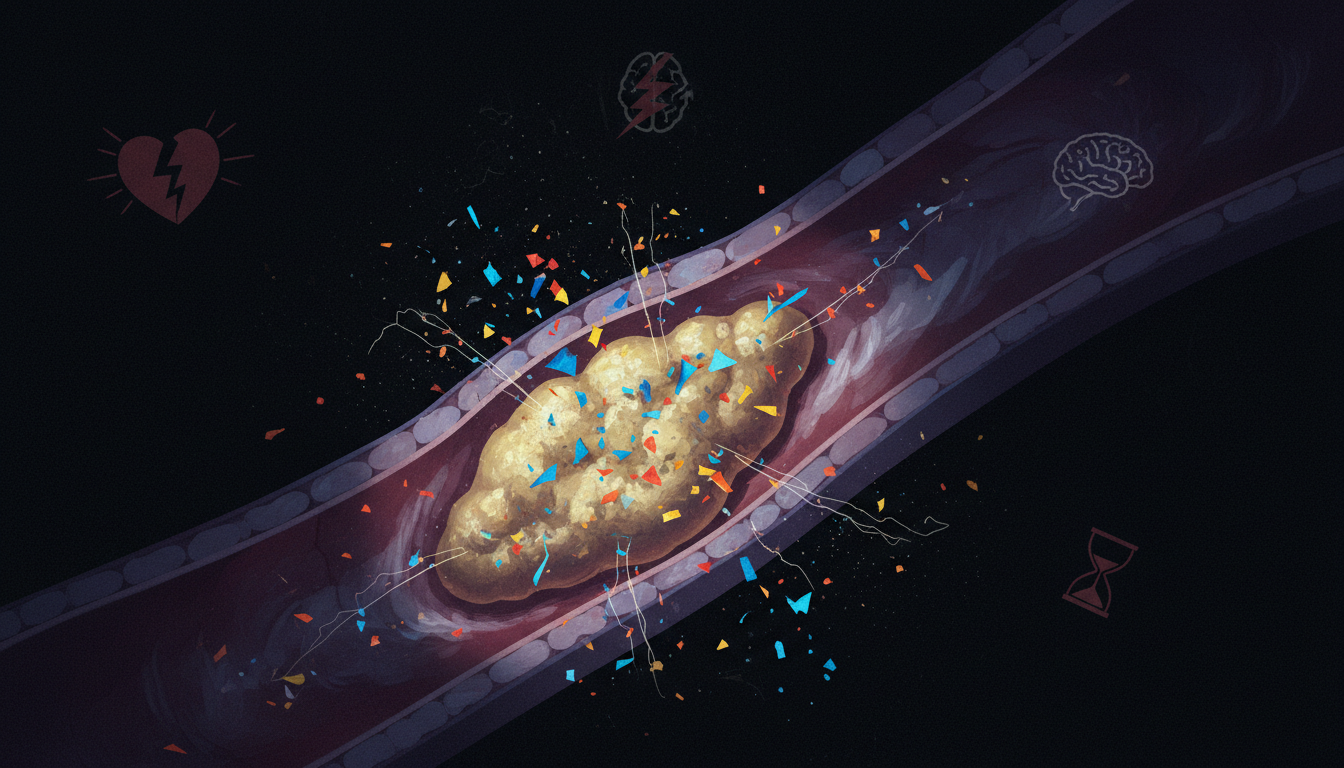
Microscopic plastic particles are no longer simply an environmental concern relegated to ocean wildlife documentaries. They are now being extracted from inside human arteries, brain tissue, and blood clots, and a landmark study published in the New England Journal of Medicine has found that patients whose carotid artery plaque contained microplastics faced a 4.53-fold higher risk of heart attack, stroke, or death compared to patients whose plaque contained no detectable plastic. The body of evidence is no longer preliminary. It is peer-reviewed, replicated across multiple institutions, and growing with each passing year.
What the Research Actually Found
The pivotal study, conducted as a prospective, multicenter, observational trial involving 304 patients undergoing carotid endarterectomy, a surgical procedure to clear dangerous plaque buildup from the carotid arteries in the neck, analyzed excised plaque specimens for the presence of microplastics and nanoplastics (MNPs). Researchers used pyrolysis-gas chromatography-mass spectrometry, stable isotope analysis, and electron microscopy to detect plastic particles. They also measured inflammatory biomarkers within the plaque tissue itself. Of the 257 patients who completed a mean follow-up of 33.7 months, those with MNPs embedded in their plaque showed dramatically worse cardiovascular outcomes than those without.
Polyethylene was among the plastic types identified within the arterial tissue, the same polymer found in plastic bags, bottles, and food packaging used by hundreds of millions of people every day.
Separate research presented at the American Heart Association’s Vascular Discovery Scientific Sessions added further weight to these findings. That study, led by Dr. Ross Clark, a vascular surgeon and assistant professor at the University of New Mexico, examined carotid artery tissue from 48 individuals. The concentration of micronanoplastics in carotid arteries was 51 times higher in plaque from people who had experienced a stroke, mini-stroke, or temporary loss of vision compared to amounts found in the walls of plaque-free arteries. Even patients with plaque who had experienced no symptoms still carried 16 times more micronanoplastics in their plaque than people with no plaque at all.
People with plaque but no symptoms had an average of 895 micrograms of micronanoplastics per gram of tissue. The implications of that baseline number, compared to healthy arterial walls, underscore how significantly plastic burden tracks with disease progression.
How Plastics Enter and Damage the Vascular System
Microplastics and nanoplastics enter the human body primarily through ingestion, inhalation, and dermal contact, according to a narrative review published in the Hellenic Journal of Cardiology. Once internalized, they interact with epithelial and immune barriers and accumulate within critical organs and vascular tissues. The review identifies the key biological mechanisms through which these particles cause harm: oxidative stress, systemic inflammation, endothelial dysfunction, and prothrombotic cascades, all of which collectively promote atherogenesis, the formation of arterial plaque that underlies heart attack and stroke.
Researchers writing in Circulation, the journal of the American Heart Association, have noted an important nuance: in real-world human exposure, microplastics do not exist in isolation. They function as carriers for a wide range of environmental contaminants, both pollutants adsorbed from the surrounding environment during degradation, and chemical additives intentionally incorporated during manufacturing. This means the cardiovascular risk observed in human studies likely reflects the combined toxic burden of plastics and co-contaminants acting together, not plastics alone. Nanoplastics, being smaller and more degraded, may carry an even heavier load of co-pollutants than their larger counterparts.
Emerging data cited in the Hellenic Journal of Cardiology review further suggests that microplastics may drive epigenetic dysregulation and alter extracellular vesicle-mediated signaling, mechanisms by which these particles could change gene expression relevant to cardiometabolic disease, potentially affecting not just the individual exposed but the biological pathways that govern long-term vascular health.
The Brain Is Not Spared
The cardiovascular findings exist alongside a parallel, and equally disturbing, body of research focused on the brain. Researchers reporting in Brain Health found that human brain tissue contains far higher concentrations of microplastics than liver or kidney tissue, and that this burden increased sharply between 2016 and 2024. A study published in Nature Medicine confirmed the presence of microplastics in brain tissue. Critically, individuals diagnosed with dementia were found to carry the heaviest plastic burden of all.
Animal studies cited by researchers in the Journal of Xenobiotics demonstrate that nanoplastics, particles measured in billionths of a meter, are small enough to cross the blood-brain barrier, the biological checkpoint designed to protect the brain from harmful substances circulating in the bloodstream. Once inside, they disrupt blood flow and worsen brain injury following stroke. For context, while a microplastic particle can be as large as a pencil eraser (under 5 millimeters), nanoplastics measure less than 1,000 nanometers, a human hair, by comparison, is 80,000 to 100,000 nanometers wide.
Who Bears the Greatest Burden
The Hellenic Journal of Cardiology review identifies specific populations as potentially bearing disproportionate risk: industrial workers with high occupational exposure, frequent consumers of seafood, and regular users of bottled water. The geographic dimension adds another layer of complexity, because the specific contaminants co-traveling with microplastics vary significantly by region, identical plastic exposure levels could produce different health outcomes across different populations, making consistent epidemiological findings inherently difficult to achieve.
Exposure pathways are pervasive in modern life. Ultraprocessed foods, bottled beverages, plastic food packaging, contaminated water supplies, and airborne particles all serve as ongoing delivery mechanisms, allowing microplastic burden to accumulate gradually inside tissues and blood vessels over years and decades.
What Can Be Done
While no medical intervention currently exists to extract microplastics from arterial tissue or the brain, researchers have identified preliminary experimental approaches. The Hellenic Journal of Cardiology review notes that enzymatic degradation techniques and antioxidant therapies show early promise in experimental settings, though significant knowledge gaps remain, including undefined dose-response relationships, limited longitudinal data, and nonstandardized detection methodologies across research institutions.
On the individual level, the research points toward practical exposure reduction: minimizing ultraprocessed food consumption, avoiding heating food in plastic containers, filtering drinking water, and supporting overall metabolic and vascular health. These steps do not eliminate exposure, the ubiquity of microplastics in the environment makes complete avoidance impossible, but they represent meaningful reductions in the ongoing accumulation documented in tissue studies.
The Scale of the Problem
Stroke remains the second leading cause of death worldwide, according to researchers writing in the Journal of Xenobiotics. The sudden blockage of blood flow to the brain, producing symptoms including weakness, facial drooping, slurred speech, dizziness, and severe headache, leads to permanent disability, cognitive decline, or death when not treated immediately. The discovery that the arteries most implicated in stroke are also the sites of the highest microplastic concentration, and that this concentration scales directly with symptom severity, is not a finding that belongs buried in academic journals.
The researchers themselves have emphasized caution in interpretation, noting that the associations observed in human studies represent the combined effects of microplastics and co-pollutants, not plastics in isolation. But the direction of the evidence is consistent across independent laboratories, research methods, and patient populations. The particles are inside human tissue. They track with inflammation. They track with disease. And the burden is increasing year over year.
This article draws on reporting from Activist Post, American Heart Association News, PubMed/NIH (New England Journal of Medicine study), Hellenic Journal of Cardiology via ScienceDirect, and Circulation (American Heart Association Journals).