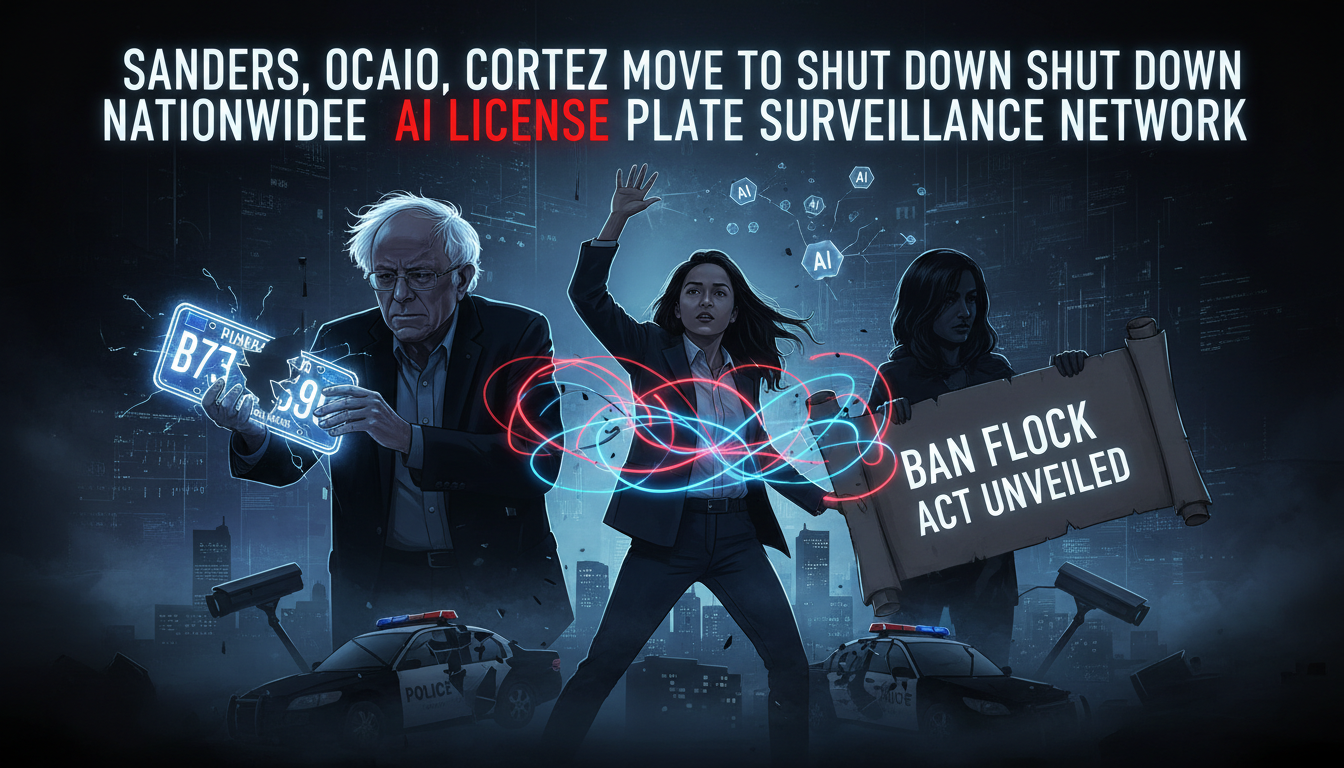
A sweeping piece of federal legislation targeting one of the most expansive AI-powered surveillance networks ever deployed on American soil has arrived in Congress. Senators Bernie Sanders (I-Vermont) and Jeff Merkley (D-Oregon), alongside Representative Alexandria Ocasio-Cortez (D-New York), introduced the Ban Flock Act on October 2, 2026 — a bill designed to sever the federal government’s relationship with Flock Safety’s automatic license plate reader (ALPR) network and defund state and local governments that continue to use it.
The move comes after months of mounting revelations about how Flock’s cameras — now numbering more than 120,000 across the United States — have been used, misused, and quietly integrated into law enforcement and immigration enforcement operations without meaningful public consent or legislative oversight.
What Flock’s Network Actually Does
Flock Safety is the largest vendor of automatic license plate readers in the United States. Its cameras scan and record approximately 20 billion vehicles every month. But the network’s capabilities extend well beyond recording license plates. According to the Sanders Senate office press release, newer Flock cameras record people as well as vehicles, and Flock’s AI system can cross-reference those images with databases containing phone numbers, relatives, and court records — effectively constructing a profile of who a person is, where they are going, and why.
The company also operates a national lookup tool that allows any agency contracting with Flock to access data generated by cameras in entirely different cities or states. A single search through this tool can return physical descriptions of individuals, records of their online accounts, and lists of their relatives. The Sanders office describes the system as scanning and recording 20 billion vehicles every month across the country.
Sanders framed the technology in stark terms during an interview with The Washington Post: “The United States is moving toward a surveillance state where a handful of giant companies make huge profits by giving the government, by selling to the government the power to track our every move. And I think that is a terrible direction in which to go.”
A Pattern of Documented Abuse
The legislation did not emerge from abstract concern. It follows a Washington Post investigation published in August 2026 that found at least 50 law enforcement officers had been charged with or accused of using license-plate-reader cameras for unauthorized purposes. Officers were found to have used the technology to stalk women and to spy on wives, girlfriends, and exes. By the time the Ban Flock Act was introduced, that number had grown, with at least 56 municipalities having deactivated, cancelled, or rejected contracts with Flock.
In late September 2026, prosecutors charged five Indianapolis police officers with misusing their access to Flock cameras — a direct result of the Post’s reporting. Flock responded to the initial investigation by announcing operational changes, including reducing its standard data retention period from one month to one week. The ACLU, however, was not satisfied, arguing in a detailed August 2026 analysis that most of the changes “seem to be following Flock’s playbook of treating legitimate privacy concerns as mere public relations problems.”
The ACLU noted that the company’s new “Evidence Mode” — which preserves data tied to a case number rather than letting it expire — could potentially worsen the retention problem depending on how broadly it is applied. If any searched data triggers indefinite retention, the ACLU warned, the change could make Flock’s data retention practices even more expansive than before.
What the Ban Flock Act Would Do
The legislation targets the network through two primary mechanisms: prohibition and defunding. Specifically, the Ban Flock Act would:
Prohibit federal use: Federal agencies would be barred from purchasing, deploying, operating, accessing, or contracting for any automatic license plate reader, including Flock Safety cameras.
Cut federal funding: The Justice Department and other federal agencies would be prohibited from making grants to state or local governments unless those governments put similar bans on ALPR technology in place — creating a significant financial incentive for jurisdictions to exit their Flock contracts.
Establish a right to sue: The bill would give individuals and state attorneys general the right to sue the federal government over violations of the act, providing an enforcement mechanism beyond regulatory agencies.
Ocasio-Cortez described the broader stakes in her statement: “Across the country, Big Tech companies like Flock Safety have built a mass surveillance system to harvest Americans’ private and personal data without their consent. AI-powered cameras are keeping track of our every move and weaponizing this data against working people to make record profits.”
Bipartisan Pressure, Divergent Approaches
The Democratic bill is not the only congressional response to the Flock controversy. Senator Josh Hawley (R-Missouri), chairman of the Senate Judiciary Committee’s crime and counterterrorism subpanel, held a separate hearing on the cameras and described them as “a surveillance network unlike any we’ve ever seen in this country.” Hawley announced on the same day that he would introduce his own legislation to regulate — rather than ban — the cameras.
“AI-powered cameras produced by Flock and its competitors are tracking and creating digital footprints of everyday Americans — a nightmare for individual liberties unless Congress enacts meaningful rules and accountability,” Hawley said in a statement.
Sanders argued that the regulatory approach championed by Hawley would be insufficient given the nature of the technology. “It’s a very, very powerful tool,” Sanders told the Post. “And I think once it’s out there and widely used, it’s going to be very hard to bring it back.” The Democratic bill’s approach — prohibition rather than regulation — reflects the view that effective guardrails on a network of this scale and sophistication are not achievable through compliance frameworks alone.
Flock Safety has stated publicly that it is open to regulation.
Surveillance Reach Beyond Criminal Investigations
The Sanders office’s press release documents additional dimensions of Flock’s reach that extend beyond officer misconduct. The company has shared state ALPR data with federal immigration officials. Law enforcement agencies have reportedly pulled Flock data to investigate activists, with logged searches corresponding to protests against ICE raids, demonstrations in support of Palestinian rights, and ‘No Kings’ protests. These revelations situate the Flock network not merely as a policing tool but as a potential instrument for monitoring constitutionally protected political activity.
A separate bill introduced in the House in July 2026, the Protection Against Mass Surveillance Act (H.R.9800), introduced by Rep. Tim Burchett (R-Tennessee), similarly sought to prohibit federal agencies from purchasing or accessing automated surveillance systems — including ALPRs, facial recognition technology, and other biometric identification tools. That bill was referred to the House Committee on Oversight and Government Reform.
The Architecture of a Surveillance State
What makes the Flock network distinctive — and, critics argue, particularly dangerous — is not any single capability but the integration of all of them. Individual license plate reads become movement histories. Movement histories, cross-referenced with phone records, family connections, and court databases, become behavioral profiles. Profiles accessible to any law enforcement agency in any state that contracts with Flock, queried through a national lookup tool with minimal documented oversight.
Senator Merkley captured the structural concern: “Right now, Flock is selling its cameras nationwide, laying the groundwork for a surveillance state while enriching corporate executives. No one should have this unchecked surveillance power at their fingertips.”
The Ban Flock Act now enters a legislative process whose outcome remains uncertain. But its introduction marks a significant moment: the first serious congressional push to not merely regulate one of the country’s largest private surveillance networks, but to cut it off from federal resources entirely.
This article draws on reporting from The Washington Post, the Office of Senator Bernie Sanders, the ACLU, and Congress.gov.
What does the Ban Flock Act do?
The Ban Flock Act would prohibit federal agencies from using automatic license plate readers like Flock Safety cameras, block federal grant funding to state and local governments that use the technology, and give individuals the right to sue the federal government for violations.
Why are Flock cameras controversial?
A Washington Post investigation found at least 50 law enforcement officers were charged with or accused of misusing Flock cameras to stalk or spy on women. The network has also been used to share data with immigration officials and track activists attending political protests.
How many Flock cameras are there in the United States?
Flock Safety operates more than 120,000 cameras across the United States, scanning and recording approximately 20 billion vehicles every month.
Want to go deeper? Ask NEX, the Decrypted Matrix research assistant, about the documents behind this story. It indexes every article here the day it is published and cites its sources.