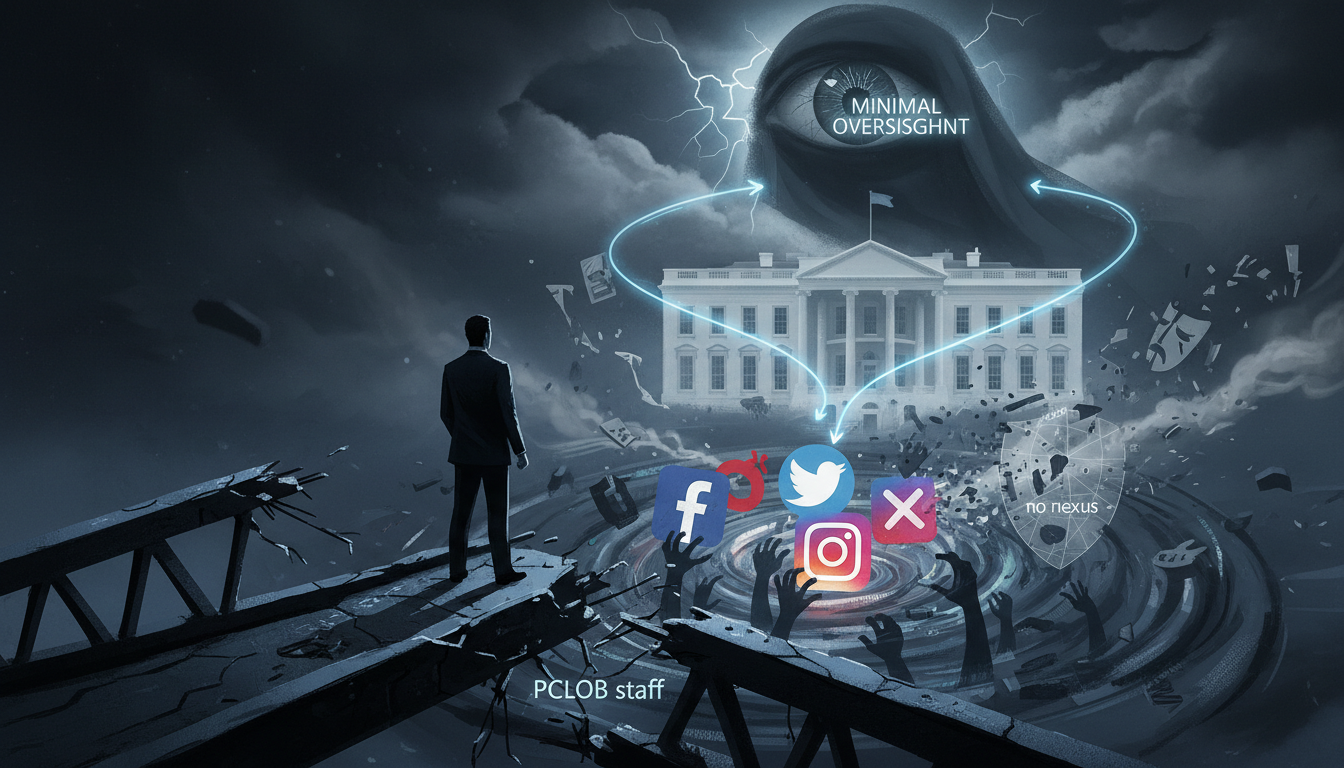
A federal oversight body has released what it describes as the first comprehensive unclassified review of the Biden administration’s effort to suppress alleged disinformation on social media, and the findings are damaging. The Privacy and Civil Liberties Oversight Board’s staff report, published November 18, 2026, concludes that the government never established a credible link between the content it targeted and domestic terrorism, ran the program across a sprawling array of agencies with little coordination, and operated with minimal transparency and few requirements that officials obtain legal approval before pressuring platforms to remove speech.
What the Government Claimed, and What the Record Shows
The 2021 White House National Strategy publicly declared that a “crisis of disinformation and misinformation, often channeled through social media platforms,” was fueling “extreme polarization” that could lead to domestic terrorism. Executive Branch officials then began contacting social media companies directly to flag content they labeled disinformation, with the goal of causing platforms to limit its spread.
The PCLOB staff report, authored under Board Member Beth A. Williams, examined that framework and found it unsupported by the evidence the government itself produced. According to the report, the government “failed to provide evidence of a nexus between disinformation and domestic terrorism.” That is not a minor procedural gap. The terrorism justification was the stated basis for the entire program.
How the Program Operated
The report details several structural problems with how counter-disinformation work was carried out between 2021 and 2024.
Subjective Definitions
The report finds that the category of “disinformation” frequently depended on subjective interpretation. Without a fixed, legally grounded definition, individual officials were making judgment calls about which speech to flag, with no consistent standard across agencies.
Diffusion Across Agencies
Counter-disinformation activity was not run from a single accountable office. The report finds the effort was “diffused across numerous agencies and components,” a structure that made oversight and accountability harder to enforce. The participating agencies included the Department of Homeland Security’s Cybersecurity and Infrastructure Security Agency, the Centers for Disease Control and Prevention, and the Office of the Surgeon General, among others.
Ad Hoc Engagements and Lack of Transparency
The report describes government contacts with social media platforms as “ad hoc” and lacking transparency. Officials were communicating with companies about specific content without consistent records, processes, or public disclosure. The report also notes that policies regarding whether the targeted speakers were foreign or domestic were inconsistent across the government, a significant concern given that domestic speech receives full First Amendment protection.
No Requirement for Legal Sign-Off
Perhaps the most direct civil liberties finding: the report states there were “limited requirements that officials seek attorney or high-level approval before encouraging the suppression of speech.” Individual government employees could contact platforms and push for content removal without obtaining legal review of whether that speech was constitutionally protected.
What the Consent Decree Already Locked In
The PCLOB report does not exist in isolation. It arrives after a consent decree reached in March 2026 between the Department of Justice and the states of Louisiana and Missouri permanently bars the U.S. Surgeon General, the CDC, and the Cybersecurity and Infrastructure Security Agency from coercing social media companies to remove content.
That consent decree, signed by U.S. District Judge Terry A. Doughty of Louisiana, grew out of a lawsuit originally filed after those states and other parties alleged that federal agencies had pressured Facebook, Instagram, Twitter, LinkedIn, and YouTube to remove content related to the COVID-19 pandemic, among other topics. The case had reached the Supreme Court, which dismissed it in 2024 on standing grounds in Murthy v. Missouri. The states then pursued a resolution directly with the Justice Department.
The consent decree explicitly states that applying labels like “misinformation,” “disinformation,” or “malinformation” to speech does not strip that speech of constitutional protection, citing United States v. Alvarez (2012). It also affirms that the parties agreed “modern technology does not alter the Government’s obligation to abide by the strictures of the First Amendment.”
Louisiana Attorney General Liz Murrill signed the decree for her state. The decree references Biden administration officials who had, in the government’s own records, described their coercive efforts favorably.
Executive Orders and the Contraction of the Program
The PCLOB report covers a timeline that extends from the program’s expansion between 2021 and 2024 to its contraction following President Trump’s return to office in January 2025. On his first day back, Trump issued an executive order titled “Restoring Freedom of Speech and Ending Federal Censorship,” which repudiated what it described as the Biden administration’s effort to pressure platforms to suppress speech the federal government did not approve.
The PCLOB report notes the impacts of Executive Order 14149 on government counter-disinformation activities, finding that recent consent decrees have curtailed some agencies’ future communications with social media companies. The report’s section on risks to free speech describes those risks as ongoing despite the program’s contraction.
Scope of the Review
The report examined efforts stretching back to World War II and the Cold War to provide historical context for how the government has countered foreign disinformation in past eras. The post-2016 period of renewed focus on foreign interference gave way, the report documents, to a significant domestic expansion starting in 2021. That expansion drew legal and political scrutiny almost from the start, contributing to the program’s eventual reduction before the administration change.
The PCLOB staff reviewed agencies including the Department of Homeland Security and its components, the CDC, the Surgeon General’s office, and others with roles in counter-disinformation work. The report examined both the policies governing those agencies’ social media engagements and the gaps in those policies.
Recommendations and Open Questions
The report includes formal recommendations, though the full text of those recommendations requires reading the complete staff report. What the public summary makes clear is that the board found existing policies governing government engagement with social media companies to be insufficient for the type of counter-disinformation work the agencies were actually conducting.
One question the report raises without fully resolving is how the government should handle genuinely foreign disinformation operations, which the report acknowledges can carry national security value to counter, while ensuring domestic speech is not swept into the same enforcement net. The inconsistency in how agencies evaluated whether targeted speakers were foreign or domestic made that line difficult to maintain in practice. Whether any future administration can build a credible, lawful foreign-focused counter-disinformation program without repeating the domestic overreach the PCLOB documents remains an open question the report does not answer.
This article draws on reporting from The Washington Times, the PCLOB Staff Report on Government Efforts to Counter Domestic Terrorism by Targeting Disinformation on Social Media, the PCLOB Oversight Reports page, and the Free Speech Center at MTSU on Missouri v. Biden Consent Decree.
What did the PCLOB report find about Biden’s social media disinformation program?
The PCLOB staff report found the government failed to provide evidence linking disinformation to domestic terrorism, ran the program across numerous agencies without consistent policies, and required little to no legal approval before officials pressured platforms to remove content.
What is the Missouri v. Biden consent decree?
A March 2026 agreement permanently barred the U.S. Surgeon General, the CDC, and the Cybersecurity and Infrastructure Security Agency from coercing social media companies to remove content, following allegations those agencies pressured platforms over COVID-19 and other topics.
Could the government label speech as disinformation and have it removed?
The consent decree in Missouri v. Biden explicitly states that applying labels like misinformation or disinformation to speech does not remove its First Amendment protection, citing the Supreme Court’s 2012 ruling in United States v. Alvarez.
Want to go deeper? Ask NEX, the Decrypted Matrix research assistant, about the documents behind this story. It indexes every article here the day it is published and cites its sources.