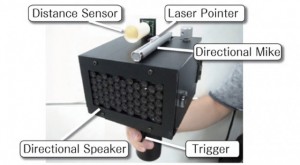
Japanese researchers developed a handheld device capable of disrupting a person’s ability to speak from distances of over 30 meters. The device, which resembled a directional gun, exploited a well-documented psychological phenomenon known as Delayed Auditory Feedback (DAF) to effectively silence targeted speakers without causing physical harm.
How the Speech Jammer Works
The device operated using two components: a directional microphone that captured the target’s speech and a directional speaker that played that speech back to the speaker after a delay of approximately 0.2 seconds. This brief delay triggered the DAF effect, a phenomenon that psychologists have long known disrupts the brain’s ability to coordinate speech. Anyone who has experienced their own voice echoing back during a phone call or video conference has encountered a mild version of this effect.
According to the research paper, DAF does not produce physical discomfort or pain. However, the inability to form coherent words creates significant psychological stress and effectively renders the target unable to continue speaking for as long as the device is aimed at them. Notably, the researchers found that DAF did not affect non-verbal vocalizations such as shouts or exclamations, only structured speech.
The Stated Purpose
The researchers described two intended applications. The first was straightforward: enforcing silence in environments like libraries. The second was more complex and carried greater implications. The researchers noted that in group conversations, certain individuals tend to dominate discussion, extend their speaking time, or interrupt others to assert dominance rather than contribute substantively. The speech jammer was conceived as a tool to enforce equitable turn-taking in conversations.
The research paper framed the device as a solution to social imbalances in communication, a way to ensure that louder or more aggressive speakers could not monopolize dialogue at the expense of others.
Free Speech and Crowd Control Implications
The potential applications beyond the laboratory raised immediate concerns for free speech advocates. In a political context, such a device could be used by audience members to silence speakers at rallies, or conversely, by authorities to prevent audiences from responding to or heckling public officials. In broadcast media, speech-jamming technology could theoretically be written into contracts requiring that live studio audiences be silenced during tapings.
The device also raised questions about crowd control. If scaled up or made more powerful, directional speech-jamming technology could give security forces and governments a tool to suppress verbal dissent at protests or public gatherings without resorting to physical force, creating the appearance of compliance without the visible brutality that draws public criticism.
The Longer-Term Technological Trajectory
The speech jammer’s development coincided with rapid advances in wearable and implantable technology. Augmented reality glasses, bionic sensory organs, and always-connected earbuds were all moving toward mainstream adoption. If such devices became standard personal equipment, the infrastructure for remotely delivering DAF effects to entire populations would theoretically already be in place.
The scenario echoed themes from Kurt Vonnegut’s short story “Harrison Bergeron,” set in a society where the government enforced equality by handicapping exceptional individuals. In that fictional world, intelligent people wore earpieces that blasted disruptive noise at regular intervals to prevent sustained thought. The speech jammer demonstrated that the technological basis for such interference was no longer purely fictional.
While the immediate practical applications of the device remained limited, its existence highlighted the growing capability to interfere with one of the most fundamental human capacities: the ability to speak freely.