In 2012, the United States Supreme Court handed down a five-to-four decision authorizing strip searches for any arrest, regardless of how minor the alleged offense. The ruling arrived on the heels of two other sweeping legal changes: the National Defense Authorization Act (NDAA), which permitted indefinite detention without trial, and HR 347, the so-called “trespass bill,” which imposed penalties of up to ten years for protesting near individuals under Secret Service protection.
Taken together, these measures represented a dramatic expansion of state power over the bodies and movements of ordinary citizens — and they arrived at a moment when grassroots protest movements were gaining unprecedented momentum.
Strip Searches as a Tool of Psychological Domination
The plaintiff in the landmark case, Albert Florence, had been stopped for a traffic-related matter and subsequently subjected to invasive body searches during booking. He described being ordered to disrobe, squat, cough, and expose himself to corrections officers — an experience he said left him feeling dehumanized and degraded.
Justice Anthony Kennedy, writing for the majority, justified the ruling by invoking national security scenarios, suggesting that a September 11 hijacker might have been apprehended during a routine traffic stop. Critics immediately noted the logical gap: a strip search during a speeding stop would not have revealed or prevented an airline attack. The reasoning appeared to conflate the act of arrest with the conditions of long-term incarceration, applying prison security protocols to citizens who had not been convicted of anything.
A Pattern of State-Sanctioned Physical Intrusion
The strip-search ruling did not emerge in isolation. It fit within a broader pattern of government-sanctioned bodily intrusion that had been escalating since the early 2000s. Reports from military detention facilities overseas described interrogation methods that included various forms of physical degradation and sexual intimidation of detainees. The solitary confinement conditions imposed on whistleblower Bradley Manning included forced nudity as a documented component of the detention protocol.
Domestically, the Transportation Security Administration (TSA) had implemented enhanced screening procedures following the 2009 “underwear bomber” incident. These procedures involved either full-body imaging technology — produced by Rapiscan, a company with financial ties to former Department of Homeland Security chief Michael Chertoff — or manual pat-down searches that involved direct contact with intimate areas of the body. The consistency of the pattern suggested something more systematic than isolated policy decisions.
Historical Precedents for Forced Nudity as a Control Mechanism
The use of compelled nakedness to break down individual autonomy and enforce submission has deep historical roots. During the era of American slavery, enslaved people were displayed unclothed on auction blocks as a deliberate assertion of absolute power over their bodies and identities. In Nazi concentration camps, prisoners were systematically stripped and photographed as part of a calculated process of dehumanization.
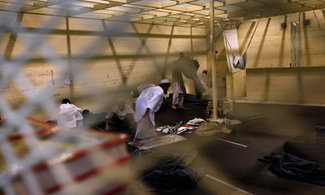
At the Guantanamo Bay detention facility, architectural choices reinforced this dynamic. Glass-fronted shower enclosures were positioned to face directly into central guard stations, ensuring that detained individuals had no possibility of physical privacy. The design itself communicated a message: the state claimed total authority over the bodies of those in its custody.
How Surveillance Infrastructure Amplifies Coercive Power
These legal and procedural developments were unfolding alongside an unprecedented expansion of domestic surveillance capabilities. The National Security Agency was constructing a massive data-processing facility in Bluffdale, Utah, designed to collect and analyze billions of electronic communications — emails, text messages, phone calls, and internet activity.
According to investigative reporting published in Wired magazine by journalist James Bamford, the facility represented a qualitative leap in the government’s ability to monitor its own population. Combined with the legal authority to arrest citizens for minor infractions and then subject them to humiliating physical searches, the surveillance apparatus created a comprehensive system of social control that required no formal declaration of martial law to function.
A Washington Post investigation by Dana Priest and William Arken revealed the scale of the security apparatus: 1,271 government agencies and 1,931 private companies working on counterterrorism and homeland security programs across roughly 10,000 locations in the United States. Approximately 854,000 individuals held top-secret security clearances. In the Washington, D.C. metropolitan area alone, 33 building complexes dedicated to classified intelligence work had been constructed or were under construction since September 2001.
The Economic Incentives Behind Expanding State Power
This vast security sector represented a multi-billion-dollar industry with powerful economic incentives to justify its own continued expansion. Every new threat — real or perceived — translated into budget increases, contract renewals, and institutional growth. The apparatus had developed what amounted to a self-sustaining economic ecosystem built around the surveillance and physical intimidation of the broader population.
The financial interests involved helped explain why these powers continued to expand regardless of which political party held office. The security-industrial complex had become too large and too profitable to dismantle through normal political processes.
The Shifting Language of Citizenship and Detention
Perhaps the most revealing element of the Supreme Court’s strip-search decision was Justice Kennedy’s repeated use of the word “detainees” to describe American citizens who had been placed under arrest. The term carried a decade of accumulated associations with individuals held at Guantanamo Bay and other overseas facilities — people to whom the government had explicitly argued normal legal protections did not apply.
By applying this language to domestic arrests, the court was subtly redefining the relationship between the state and its citizens. The word “detainee” carried an implicit message: once in government custody, an individual occupied a legal gray zone where traditional rights and dignity could be suspended at the discretion of authorities.
This linguistic shift, combined with the legal authority to arrest for trivial offenses and then conduct invasive physical searches, created conditions under which protest, dissent, and nonconformity carried not just legal risks but the threat of personal degradation — a combination historically associated with authoritarian governance rather than constitutional democracy.