The man identified as the gunman in the Aurora, Colorado movie theater massacre was James Holmes, a 24-year-old neuroscience doctoral candidate at the University of Colorado’s Anschutz Medical Campus. Holmes allegedly opened fire during a midnight screening of “The Dark Knight Rises” on July 20, 2012, killing 12 people and wounding dozens more.
Prior to carrying out the assault, Holmes reportedly dyed his hair red and told authorities he was “The Joker,” referencing the iconic villain from the Batman franchise.
A Neuroscience Student with No History of Violence
By all accounts, nothing in Holmes’ background suggested he was capable of mass violence. Those who knew him described a quiet, introverted individual who spent most of his time on academic pursuits and online gaming.
Billy Kromka, a pre-medical student who had worked alongside Holmes as a research assistant at the Anschutz campus during the previous summer, expressed total disbelief. Kromka told reporters that Holmes seemed entirely incapable of such an act based on their three months working together in the lab.
Holmes had graduated with honors from the University of California, Riverside, earning a bachelor’s degree in neuroscience in 2010. He had no criminal record beyond a single traffic citation. At the time of the shooting, he was collecting unemployment benefits.
Some observers raised questions about whether Holmes’ work in neuroscience research may have exposed him to experimental protocols involving cognitive manipulation. His detached demeanor during and after the attack struck many analysts as consistent with someone operating under the influence of pharmaceutical compounds, psychological conditioning, or some combination of both.
Contradictions in the Official Lone Gunman Narrative
Several aspects of Holmes’ behavior during and after the shooting defied logical explanation for someone supposedly driven by murderous intent.
After unleashing gunfire on a crowded theater, Holmes walked outside and surrendered to responding officers without any resistance whatsoever. For someone allegedly committed to maximum carnage, this passive capitulation made little sense.
Even more puzzling was what happened next. Holmes voluntarily informed police that his apartment had been rigged with explosive devices. If his goal was to inflict as many casualties as possible — potentially including the law enforcement officers who would inevitably search his residence — why would he disclose the trap in advance?
Police confirmed that Holmes offered no resistance during his arrest and proactively warned them about the explosives awaiting them at his home.
Military-Grade Equipment and Sophisticated Explosives
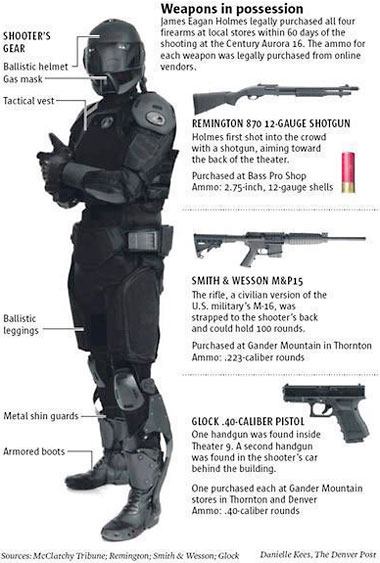
The inventory of equipment recovered from Holmes and his vehicle painted a picture far removed from a typical civilian arsenal. Law enforcement found a semi-automatic rifle, two handguns, a knife, a bulletproof vest, a ballistic helmet, gas delivery devices, a gas mask, military-style SWAT tactical clothing, and unidentified explosive materials. During the attack itself, Holmes wore the gas mask, ballistic helmet and vest, along with protective gear covering his legs, groin, and throat.
This level of tactical outfitting raised immediate questions about how a graduate student with no military background or tactical training acquired such specialized equipment.
The situation at his apartment proved equally alarming. Aurora Police Chief Dan Oates described the booby-trap system as extraordinarily sophisticated — unlike anything his department’s bomb technicians had previously encountered. The setup included interconnected trip wires, containers of liquid designed to mix and ignite upon contact, what appeared to be commercial-grade mortar shells potentially packed with smokeless powder, inflated balloons filled with an unidentified powder, bottles of linked liquid compounds, and devices mounted on the refrigerator with blinking indicator lights.
Disarming the apparatus required approximately 100 personnel and multiple controlled detonations. A police sergeant confirmed the primary device was configured to detonate when anyone entered the apartment, and was specifically engineered to kill.
The Cost Problem: Where Did the Money Come From?
One of the most glaring unanswered questions centered on financing. Holmes was unemployed and living on government assistance at the time of the shooting. Yet the total cost of his arsenal — including a quality AR-15 rifle, a shotgun, a handgun, approximately 6,000 rounds of ammunition, spare magazines, optical sights, body armor with ballistic helmet, bomb-making components, and specialized tactical clothing — represented an investment conservatively estimated between $10,000 and $20,000.
Beyond the financial puzzle, there was the question of expertise. Constructing the kind of elaborate, interconnected explosive system found in Holmes’ apartment requires knowledge that simply is not part of any neuroscience curriculum. The manufacturing of explosive booby-trap devices is itself a serious felony, and the sophistication of what investigators encountered suggested training well beyond what any civilian hobbyist could acquire independently.
A Pattern of Government-Linked Entrapment Operations
The Aurora shooting occurred against a backdrop of documented cases in which federal law enforcement agencies had orchestrated elaborate sting operations involving would-be domestic terrorists. In multiple instances, the FBI had provided weapons, equipment, tactical guidance, and even transportation to individuals who were subsequently arrested before carrying out planned attacks.
The New York Times had reported extensively on this pattern, detailing cases where undercover agents supplied dummy missiles, inert explosives, deactivated suicide vests, and vehicles loaded with fake bomb materials. In one notable case, an FBI agent actually drove the van intended for the attack.
These documented operations demonstrated that federal agencies possessed both the capability and the institutional willingness to equip individuals with sophisticated tactical gear and guide them toward violent scenarios.
Timing Raised Questions About Political Motivation
The shooting took place just days before a scheduled United Nations vote on a global small arms treaty — an agreement that critics warned could potentially impact domestic firearms regulations. Forbes had published an analysis suggesting the treaty might be used to assert federal authority over state-level gun laws, raising concerns about Second Amendment implications.
This timing led some observers to draw parallels to Operation Fast and Furious, the ATF program that had facilitated the transfer of thousands of firearms to Mexican criminal organizations. That operation was later revealed to have been designed, at least in part, to generate evidence supporting stricter domestic gun control measures.
Historical Context: The Dangers of Centralized Force
The broader debate surrounding the Aurora tragedy touched on fundamental questions about the relationship between civilian armament and government power. Throughout the twentieth century, numerous regimes implemented civilian disarmament programs that preceded large-scale atrocities.
The historical record includes devastating examples: tens of millions killed under Mao Zedong’s campaigns in China, millions more under Stalin’s purges in the Soviet Union, the Holocaust under Hitler’s Germany, and the Cambodian genocide under Pol Pot. In each case, the consolidation of armed force exclusively in government hands preceded systematic violence against civilian populations.
A policy paper from the Geneva Centre for the Democratic Control of Armed Forces outlined frameworks for establishing state monopolies on the legitimate use of force at local, national, regional, and global levels — a concept that civil liberties advocates viewed with deep concern given this historical pattern.
Unanswered Questions Surrounding the Aurora Massacre
The Aurora shooting left behind a trail of unresolved contradictions. A quiet, academically accomplished neuroscience student with no criminal history and no apparent means of financial support somehow acquired thousands of dollars worth of military-grade tactical equipment, constructed professional-caliber explosive devices, executed a meticulously planned assault on a crowded theater, and then immediately and calmly turned himself in while helpfully warning police about the dangers waiting at his apartment.
Whether these inconsistencies pointed to undisclosed third-party involvement, an undocumented source of funding and training, or simply an extraordinarily unusual criminal case remained a matter of intense debate. What was clear was that the official narrative of a lone, disturbed graduate student acting entirely on his own initiative left numerous critical questions unanswered.