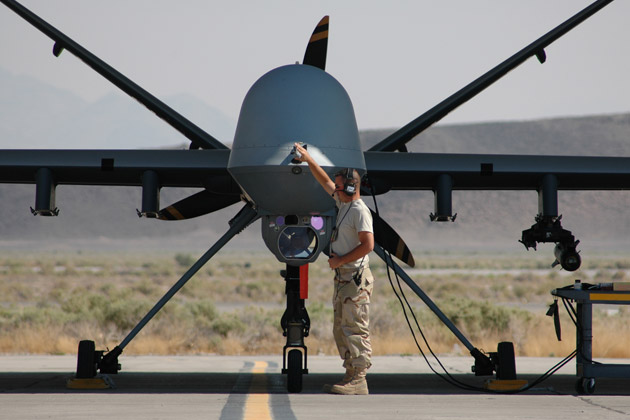
Predator Drone Used to Arrest North Dakota Farmer on His Own Land
In Lakota, North Dakota, the same unmanned aerial technology that transformed military operations over Iraq and Afghanistan found a controversial new mission: domestic law enforcement on American soil.
Surrounded by 3,000 acres of corn and soybean fields and miles from the nearest town, farmer Rodney Brossart and five members of his family were arrested after a dispute over six stray cattle belonging to a neighbor spiraled into a 16-hour armed standoff with police. A Predator drone was deployed to locate the family before a SWAT team moved in.
The incident represented one of the earliest documented cases in the United States where an unmanned aerial vehicle assisted in the arrest of American citizens on private property. It became a flashpoint in the intensifying national debate over how military-grade surveillance technology was beginning to proliferate across civilian airspace.
From Battlefield Weapons to Backyard Surveillance Tools
Modern drones extend far beyond the Hellfire missile-equipped aircraft familiar from combat footage. The industry — which prefers the term Unmanned Aerial Systems — now produces devices small enough to fit in a human palm and as unassuming as hobbyist remote-controlled airplanes.
These systems offer practical benefits: rapidly searching rural terrain for missing children, identifying wildfire hotspots before they spread, monitoring agricultural crops, and even enabling paparazzi to pursue celebrity photographs from new angles. Government projections estimated that as many as 30,000 drones would operate in American skies by the end of the decade.
Yet fundamental questions remained unanswered. Could drones share domestic airspace safely with manned aircraft? Could their surveillance capabilities be deployed without violating constitutional privacy protections? And who was responsible for overseeing drone operators?
The American Civil Liberties Union sounded an alarm in a policy paper titled “Protecting Privacy From Aerial Surveillance,” warning that all the necessary conditions were falling into place for routine aerial monitoring of everyday American life — a transformation that would fundamentally alter the nature of public existence in the country.
Grand Forks Air Force Base Becomes a Drone Hub
The Grand Forks base had been operating drones since 2005, when it transitioned from flying tankers to unmanned aerial systems. The North Dakota Air National Guard’s celebrated Happy Hooligans unit had similarly conducted drone missions over Iraq and Afghanistan from its facility in Fargo.
Operational hours were climbing rapidly. Customs and Border Patrol Predators logged over 30 flight hours in 2009, more than 55 hours in 2010 mapping flood-ravaged areas of the Red River Valley spanning North Dakota and Minnesota, and nearly 250 hours of disaster relief support along the northern border in 2011.
The base, which operated two Predators at the time, expected to eventually house as many as 15 Northrop Grumman Global Hawks and six to eight General Atomics Predators or Reapers, bringing an additional 907 Air Force personnel to the installation.
Motorists on Highway 2 near the base reported routinely seeing the unarmed Customs Predator B practicing touch-and-go landings in the morning. A local sheriff’s deputy described looking up from writing reports in his patrol car one night to find a drone silently hovering overhead. Don “Bama” Nance, a 20-year Air Force veteran who retired to Emerado and took up mowing the base golf course, noted that the drones were a constant presence over the third hole.
Eastern North Dakota Bets on Drones for Economic Growth
For this stretch of eastern North Dakota, the expanding drone presence carried significant economic appeal. The University of North Dakota had aggressively partnered with military branches and defense contractors, working behind locked doors and security protocols to position the region as a national center for unmanned aircraft activity.
The state invested an estimated $12.5 million in the initiative. The local Economic Development Corporation hired a dedicated drone coordinator to recruit additional companies to join the 16 drone-related firms that had already established operations in the area.
Al Palmer, director of UND’s Center for Unmanned Aircraft Systems Research, Education and Training, compared the state of unmanned aviation to where traditional aviation stood in 1925, declaring the possibilities limitless.
UND operated a fleet of seven different drone types and in 2009 became the first American university to offer a four-year degree in unmanned aircraft piloting. By 2012, the program had produced 23 graduates with 84 students enrolled, open exclusively to US citizens. The university also partnered with Northland Community College in Thief River Falls, Minnesota, which had developed the nation’s first drone maintenance training center and displayed its own full-scale Global Hawk.
Additionally, UND served as an incubator for industry startups. One tenant, the Unmanned Applications Institute International, offered five-day training courses that could teach a law enforcement officer to operate a drone no larger than a bathtub toy.
Douglas McDonald, the company’s director of special operations and president of a local chapter of the unmanned vehicle trade group, offered a blunt response to privacy objections. He suggested that anyone worried about drones overhead might have reason to be surveilled. But he also argued that the same skeptics would welcome drone technology the moment their child went missing, their car was stolen, or illegal marijuana cultivation appeared on their lakefront property.
Privacy Advocates and Lawmakers Push Back Against Domestic Drones
Despite industry enthusiasm, resistance was building. Organizations ranging from the Electronic Privacy Information Center to the American Library Association raised formal concerns with the Federal Aviation Administration about the implications of opening American airspace to unmanned vehicles. Representatives Edward Markey and Joe Barton, co-chairs of the Congressional Bi-Partisan Privacy Caucus, joined the pushback.
The federal government, meanwhile, had been quietly expanding drone operations with minimal public oversight. Even as overseas conflicts wound down, the military lobbied for additional pilot funding. Although FAA approval was technically required for all domestic drone flights, the agency had already issued at least 266 active testing permits with little transparency. Safety data painted a troubling picture: unmanned aircraft experienced accidents at seven times the rate of general aviation and 353 times the rate of commercial aviation.
Under commercial and political pressure, the Obama administration directed the FAA to develop new regulations for expanding small drone use domestically, with a target of granting drones access to airspace previously reserved for piloted aircraft by 2015.
Ryan Calo, director of privacy and robotics at Stanford Law School’s Center for Internet and Society, captured the unease many felt about the technology. He described drones as inscrutable, airborne, and intelligent — qualities that make them genuinely difficult for the human mind to categorize cleanly.
The Grand Forks Sheriff’s Department had received its own drone from the university for just one dollar as part of a pilot program to develop law enforcement policies and procedures. Sheriff Robert Rost insisted that the department had no interest in violating anyone’s rights and was focused exclusively on public safety, assuring residents that Big Brother-style surveillance was not the goal.
Still, transparency remained elusive. Some university equipment was off-limits to the public due to federal privacy regulations. Anyone photographing near the base could expect questioning from county, state, and Air Force law enforcement. When asked how many times US Border Protection had dispatched drones at the request of local police, an agency spokeswoman said those figures were not tracked.
Constitutional Questions Loom Over Warrantless Drone Surveillance
Meanwhile, the Air Force had proposed expanding restricted airspace near Devils Lake by seven nautical miles for laser training exercises with drones. Of 43 public comments submitted on the proposal, 42 opposed it — primarily citing safety concerns and fears of interference with commercial and general aviation. The FAA approved the expansion anyway.
Not far from the base, retired airman Arnie Sevigny mounted his own quiet protest: a tattered jet fighter-shaped kite whipping in the wind 100 feet above his property, staked firmly to the ground. He quipped that his kite had no camera and posed no invasion of privacy, and questioned the need for drones at all when existing satellites could already read the face of a dime in someone’s hand.
Brossart himself remained defiant. He still did not know what the Predator drone that led to his family’s arrest had actually captured. Despite court demands from his defense team, the footage had never been produced. He believed authorities were withholding the video because it would reveal exactly what they had done.
A judge was expected to rule imminently on whether the charges against Brossart — who had a history of confrontations with authorities — should be dismissed. His attorney, Bruce Quick, argued in part that the warrantless deployment of the drone constituted outrageous government conduct that violated Brossart’s Fourth Amendment protections against unreasonable search and seizure.
With case law on domestic drone use still largely undefined, Quick predicted that courts, Congress, and state legislatures would inevitably be forced to establish clear legal boundaries. The concern, he emphasized, extended well beyond criminal defense attorneys to anyone who valued civil liberties. The idea of quietly surrendering personal privacy to airborne government surveillance was something few Americans were willing to accept without a fight.
Originally published July 23, 2012. Content sourced from StarTribune.com reporting by Mark Brunswick.