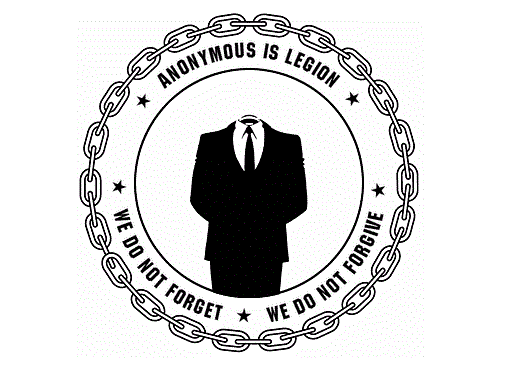
The Anonymous collective has been one of the most debated phenomena of the digital age — a decentralized, leaderless network that defies conventional definitions of organization, activism, and protest. A satirical manifesto that circulated in early internet forums offered a distorted mirror of the movement’s self-image, raising questions about what Anonymous truly represents.
The Satirical Code and Its Subtext
Among the many texts associated with Anonymous, a mock code of conduct circulated that read as an exaggerated self-parody. Written in the style of a manifesto, it described Anonymous as void of restraint, dignity, and purpose — a deliberate inversion of the movement’s more serious declarations. The satirical piece suggested that Anonymous’s greatest weapon was sheer numbers rather than competence, and that its concept of “elimination” amounted to little more than photoshopped images and empty threats.
Whether intended as self-aware humor from within the movement or as external mockery, the document highlighted a real tension at the heart of Anonymous: the gap between its grandiose rhetoric and the often mundane reality of its operations.
The Structure of a Structureless Movement
Anonymous operates without formal leadership, membership rolls, or organizational hierarchy. Anyone can claim affiliation simply by participating in an action or adopting the collective’s imagery — most iconically, the Guy Fawkes mask popularized by the graphic novel and film “V for Vendetta.” This radical openness is simultaneously the movement’s greatest strength and most significant vulnerability.
The lack of centralized authority means that Anonymous can mobilize rapidly around causes ranging from internet freedom to government corruption. It also means that any individual can act under the Anonymous banner, regardless of skill level or intention, making the collective’s actions unpredictable and its reputation inconsistent.
Notable Operations and Real-World Impact
Despite the satirical self-deprecation, Anonymous has been involved in operations with genuine geopolitical consequences. The collective targeted the Church of Scientology in Project Chanology, supported Arab Spring protesters by attacking government websites, took on drug cartels in Mexico, and launched operations against ISIS recruitment networks. In these cases, Anonymous demonstrated that decentralized digital activism could produce tangible pressure on powerful institutions.
At the same time, the movement has been criticized for harassment campaigns, doxxing innocent individuals, and operations that caused collateral damage to uninvolved parties. The absence of accountability mechanisms meant that harmful actions carried out under the Anonymous name could not be meaningfully policed by the collective itself.
Identity, Anonymity, and the Digital Age
The deeper significance of Anonymous may lie less in its specific operations than in what it represents about digital-era power dynamics. The movement demonstrated that anonymity itself could function as a form of collective identity — that individuals with no connection to one another could coordinate actions through shared ideology and distributed communication channels.
The satirical manifesto, with its self-mocking tone, captured something essential about this paradox: a movement that simultaneously claimed to be everything and nothing, powerful and impotent, serious and absurd. Whether Anonymous endures as a meaningful force or fades into internet history, it established a template for leaderless digital activism that continues to influence how protest movements organize in the connected age.