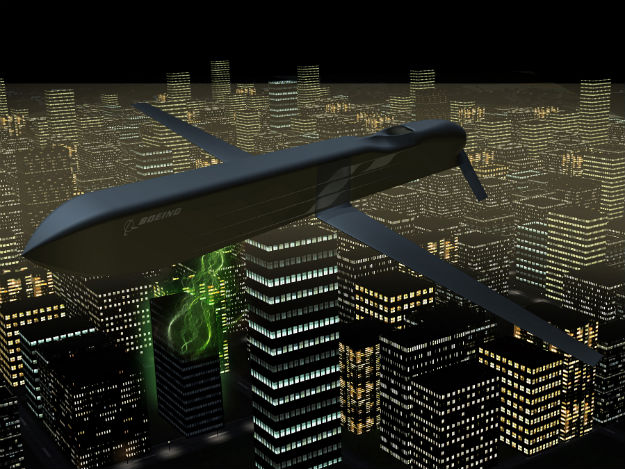
The CHAMP Program: A Missile That Disables Electronics Without Explosions
In October 2012, Boeing and the United States Air Force successfully tested one of the most unusual weapons in modern military development — a missile designed not to destroy targets through impact, but to disable their electronics from the air using directed microwave energy.

The Counter-electronics High-powered Microwave Advanced Missile Project, known as CHAMP, was built to fly a preprogrammed route over enemy positions and emit bursts of high-power microwaves capable of shutting down computers, radars, and other electronic systems — all without causing physical harm to people or structures.
On October 16, 2012, a CHAMP missile flew an hour-long route at low altitude over the Utah desert, successfully disabling the electronics inside seven separate targets along its path. In one building filled with computers, every screen went dark as the missile passed overhead. According to Boeing, the weapon even knocked out the remotely controlled cameras that were recording the test.
A Non-Kinetic Alternative to Traditional Strikes
Unlike conventional missiles that rely on explosive warheads to destroy targets, CHAMP operates as a non-kinetic weapon. It uses directed electromagnetic energy rather than physical force, making it functionally similar to a localized electromagnetic pulse. The concept opens the door to neutralizing military installations, individual vehicles, or even entire neighborhoods of electronic infrastructure without collateral damage to buildings or personnel.
Boeing described it as a weapon that “renders electronic targets useless” — a significant departure from the blast-and-shrapnel approach that has defined missile warfare for decades.
Strategic Role in Future Conflicts
Military planners envisioned CHAMP as a “door kicker” for combat operations. The scenario involved launching the missile from a stealth aircraft ahead of a larger strike force. By disabling enemy air defense networks and command-and-control centers, CHAMP would create corridors for less stealthy aircraft and ground forces to operate safely.
Keith Coleman, the CHAMP program manager at Boeing’s Phantom Works division, stated at the time that the technology could eventually render an enemy’s electronic and data systems inoperable before the first troops or aircraft even arrived in a conflict zone.
Broader Electronic Warfare Landscape
At the time of the CHAMP test, the Pentagon was investing heavily in electronic warfare capabilities across multiple branches. The Navy was acquiring EA-18G Growler electronic attack jets, while the Air Force and Marine Corps were developing the Next Generation Jammer system for use alongside the F-35 Joint Strike Fighter’s Active Electronically Scanned Array (AESA) radars, which could be repurposed for jamming enemy sensors.
The Navy was also considering equipping its planned fleet of stealthy unmanned combat aircraft, known as UCLASS, with electronic warfare systems designed to suppress enemy electronics. CHAMP represented one component of a broader Pentagon strategy focused on defeating increasingly sophisticated air defense systems being developed by potential adversaries.
While CHAMP was described as a technology demonstrator rather than a production-ready weapon, the successful 2012 test proved that directed-energy microwave weapons were a viable concept for future military operations.