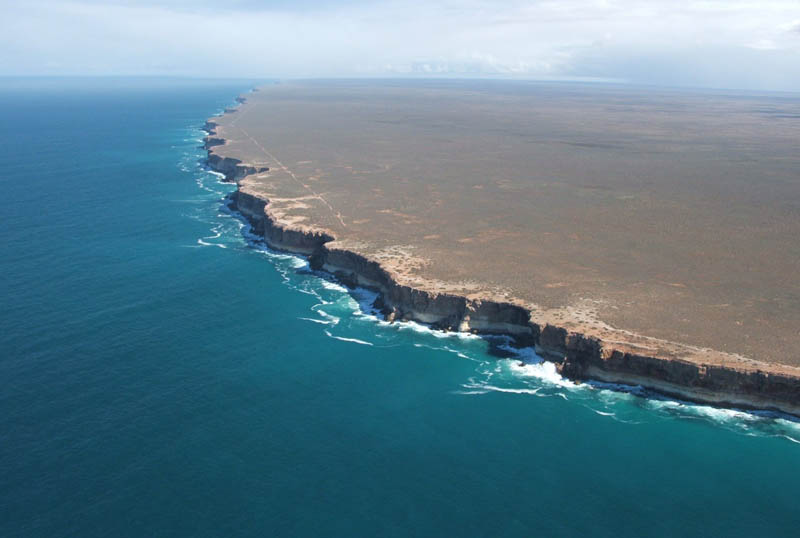
The Nullarbor Plain: Earths Largest Limestone Karst
The Nullarbor Plain stands as the largest limestone karst landscape on the planet, spanning approximately 270,000 square kilometers between Norseman in Western Australia and Ceduna in South Australia. The formation stretches roughly 2,000 kilometers, with two-thirds falling within Western Australia and the remainder in South Australia.
Despite its name deriving from the Latin for “no trees,” the plain sustains a diverse carpet of bluebush and saltbush, drought-resistant and salt-tolerant shrubs adapted to the harsh conditions. Along its outer edges, open woodlands of Myall acacias provide additional vegetation cover.
The Bunda Cliffs: A Dramatic Southern Border
Along the southern edge of the Nullarbor, the Bunda Cliffs rise dramatically from the Southern Ocean, forming the coastline of the Great Australian Bight. These limestone sea cliffs extend for roughly 200 kilometers and drop up to 120 meters to the water below. The sheer vertical faces, carved by millennia of ocean erosion, create one of the most visually striking coastlines on the continent.
To the north, the Great Victoria Desert forms the opposite boundary of the plain, creating a stark contrast between the arid interior and the ocean-battered southern edge.
Surprising Biodiversity in a Harsh Landscape
A 1984 Biological Survey of the Nullarbor documented a level of biodiversity that defied the regions barren reputation:
- 794 vascular plant species across the survey area
- 56 mammal species, including one of Australias largest populations of southern hairy-nosed wombats
- 249 bird species, including the endemic Nullarbor Quail and Naretha Blue Bonnet
- 86 reptile species and a single frog species, with numerous new records and range extensions documented during the study
The survey revealed that what appears to be an empty expanse from above harbors a complex web of life adapted to one of the most extreme environments on the Australian continent.