
In 1972, a team of MIT researchers built a computer model for the Club of Rome that projected a dramatic decline in global population by the end of the twenty-first century. Decades later, that model continues to resurface in policy debates about resource scarcity, population control, and the future of industrial civilization.
Australian physicist Graham Turner revisited the original data and concluded that real-world trends closely tracked the projections. His assessment was direct: the world remains on a collision course with ecological limits, and only coordinated investment in green technologies and limits on economic expansion could avert disaster.
The Club of Rome and Its Controversial Model
The Club of Rome was founded in 1968 as a think tank focused on global resource challenges. Its landmark 1972 publication, The Limits to Growth, used MIT-developed computer simulations to argue that unchecked consumption of finite resources like oil, food, and water would eventually trigger civilizational collapse, accompanied by a steep reduction in human population.
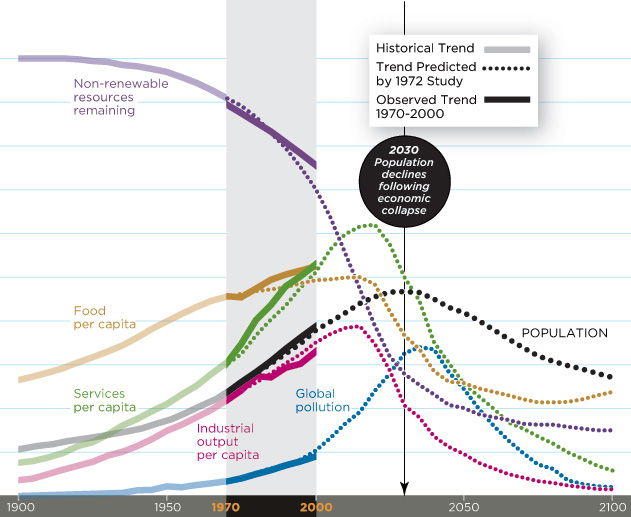
The graph from the original study, while notably lacking specific numerical values on its vertical axis, appeared to show global population falling from projected peaks of roughly 9 to 10 billion to approximately 4.5 billion by 2100, a decline representing more than half of humanity.
Critics Challenge the Integrity of the Model
The model did not go unchallenged. Investigations in the early 1980s found that the MIT computer model had been configured to produce the outcomes that Club of Rome founder Aurelio Peccei wanted to demonstrate. Researchers documented his own admission that the exercise was intended as shock treatment to compel nations toward population control measures. Economist Christopher Freeman characterized the MIT team as Malthus with a computer.
Economist Gunnar Myrdal was equally blunt, arguing that the model was designed to impress the general public while possessing little scientific validity.
The Post-Industrial Vision
The Club of Rome published The First Global Revolution in 1991, which contained a revealing passage: the organization stated that in searching for a common enemy to unite humanity, it had settled on pollution, global warming, water shortages, and famine. The document declared that the real enemy is humanity itself.
This framing aligned with broader agendas around sustainable development and population management. Programs like the United Nations Agenda 21 were built on similar premises about resource depletion, though critics argued that many of the underlying assumptions were flawed or excluded viable alternatives.
Resource Scarcity Claims Under Scrutiny
Several of the original predictions have been contradicted by subsequent developments. The peak oil hypothesis, central to the projections, has been undermined by discoveries in shale and deepwater extraction. Even mainstream financial outlets have acknowledged that known oil reserves could sustain global demand for centuries, though the desirability of continued fossil fuel dependence remains a separate question.
Food scarcity, another pillar of the model, is driven less by an inability to grow enough and more by financial speculation that inflates prices, along with policy decisions like dedicating agricultural land to biofuel production rather than food. The push for genetically modified crops, promoted as a solution to yield shortfalls, has in many cases failed to deliver promised productivity gains while creating new economic pressures on farmers.
Clean water challenges are real but are exacerbated by industrial contamination, including pharmaceuticals and synthetic compounds, rather than by simple overconsumption.
The Debt Dimension
Some analysts have argued that the most immediate threat to global stability is not resource depletion but financial unsustainability. The accumulation of debt in the hundreds of trillions of dollars, backed ultimately by the productive capacity of populations, may itself represent an unsustainable trajectory. If confidence in debt-based systems collapses, the economic fallout could produce consequences similar to those predicted by resource-scarcity models but driven by financial rather than ecological factors.
Framing the Debate
The recurring revival of the Limits to Growth model raises fundamental questions about who controls the narrative around population and resources. Proponents frame the challenge as a zero-sum equation, implying that population reduction is an inevitable variable. Critics counter that genuine innovation in energy, agriculture, and resource management could render such equations obsolete, if those in positions of power were willing to pursue those alternatives.
What remains clear is that the model functions less as a neutral scientific prediction and more as a policy instrument, one that continues to shape debates about the relationship between human civilization and the planet carrying capacity.