On December 7, 1968, a Minnesota jury declared a $14,000 mortgage void in two hours. The bank president had already admitted, under oath, that the bank loaned no money. What happened in the eighteen months that followed is the story you can't find anywhere else online — pieced together from the actual court docket.
From practice to theory · 100% free
On Saturday morning, December 7, 1968, a jury in Credit River Township, Scott County, Minnesota walked into a justice-of-the-peace courtroom at 10 AM and walked out at 12:15 PM with a unanimous verdict. The whole affair took about two hours. The bank's entire case went in through one witness — its own president. Jerome Daly, appearing pro se, put himself on the stand as the only witness for the defense. Justice of the Peace Martin V. Mahoney presided. By the time the jury returned, the bank had forfeited its mortgage, its sheriff's sale, and any claim on the property. It also owed Daly $75 in costs.
The case is about bookkeeping — specifically, about what a banker admitted under oath when asked, in plain language, how his bank actually processed a mortgage loan. It is not a technicality, and the jury were not neighbors doing a favor.
The loan in question was a $14,000 mortgage, dated May 8, 1964. First National Bank of Montgomery had initiated foreclosure after Daly defaulted. By the time the case reached Mahoney's court, the sheriff's sale had already been held — June 26, 1967 — and Daly was fighting to recover his property after the fact.
Daly's defense was not that he never signed a note. It was that the bank had given him nothing of value in exchange for signing it.
To understand why a jury agreed with him, you have to follow the bookkeeping. The standard understanding of a mortgage loan goes like this: the bank has depositors' money sitting in its vault, the bank lends that money to a borrower, the borrower repays it over time with interest. Simple intermediation. The bank is the lender in any meaningful sense of the word.
What Lawrence V. Morgan, president of First National Bank of Montgomery, admitted under oath is that this is not what happened.
Here is the chain of events Morgan confirmed, drawn from Mahoney's memorandum and the trial record:
When Daly signed the promissory note, that note carried actual cash value equal to the loan amount — $14,000. The bank did not receive the note and then reach into existing reserves to fund the loan. Instead, the bank recorded the note as an asset on its own books. That is standard Federal Reserve procedure, described in the Federal Reserve Bank of Chicago's own publication, Modern Money Mechanics, which Daly introduced as Exhibit C at trial.
Once the note was booked as an asset, the bank created a corresponding liability — a new deposit — in the same amount. The deposit did not come from any prior account. It did not represent any pre-existing money held by the bank. It was created in that transaction, at that moment, by bookkeeping entry. The bank then issued a check drawn on that new deposit.
That check went to Daly as the "loan."
Follow the sequence all the way through: Daly's note created the asset. The asset created the deposit. The deposit funded the check. The check was handed back to Daly as if the bank were lending him something. The bank's own pre-existing money, depositor funds, or legal tender played no role in the transaction. The bank invested zero dollars of its own capital.
Daly, in other words, received back the cash value of the instrument he had just signed — minus a re-labeling of the relationship. What the paperwork called a "loan" was, in mechanical terms, an exchange: his $14,000 note for a $14,000 check that his note had just created.
And then he was required to repay it, plus interest, over the life of the mortgage.
Mahoney's memorandum records the testimony directly. The key exchange:
When Morgan was asked what cash value the bank had actually given to obtain the promissory note, he answered: "Nothing."
When pressed further — asked to explain the mechanics of how the loan funds came into existence — Morgan's answer was: "That's how it works."
Mahoney's memorandum then states, in Mahoney's own words:
"Plaintiff admitted that it, in combination with the Federal Reserve Bank of Minneapolis, which are for all practical purposes, because of there interlocking activity and practices, and both being Banking Institutions Incorporated under the Laws of the United States, are in the Law to be treated as one and the same Bank, did create the entire $14,000.00 in money or credit upon its own books by bookkeeping entry. That this was the Consideration used to support the Note dated May 8, 1964 and the Mortgage of the same date. The money and credit first came into existence when they created it."
(Judgment and Decree, Dec 9 1968)
Morgan also confirmed, on the record, that no United States law or statute authorized the bank to operate this way. The bank president, under oath, could not name a statute permitting his institution to create money from a bookkeeping entry and lend it back to the borrower as if it were the bank's own funds. He was not asked a trick question. He simply could not provide a legal basis for standard banking practice.
Daly had not waited for trial to lay out his theory. On November 30, 1968 — before the December 7 trial date — he filed an Amended Answer and Counterclaim containing eight counts.
Counts I and II covered basic denial and assertion of ownership. Count III alleged that the note and mortgage were void because the bank provided no lawful consideration. Count IV specified the mechanism: the bank created $14,000 by bookkeeping entry on its own books, which was unconstitutional and void. Count V went further, alleging that the Federal Reserve Banking Act and National Banking Act, to the extent they authorized banks to create money this way, were themselves unconstitutional. Counts VI and VII pressed forgery and usury. Count VIII addressed slander of title from the recording of the mortgage and the sheriff's sale.
The jury returned a unanimous verdict. Mahoney's judgment adopted Daly's counterclaim in full. Every count.
This is unusual. A judge adopting a pro se pleading structure in its entirety — including constitutional challenges to federal banking legislation — reflects how complete Morgan's admissions were. There was nothing on the bank's side of the ledger to weigh against them. Its own president had answered the critical question with one word: nothing.
Mahoney entered the Judgment and Decree on December 9, 1968. Four conclusions, each clean:
Daly was awarded $75 in costs.
Mahoney's legal basis for the consideration requirement was Anheuser-Busch Brewing Co. v. Emma Mason, 44 Minn. 318, 46 N.W. 558 — a Minnesota Supreme Court case holding that lawful consideration must exist to support a note. He was not reaching for novel law. He was applying a long-settled contract principle to the undisputed facts Morgan had just put into the record. When he wrote "Only God can create something of value out of nothing," he was making a point about consideration, not a theological one — the bank had created the loan money from nothing, leaving the note with no lawful support.
He also addressed the bank's waiver-and-estoppel defense directly. The bank had argued that Daly, by accepting the loan and making payments, had waived any right to challenge the consideration. Mahoney rejected this: "The Law leaves wrongdoers where it finds them." A party who has acted fraudulently or unlawfully cannot invoke equity to protect itself from the consequences.
The December 9 ruling is the foundation this case file builds from. Everything that came afterward — the procedural maneuvering, the challenges to Mahoney's jurisdiction, the appeal proceedings — none of it touched these facts: a bank president testified under oath that his bank created $14,000 from a bookkeeping entry and admitted he could cite no statute authorizing the practice. A jury found that was not lawful consideration. A judge agreed.
The December 9 ruling is where the story of Credit River begins. The next eighteen months — what happened to Mahoney's court, to Daly, and to the bank's unperfected appeal — are where the story most people don't know starts.
The December 9, 1968 judgment was a problem for a bank. The usual response to a legal problem is to appeal it. The bank tried. What happened next is the part of the Credit River story that most secondary accounts get wrong, and getting it wrong matters, because the errors are exactly the kind of thing that discredits the underlying doctrine when someone tries to cite it in court.
This section covers the eighteen months between Mahoney's December ruling and the case's actual end in June 1970. No court ever reversed either Mahoney judgment on the merits. The case was not overturned. It was neutralized through five distinct procedural mechanisms, none of which involved anyone rebutting Lawrence Morgan's sworn testimony or addressing Mahoney's legal analysis.
Here is what actually happened.
Between December 10 and December 20, 1968, First National Bank of Montgomery filed its notices of appeal, sureties, and affidavits. That is the paperwork a party files when it intends to take a judgment to the next level. Standard procedure.
There was a statutory requirement the bank had to satisfy first. Under M.S.A. 532.38, subdivision 4, a party appealing from a justice-of-the-peace court had to pay $2 to the court clerk within ten days of judgment. The statute was specific and unambiguous. Without the fee paid in proper form, the appeal did not lawfully exist. It had no legal effect. There was nothing for a district court to hear.
The bank submitted the $2. It tendered two Federal Reserve Notes, two $1 bills.
On January 6, 1969, Justice of the Peace Martin V. Mahoney issued a Notice of Refusal to Allow Appeal. He ruled that Federal Reserve Notes were not lawful money for purposes of satisfying the statutory fee requirement, and he explained why at length.
His constitutional ground was Article 1, Section 10 of the U.S. Constitution: "No State shall make any thing but Gold and Silver Coin a Tender in Payment of Debts." Mahoney's analysis connected that clause to the specific transaction. The Clerk of the District Court is an officer of the Judicial Branch of the State of Minnesota. When the clerk accepts a payment, that is an act of the State of Minnesota. The Constitution prohibits States from making anything but gold and silver coin a tender in payment of debts. Therefore, the State of Minnesota cannot lawfully accept Federal Reserve Notes as tender for a statutory court fee.
The two notes the bank had submitted, one bearing Serial No. L12782836 and the other a Minneapolis Federal Reserve Bank issue, were ruled "not lawful money within the contemplation of the Constitution of the United States and are null and void."
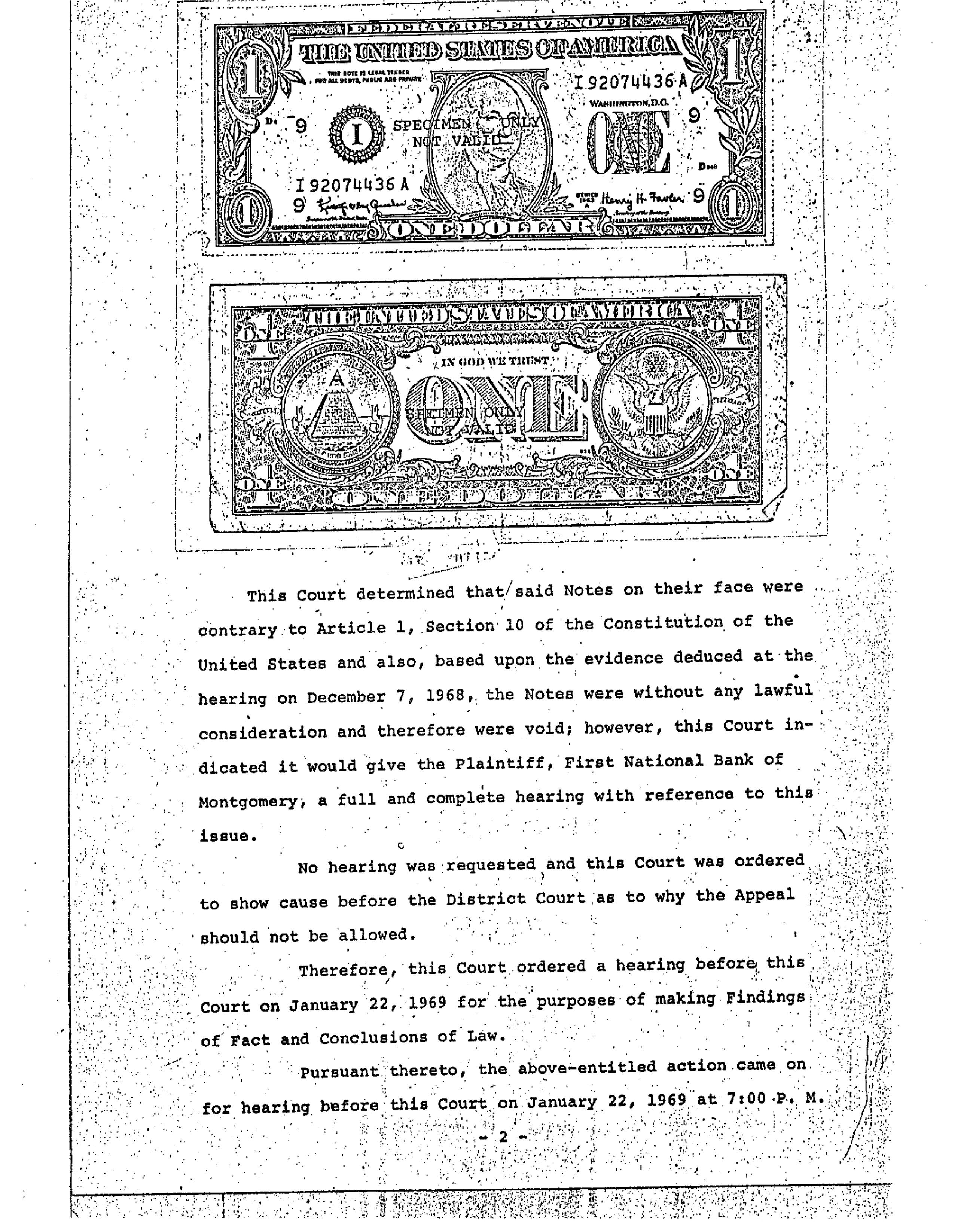
Mahoney's ruling was not a closed door. He explicitly offered the bank a path forward. His notice stated: "If Plaintiff will file a brief on the Law and the Facts with this Court within 10 days, or if Plaintiff will file an application for a full and Complete hearing before this Court on this determination a prompt hearing will be set." If the bank could satisfy him that Federal Reserve Notes were in fact lawful money issued in pursuance of and under the authority of the Constitution, he said he stood "ready and willing to reverse himself in this determination."
The bank had ten days. It used none of them.
It filed no brief. It made no application for a hearing. It did not contest the constitutional analysis or attempt to introduce any authority holding that FRNs satisfied the Article 1, Section 10 tender requirement. Instead, on January 15, 1969, the bank filed an Affidavit of Prejudice.
The bank's appeal was never lawfully perfected from that moment forward. Every procedural move that followed was built on top of an appeal that had no lawful foundation.
Nine days after Mahoney's Notice of Refusal, First National Bank of Montgomery invoked a separate procedural tool: the Affidavit of Prejudice. Under Minnesota procedure, a party who swears that the presiding judge is prejudiced can trigger reassignment to a different judge before a hearing occurs. The affidavit does not require proof of actual bias. Filing it is enough to require transfer.
It moves fast, and in this case it produced the desired result the very next day.
On January 16, 1969, District Judge Harold E. Flynn of the First Judicial District of Minnesota signed an Order Transferring File. The order directed Hugo L. Hentges, Clerk of District Court of Scott County, to forward the entire First National Bank of Montgomery v. Jerome Daly file to McLeod County, specifically to the courthouse in Glencoe, for hearing at the chief judge's next special term on January 24, 1969.
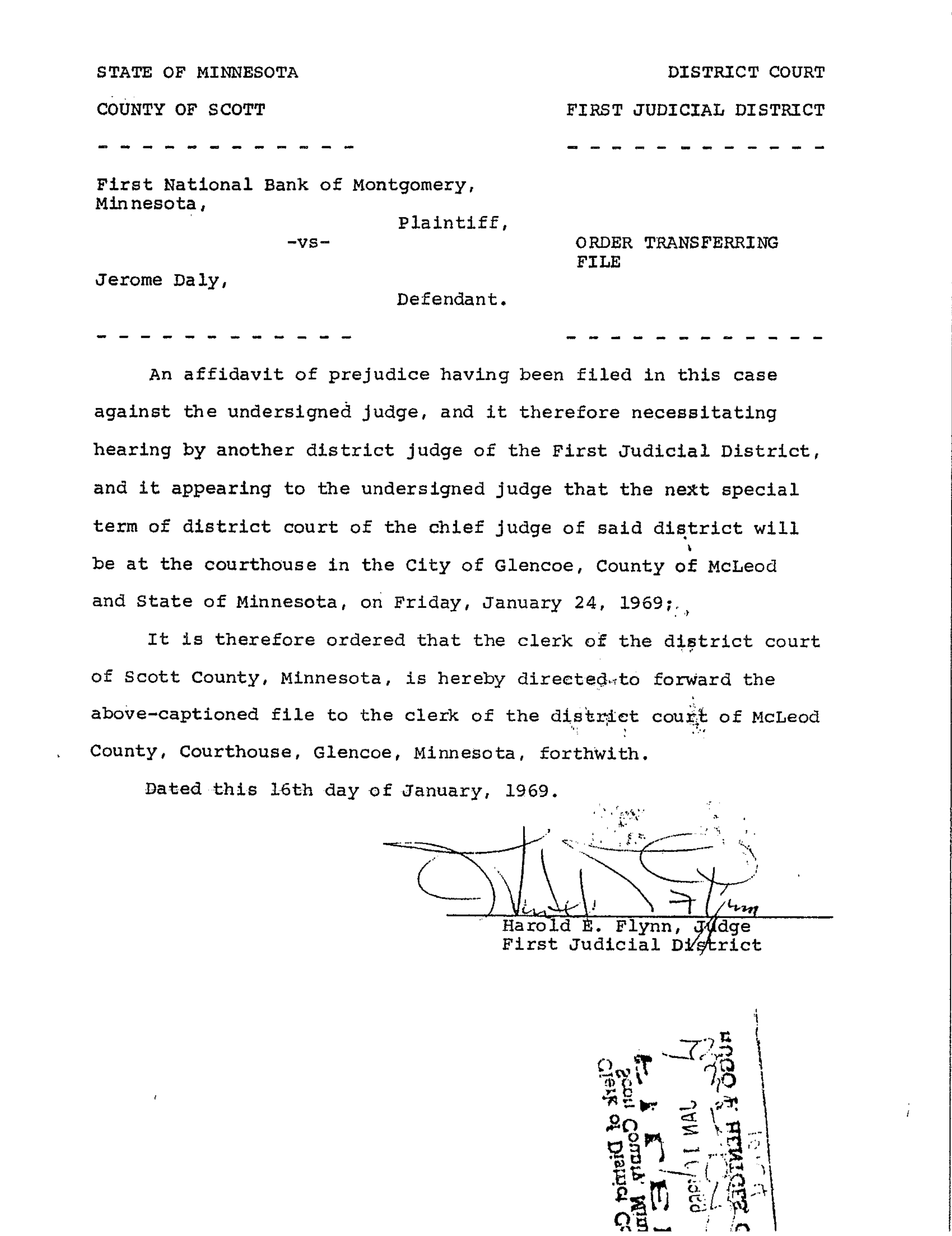
The order is one page. Its substance is procedural. It recites that an affidavit of prejudice was filed against the presiding judge and that hearing by another district judge of the First Judicial District is therefore necessary. Then it directs the transfer. That is all it does.
Judge Flynn did not address Mahoney's January 6 ruling on the Federal Reserve Notes. He did not address whether the bank's appeal had been lawfully perfected under M.S.A. 532.38. He did not address the constitutional question Mahoney had raised about Article 1, Section 10. He did not address the underlying merits of the December 9 judgment at all. The order treats the case as if it is a live appeal properly before the District Court, without examining whether the precondition for that posture had been satisfied.
That precondition had not been satisfied. Mahoney had said so on January 6. The question was whether Mahoney would accept the transfer, or whether he would hold that the transfer order itself was void for lack of jurisdictional foundation.
He held that it was void.
On January 20, 1969, Ralph Hendrickson, cashier of First National Bank of Montgomery, was served with a Motion and Order to Show Cause setting a hearing before Mahoney's court at 7:00 PM on January 22, 1969. Mahoney was not treating the case as transferred. He was proceeding as if his court retained jurisdiction.
The bank was served four days before the hearing. It did not appear. It did not contact the court to request a continuance. It did not send a representative or an attorney. Mahoney waited one full hour in his courtroom on the evening of January 22. Then he proceeded, taking testimony from Daly, who appeared without the bank being present.
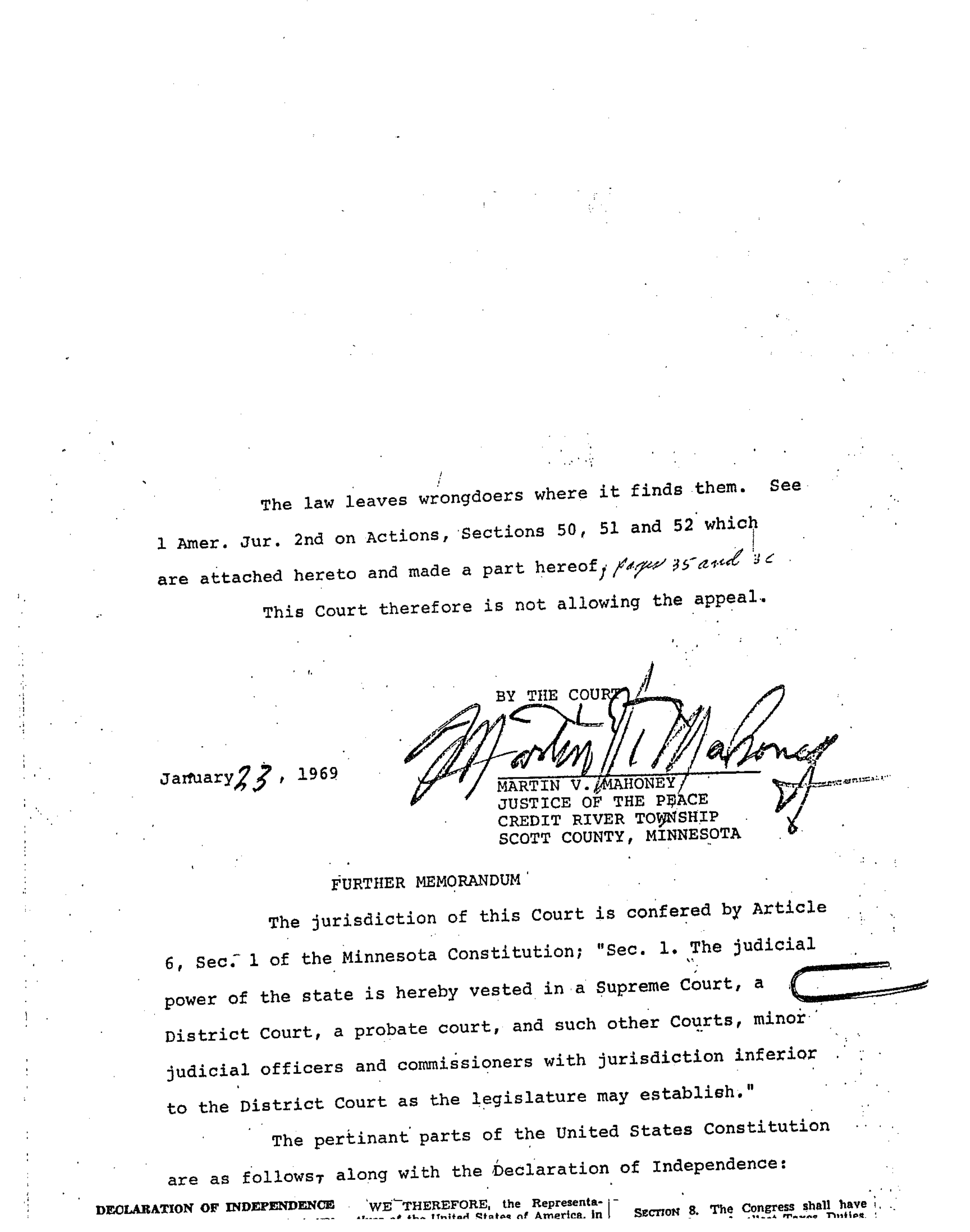
The next day, January 23, 1969, Mahoney issued Supplemental Findings of Fact, Conclusions of Law, and Judgment from the Justice Court of Credit River Township, Scott County. It is the second Mahoney ruling in this case, and in some respects the more doctrinally significant one.
The supplemental judgment opens by narrating the full sequence of events from December 7, 1968 forward: the trial, the original judgment, the Notice of Refusal, the service of Hendrickson, the bank's non-appearance at the January 22 hearing. It then proceeds to its numbered conclusions.
First conclusion: the original December 9, 1968 judgment is confirmed in all respects.
Second conclusion: the two Federal Reserve Note bills tendered as the appeal fee are declared "null and void for any lawful purpose." They are not lawful money, they are in violation of the Constitution, they are "not valid for any purpose." The Notice of Refusal to Allow Appeal is made absolute.
Third conclusion: jurisdiction. This is the core holding that Mahoney used to reject Judge Flynn's transfer order.
"I hold that this case has not been lawfully removed from this Court and Jurisdiction thereof is still vested in this Court."
The reasoning: M.S.A. 532.38 required $2 in lawful tender to perfect the appeal. The bank tendered Federal Reserve Notes that Mahoney had already ruled were not lawful tender. An appeal that was never lawfully perfected confers no jurisdiction on the District Court. Without that jurisdictional foundation, Judge Flynn's transfer order had no legal effect. The case had not left Mahoney's court. It was still in his court.
Fourth conclusion: the bank was estopped from challenging Mahoney's jurisdiction at all. First National Bank of Montgomery had filed the original action in Mahoney's justice court. It had invoked that court's jurisdiction voluntarily. Having asked Mahoney's court to decide the dispute, the bank could not now turn around and claim the court had no authority over the proceeding.
Mahoney then extended his constitutional analysis well beyond what the December 9 judgment had said. The supplemental judgment is where his findings reach their broadest scope:
"The Federal Reserve and National Banks exercise an exclusive monopoly and privilege of creating credit and issuing their Notes at the expense of the public, which does not receive a fair equivalent. This scheme is for the benefit of an idle monopoly and is used to rob, blackmail and oppress the producers of wealth."
And on the banking statutes directly:
"The Federal Reserve Act and the National Bank Act is in its operation and effect contrary to the whole letter and spirit of the Constitution of the United States; confers an unlawful and unnecessary power on private parties; holds all of our fellow citizens in dependance; is subversive to the rights and liberties of the people. It has defied the lawfully constituted Government of the United States. The two banking acts and Sec. 462 of Title 31, U.S.C., are therefore unconstitutional and void."
He also ruled that Title 31 U.S.C. Section 462, which attempts to make Federal Reserve Notes legal tender, is in direct conflict with the Constitution and is therefore unconstitutional and void. He cited Title 12 U.S.C. sections 411, 412, 417, 418, and 420, among other authorities, in support of his analysis.
The December 9 judgment had found that this specific note and mortgage lacked lawful consideration. The January 23 judgment declared the Federal Reserve Act and the National Bank Act unconstitutional and void in their entirety.
Neither ruling was ever reviewed on the merits by any appellate court.
The situation after January 23 was this: Mahoney's court held that the case had not left his court, and he had just issued his most sweeping findings yet. Judge Flynn's court held that the file had been transferred to McLeod County. The Minnesota Supreme Court had not weighed in. No one had resolved the jurisdictional conflict. The bank's appeal remained unperfected.
On April 15, 1969, the Minnesota Supreme Court took the only direct action it ever took on the First National Bank of Montgomery v. Daly file.
Associate Justice Walter F. Rogosheske signed the order. It is one sentence: "Pursuant to said motion, and upon all of the files herein, IT IS ORDERED that the appeal be, and hereby is dismissed."
The caption of the order reads: "First National Bank of Montgomery, Respondent vs. Jerome Daly, Appellant" — case no. 41929. Daly was the appellant. The bank had moved to dismiss Daly's appeal, and the court granted the motion. Mae Sherman, Clerk of the Supreme Court, filed the order the same day.
The bank's own appeal, the one Mahoney had rejected on January 6 for tendering Federal Reserve Notes as the statutory fee, never reached the Minnesota Supreme Court. It was never lawfully perfected. What the Supreme Court dismissed was Daly's separate appeal, apparently from some adverse District Court ruling that occurred after Judge Flynn's January 16 transfer order. Daly was apparently appealing something that went against him in the district-court proceedings that followed the file transfer.
The standard framing of Credit River's legal history says the Minnesota Supreme Court reversed Mahoney's ruling. That is not what this order is. The order contains no merits analysis. It has no discussion of lawful consideration, no discussion of Federal Reserve Notes as legal tender, no analysis of JP-court jurisdiction, and no assessment of either the December 9 or January 23 Mahoney judgments. It is a one-sentence procedural dismissal of Daly's appeal, issued on the bank's motion, with no reasoning whatsoever.
The two Mahoney judgments received no appellate review from the Minnesota Supreme Court, or from any other court.
The April 15 dismissal closed the only Supreme Court path the file had ever found. The bank's own appeal had been unperfected since January. Daly's appeal had just been dismissed without reasoning. The jurisdictional conflict between Mahoney's court and Judge Flynn's transfer order was unresolved and apparently going nowhere. By spring 1969, the bank had exhausted its direct procedural options against the Credit River file.
The next move came from outside the Credit River docket entirely.
Jerome Daly, following the December 1968 win, had brought a similar case in Mahoney's court: Leo Zurn v. Roger D. Derrick and Northwestern National Bank of Minneapolis. Same legal theory, same JP court, same judge presiding. The defendant bank in that case was not First National Bank of Montgomery. It was Northwestern National Bank of Minneapolis, a substantially larger institution.
Northwestern took a different approach than the Montgomery bank had. Rather than attempting to work through the statutory appeal process that had failed in Credit River, Northwestern petitioned the Minnesota Supreme Court for a writ of prohibition, which is an order from a superior court directing an inferior court to stop acting outside the bounds of its jurisdiction. This is a common-law mechanism for supervising courts that are operating beyond their statutory authority.
On July 11, 1969, Justice C. Donald Peterson, acting on behalf of the Minnesota Supreme Court, issued an order staying all proceedings in Mahoney's JP court in the Zurn case pending determination of Northwestern's writ petition. The stay was clear and direct: Mahoney's court was not to proceed with the Zurn case until the Supreme Court resolved whether a writ of prohibition should issue.
On July 14, 1969, Mahoney held a hearing in the Zurn case and entered findings of fact, conclusions of law, and an order for judgment in favor of Zurn. He did this three days after being served with Peterson's stay order.
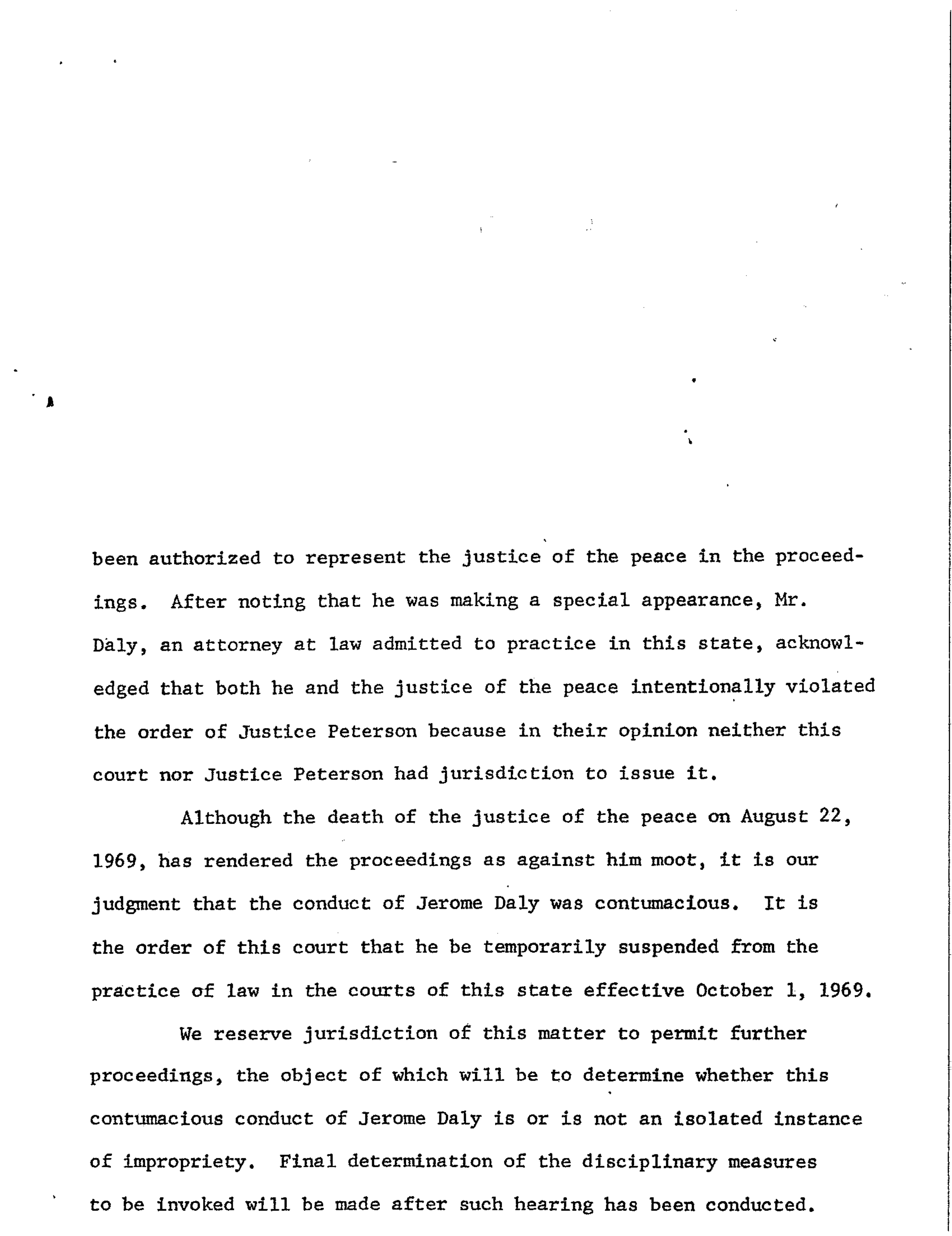
On August 21, 1969, Jerome Daly appeared before the Minnesota Supreme Court and acknowledged that both he and Mahoney had intentionally violated the stay. His defense was that in their judgment, neither the Supreme Court nor Justice Peterson had jurisdiction to issue the stay in the first place. They believed that justice-of-the-peace courts occupied a constitutional status that placed them outside Supreme Court supervisory authority. The Supreme Court, in its later contempt opinion, characterized this reasoning as "fanciful notions that justice of the peace courts have a constitutional status giving them immunity from the jurisdiction of the supreme court."
Daly's legal analysis about JP-court independence from Supreme Court supervisory authority was the same reasoning that had animated the January 23 supplemental judgment. In Mahoney's view, the Supreme Court could not stay proceedings in a JP court because the Supreme Court lacked jurisdiction over JP courts in matters where the JP court's own jurisdictional question was at issue.
The contempt vehicle the court used to respond was not Bank of Montgomery v. Daly. It was a separate proceeding: In re Jerome Daly, Sp. 42174. The Credit River case was not the subject of the contempt. Zurn v. Derrick was. This distinction matters for understanding what the contempt opinion was and was not about.
The per curiam opinion in In re Jerome Daly, issued September 5, 1969, contains a line about Mahoney: "the death of the justice of the peace on August 22, 1969 has rendered the proceedings as against him moot."
August 22, 1969. The proceedings against Mahoney personally were dropped because he had died.
You may have read that Mahoney was poisoned, or that his death was suspicious. The Minnesota Supreme Court opinion gives no cause of death, and no document in the primary docket of First National Bank of Montgomery v. Daly mentions a cause of death. Without a death certificate, coroner's report, or contemporaneous newspaper coverage, the cause is unverified, even if the timing invites suspicion. The contempt proceedings had been ordered on August 12, 1969. Daly's appearance before the court was August 21. Mahoney died the following day. The court mooted the proceedings against him. That is what the primary record shows.
What may have happened is a separate question from what the documents establish. Anyone citing Mahoney's death as assassination should understand that the primary record contains nothing to support that characterization.
The September 5, 1969 per curiam opinion in In re Jerome Daly (Sp. 42174) addressed the contempt that remained live after Mahoney's death. Daly had acknowledged the intentional violation on August 21. His justification, that the court lacked jurisdiction to issue the stay, did not amount to a defense.
Before reaching the question of discipline, the court analyzed the Zurn complaint in detail and identified six separate jurisdictional defects placing it outside JP-court statutory authority under Minn. St. sections 530.05, 531.03, 531.04, and 532.29. The summons was returnable at 7:00 PM rather than between 9:00 AM and 5:00 PM. The summons did not state the amount claimed. Service had been performed on Northwestern National Bank in Minneapolis, a city of more than 200,000 people. Service had been performed outside Scott County without the required 20-day continuance. The amount in controversy exceeded the $100 JP-court jurisdictional limit. And the relief sought, which was declaratory judgment, was outside JP-court equitable jurisdiction.
The court cited Smith v. Tuman, 262 Minn. 149, 114 N.W.2d 73, for the proposition that acts of a JP court in excess of its jurisdiction are nullities subject to writ of prohibition.
Then it reached Daly's conduct directly:
"We are satisfied from the record that the justice of the peace acted upon the advice and at the instance of attorney Jerome Daly. Mr. Mahoney was not admitted to practice as a lawyer. An attorney who intentionally and deliberately advises and encourages a justice of the peace or any other person to disregard an order of the Minnesota Supreme Court is guilty of contempt."
The discipline imposed was a temporary suspension.
"It is the order of this court that he be temporarily suspended from the practice of law in the courts of this state effective October 1, 1969."
The court reserved jurisdiction for further proceedings before referee Hon. E.R. Selnes, District Judge, together with the State Board of Law Examiners, to determine what final discipline should be imposed.
Three things are essential to get right about this.
First: the contempt was for the Zurn stay violation, not for anything that happened in Bank of Montgomery v. Daly. The Credit River judgment itself was never the direct subject of these proceedings. Daly's suspension did not arise from anything Mahoney or Daly did in the Credit River case. It arose from their joint decision to defy Peterson's stay order in the separate Zurn litigation.
Second: "temporarily suspended" is the opinion's exact language. Final discipline was reserved for later proceedings before the referee and the Board of Law Examiners. The outcome of those proceedings is not resolved by any primary document currently in the vault. Whether the suspension was made permanent, modified, or eventually vacated is an open question from the primary sources available. Saying Daly "was disbarred" goes beyond what the September 5 opinion actually ordered.
Third: regardless of how the final discipline resolved, the practical effect as of October 1, 1969 was complete. Daly could not practice law. He could not appear as counsel for new clients. He could not litigate Credit River-style bank-consideration cases on behalf of anyone. The doctrine had two people capable of pressing it: Mahoney, who was dead, and Daly, who was suspended. Both were gone.
On June 19, 1970, both parties to First National Bank of Montgomery v. Jerome Daly signed a Stipulation of Dismissal.
The operative text is one sentence: "The above entitled action is hereby dismissed with prejudice to both parties and without costs to either party."
Two signatures appear on the document. Jerome Daly signed, identifying himself as "Attorney Pro se." Because his suspension had taken effect October 1, 1969, he was signing not as counsel but as a party appearing in his own right. Theodore R. Mellby signed for First National Bank of Montgomery, listing an address at 400 1st Street South, Montgomery, Minnesota. The stipulation was filed by Hugo A. Hentges, Clerk of District Court, Scott County, on June 22, 1970, as File No. 19144.
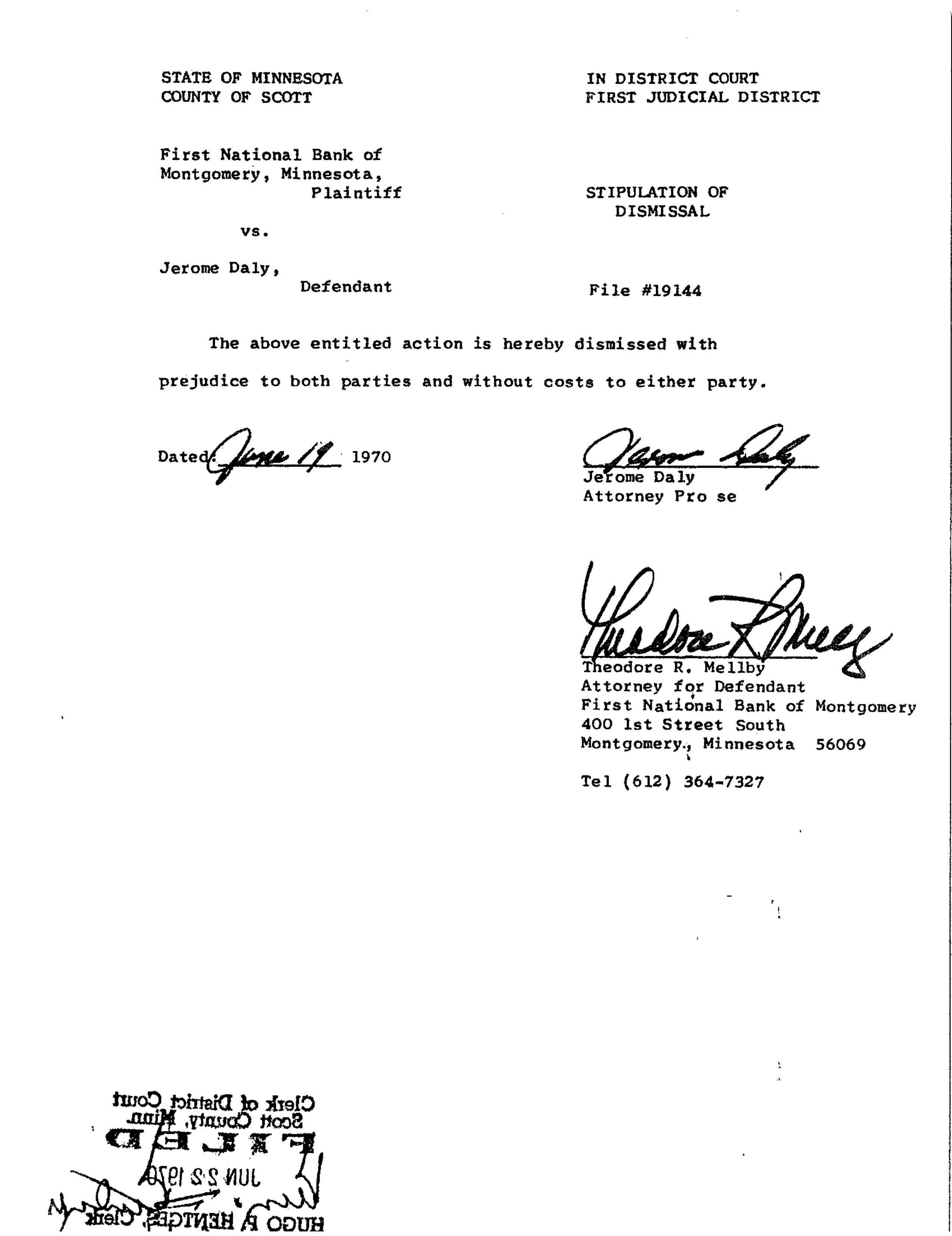
By June 1970 the arithmetic was plain. Mahoney had been dead for ten months. Daly had been suspended from practice for eight months. The bank's original appeal had been statutorily defective since January 1969 and was never cured. The jurisdictional conflict between Mahoney's court and the District Court had never been resolved by any appellate tribunal. No realistic enforcement path existed for either side. Both parties signed and walked away.
Dismissal with prejudice means neither party can refile the same claims. The bank's $14,000 claim against Daly is permanently extinguished. Daly cannot re-litigate the same counterclaim against the bank. But "with prejudice to both parties and without costs to either" is a cease-fire, not a ruling on the merits. The stipulation does not vacate Mahoney's December 9, 1968 judgment. It does not vacate his January 23, 1969 supplemental judgment. Neither of those rulings was the subject of the stipulation. They were simply left on the books, where they remain.
No appellate court reviewed the consideration question. No appellate court addressed whether Federal Reserve Notes satisfied the Article 1, Section 10 tender requirement. No appellate court reviewed Mahoney's holding that the Federal Reserve Act and the National Bank Act are unconstitutional and void. The bank obtained no appellate ruling in its favor. Daly's appeal was dismissed without reasoning. The Mahoney judgments stand exactly as he wrote them.
The suppression was real. What it did not include was any substantive rebuttal. Lawrence Morgan testified under oath that his bank created $14,000 from a bookkeeping entry and could cite no statute authorizing the practice. That testimony was never disputed on the merits in any court. Mahoney's legal analysis of those facts was never addressed by any court with authority to reverse it.
The mechanism that neutralized Credit River was not a better argument. It was the removal of the two people capable of pressing the doctrine forward, through Mahoney's death and Daly's contempt suspension in a separate case. Once both were gone, the parties signed a piece of paper and the case ended.
That is the record. § 3 addresses what survives it.
The case ended in a handshake between a suspended attorney and a bank lawyer. Neither party got anything it had spent eighteen months fighting for. The bank never obtained an appellate ruling vacating Mahoney's judgment. Daly never got his doctrine reviewed on the merits. Both sides signed a piece of paper and left. That is the ending.
What the ending did not include was a rebuttal.
The December 9, 1968 Judgment and Decree (the note, mortgage, and sheriff's sale declared "null and void for failure of lawful consideration") was never reversed by any court. The January 23, 1969 supplemental judgment, which confirmed the December ruling and added Mahoney's broader constitutional findings, likewise received no appellate review. Both rulings remain on the books of Justice Court, Credit River Township, Scott County, Minnesota, exactly as Mahoney wrote them.
That is the precise legal posture. A justice-of-the-peace court bench ruling does not create binding precedent in any other court: not in Minnesota state courts, not in federal courts, not anywhere. JP-court decisions have evidentiary and persuasive weight; they do not function as appellate authority. Anyone who cites the Mahoney rulings as binding precedent is making a claim the record does not support. The rulings stand unreversed. They do not bind.
The distinction matters and § 4 depends on it. What Mahoney's rulings offer is not a prepackaged legal win. They offer two unrebutted factual findings, signed by a sitting judge after a jury verdict, that have never been challenged on the merits in a court with authority to address them.
Lawrence V. Morgan, president of First National Bank of Montgomery, testified under oath on December 7, 1968. When asked what actual cash value the bank had contributed to obtain the promissory note, he answered: "Nothing." When asked how the loan funds came into existence, he answered: "That's how it works." He confirmed, under cross-examination, that the entire $14,000 had been created by bookkeeping entry, that the bank and the Federal Reserve Bank of Minneapolis were for practical purposes the same institution, and that no United States law or statute authorized the bank to create money in this fashion.
Mahoney's memorandum recorded those admissions and built a legal analysis from them. He found failure of lawful consideration, cited Anheuser-Busch Brewing Co. v. Emma Mason, 44 Minn. 318, 46 N.W. 558, rejected the bank's waiver defense, and applied existing Minnesota contract law to Morgan's undisputed admissions.
No court ever addressed those facts. As § 2 documents, the suppression worked by removing Mahoney and Daly, not by producing a better argument against Morgan's testimony. The MN Supreme Court's April 1969 one-sentence dismissal of Daly's separate appeal contains no merits analysis and no reference to Morgan's admissions. The June 1970 stipulation extinguished the parties' claims against each other; it did not vacate Mahoney's findings.
Morgan's sworn testimony and Mahoney's legal analysis have been sitting on the books, untouched, for over fifty years.
In 2003, Walker F. Todd, who had spent twenty years as an attorney and legal officer at the Federal Reserve Banks of New York and Cleveland (Ohio Bar No. 0064539), submitted a sworn expert affidavit in Bank One, N.A. v. Harshavardhan Dave and Pratima Dave, Case No. 03-047448-CZ, Oakland County Circuit Court, Michigan.
Todd was not a fringe critic of the banking system. He had worked the discount window and the open market trading desk from inside the Federal Reserve for two decades. He testified under penalty of perjury, citing GAAP, UCC 1-201(24), 12 U.S.C. § 1813(l)(1), and Federal Reserve publications.
His conclusion about the specific transaction at issue:
"The Plaintiff in fact never lent any of its own pre-existing money, credit, or assets as consideration to purchase the Note or credit agreement from the Defendants." (¶15)
And on what the bank was doing instead:
"The Plaintiff is trying to use the credit application form or the Note to persuade and deceive the Defendants into believing that the opposite occurred and that the Defendants were the borrower and not the lender." (¶17)
Todd's framework goes beyond Credit River in analytical depth. He applied the GAAP Matching Principle: when a bank accepts an instrument as an asset, it must record an offsetting liability. The borrower's note becomes a bank asset; the deposit created in exchange is the matching liability. The loan proceeds came from the note, not from any prior bank funds. He noted the inequality of obligations when the bank extends money of account but demands repayment in money of exchange, and concluded there is "an utter failure of consideration for the 'loan contract'" when the bank monetizes the borrower's signature without contributing pre-existing assets.
This is the closest Credit River has to independent expert confirmation. The Credit River record contains a banker's confession under cross-examination. The Todd affidavit contains a Federal Reserve attorney's sworn expert analysis, under penalty of perjury, with full statutory citation, in a state circuit court. Same factual conclusion. Substantially different credibility weight.
One important clarification before citing either: an expert affidavit is not appellate precedent. Todd's affidavit is sworn testimony from a credentialed Federal Reserve insider describing the same mechanics Mahoney's court found. It is powerful evidence. It is not a court ruling. The Oakland County circuit court entered judgment for Bank One anyway (summary disposition, January 8, 2004, $256,763.35), which is itself informative. The system's response to the Todd affidavit was to sidestep the accounting arguments rather than rebut them, the same pattern Credit River displayed thirty-five years earlier.
The two documents are mutually reinforcing as evidence. Neither is independently binding as law.
The Federal Reserve Bank of Chicago's Modern Money Mechanics (originally 1961, last revised June 1992) was not a third-party commentary on banking. It was the Fed's own public-education workbook on money creation. Daly introduced it as Exhibit C at the Credit River trial. Walker Todd cited it in ¶13 of his affidavit.
The relevant sentence: "What [banks] do when they make loans is to accept promissory notes in exchange for credits to the borrowers' transaction accounts." The booklet explicitly states that "the actual process of money creation takes place primarily in banks" and that "deposits merely [are] book entries." The Chicago Fed published that description for thirty-three years. Withdrawing the booklet did not retract the text. It remains the Fed's on-the-record account of the system the Credit River banker confirmed under oath.
What the Credit River jury found, what Walker Todd confirmed under penalty of perjury, and what the Federal Reserve's own publication describes all reduce to the same proposition: when a bank extends a loan by crediting a deposit account in exchange for a promissory note, the bank has not contributed pre-existing money, credit, or assets to the transaction. The borrower's instrument funds the deposit that funds the loan. The bank monetizes the borrower's signature.
The legal consequence, under standard contract consideration doctrine, is what Mahoney found: a party that contributes nothing of prior value to obtain a note has not provided lawful consideration for it. Todd states the same conclusion in UCC terms: the bank's recordkeeping creates the inference of failure of consideration for the "loan contract." The additional UCC dimension Todd identifies (the inequality between obligations the bank extended in money of account and repayment it demanded in money of exchange) adds a second analytical angle on the same factual reality.
That kernel is the substance. The legal instruments through which it might be pressed in current litigation are covered in § 4. The kernel itself is not a contested proposition. It is described in the Fed's own publications, confirmed by the bank's own officer under oath, and analyzed by a Federal Reserve attorney under penalty of perjury.
The honest close is also the necessary one.
Justice of the Peace Martin V. Mahoney presided over a Minnesota JP court. JP courts are inferior courts of limited statutory jurisdiction. Their bench rulings do not create binding precedent in any court, anywhere. A JP-court finding carries the same precedential weight in a state circuit court or a federal district court as no precedent at all. Unreversed is not the same as authoritative.
The same limitation applies to Walker Todd's affidavit. Todd's credentials are genuine, his analysis is substantive, and his affidavit was submitted under penalty of perjury in a real circuit court case. None of that makes it appellate precedent. It is testimony: persuasive, substantive, credentialed. But testimony is evidence, not a ruling. The Oakland County court entered judgment for the bank without rebutting it.
What this means practically: there is no court ruling anyone can hand a judge today and say "this establishes, as a matter of binding law, that my loan lacked consideration." That ruling does not exist. Credit River's suppression mechanism is specifically why it does not exist. Mahoney's unreversed judgments, Todd's unrebutted affidavit, and the Chicago Fed's Modern Money Mechanics together constitute a substantial evidentiary record supporting a specific factual claim about how bank lending works. They do not constitute case law.
§ 4 addresses what that evidentiary record might be used to accomplish in current disputes. The angles there are research starting points, not prepackaged wins. The difference between those two things is the difference between useful doctrine and the kind of claim that produces sanctions.
This section is a research orientation, not a filing template. It identifies five legal angles that have produced documented results in cases involving bank lending, mortgage enforcement, and consumer debt. For each angle, the goal is the same: give a clear picture of the theory, the case law that supports it, when it fits a given set of facts, when it does not, and what a realistic assessment of success looks like.
The word "might" in the title is load-bearing. Every angle here is a starting point for research or conversation with counsel. None of them is a substitute for analyzing your specific facts, in your specific state, with your specific procedural posture. The difference between a useful legal argument and a sanctions-producing one is usually not the theory; it is whether the theory fits the facts and the forum.
The theory. When a bank originates a mortgage, it does not transfer pre-existing funds. Instead, it accepts the borrower's promissory note as an asset, creates a matching deposit liability on its books, and then issues a check against that deposit. The borrower's own signed instrument funds the transaction. Under basic contract law, consideration must pass from the party claiming benefit of a contract. If the bank lent nothing of its own but received a note worth $200,000, the contractual consideration question is at minimum contestable.
Walker F. Todd, an attorney and legal officer for the Federal Reserve Banks of New York and Cleveland for over twenty years, testified to exactly this under penalty of perjury in Bank One, N.A. v. Dave, Case No. 03-047448-CZ (Oakland County Circuit Court, Michigan, 2003). His affidavit states: "The Plaintiff in fact never lent any of its own pre-existing money, credit, or assets as consideration to purchase the Note or credit agreement from the Defendants." He identified the mechanism as consistent with GAAP matching principles: the bank records the promissory note as an asset, creates a demand-deposit liability of equal value, and issues funds from that deposit. Nothing pre-existing left the bank's possession.
The Credit River case (§§ 1-3 of this dossier) produced the same finding from the bank president's own sworn testimony. Mahoney's December 9, 1968 Judgment found the note and mortgage "null and void for failure of lawful consideration."
Relevant law. UCC § 3-301 defines who is "entitled to enforce" a negotiable instrument. UCC § 3-501 covers presentment. On the consideration question specifically: if the note is the bank's asset from the moment of signing, arguments about whether the bank tendered anything of value in exchange become viable under standard contract formation doctrine.
When it fits. This argument is best deployed in cases involving secured promissory notes where the bank is the original lender and the chain of events mirrors the Credit River fact pattern: the borrower signed a note, the bank booked it as an asset, the bank issued funds, and no pre-existing money changed hands. Mortgage cases in judicial-foreclosure states, where the borrower can raise affirmative defenses and counterclaims before a judgment is entered, present the best procedural window.
When it does not fit. Unsecured consumer credit (credit cards, personal loans) involves a different accounting treatment, and the consideration question is murkier because credit lines often involve revolving balances where value did pass incrementally over time. Cases where the borrower received actual funds, used them, and made payments for years are harder to argue on consideration grounds; courts will look at the full course of dealing. This argument also loses traction where the bank has already transferred the note to a holder in due course, because HDC status under UCC § 3-302 insulates the current plaintiff from many personal defenses.
Honest assessment. At the appellate level, courts have consistently entered judgment for banks without rebutting the Walker Todd analysis. (The Oakland County court did exactly that in Bank One v. Dave.) The system has not yet produced an appellate court that adopted this theory to reverse a money judgment in favor of a bank. That does not make the theory wrong on the facts. It makes it a counterclaim and discovery tool, not a standalone winning argument. Its practical value is in shifting the case posture: forcing the bank's witnesses to testify, creating a record for appeal, and putting pressure on settlements. Used correctly in that capacity, it has been effective.
The theory. Mortgage Electronic Registration Systems, Inc. (MERS) is a private registry established in 1995 to track mortgage transfers among its member banks without requiring recorded public assignments at each transfer. By 2009, approximately 60 million U.S. mortgages were registered in MERS's name. When the foreclosure crisis arrived, MERS began attempting to foreclose in its own name, at which point courts in multiple states issued rulings that have shaped mortgage litigation ever since.
The core doctrine is straightforward. MERS's own Terms and Conditions state that MERS "shall have no rights whatsoever to any payments made on account of such mortgage loans, to any servicing rights related to such mortgage loans, or to any mortgaged properties securing such mortgage loans." If MERS receives no payments and has no interest in the property, it is not a real party in interest. It cannot foreclose. And if MERS cannot assign the note (because it does not hold the note), then an assignment from MERS to a foreclosing trust or servicer is an assignment of nothing.
Cases that support it. Landmark National Bank v. Kesler, 2009 Kan. LEXIS 834 (Kan. 2009) is the foundational appellate holding: a mortgage separated from the note it secures becomes unenforceable, and MERS as mere nominee lacks authority to act as anything other than a straw party. In re Mitchell, Case No. BK-S-07-16226-LBR (Bankr. D. Nev. 2009) produced a 20-page analysis finding MERS's "Certifying Officers" are bank employees (not MERS employees) with no personal knowledge of the loan, which is directly relevant to authentication requirements. MERS v. Southwest Homes of Arkansas, 2009 WL 723182 (Ark. 2009) held that MERS's claimed authority beyond clerical recordkeeping is "a fantasy." Several New York Supreme Court decisions dismissed foreclosures sua sponte (meaning without the borrower even raising the argument) on standing grounds when the MERS chain of assignment failed.
When it fits. Securitized mortgages assigned through MERS, in states with judicial foreclosure, present the strongest opportunity. The borrower needs an active foreclosure case still pending (or appealable) in which the plaintiff's standing can be challenged. Standing challenges must typically be raised early; failure to raise them can waive the argument in some jurisdictions.
When it does not fit. Non-judicial foreclosure states (Arizona, California, Nevada) limit the deployment because there is no court hearing at which to raise the argument. The challenge has to come instead as a quiet title action or wrongful foreclosure cause of action filed by the borrower as plaintiff. Post-sale cases where the foreclosure is already complete face additional procedural hurdles. And where the original lender (not MERS) held the note continuously and can produce it, standing is less contestable.
Honest assessment. MERS standing arguments have produced outright dismissals in documented cases across Kansas, Nevada, Florida, New York, Texas, South Carolina, Arkansas, and Vermont. The theory is mainstream foreclosure defense, not fringe, and courts have consistently applied it as an extension of ordinary standing doctrine. Post-2012 lenders have adapted their practices, and newer loans are less likely to present the same documentary gaps. On pre-2012 loans with MERS in the chain, standing challenges remain viable and worth investigating.
The theory. The Fair Debt Collection Practices Act, 15 U.S.C. § 1692g, requires a debt collector to send a written notice containing the amount of the debt, the name of the creditor, and a statement that the consumer has thirty days to dispute the debt in writing. If the consumer disputes the debt in writing within that window, the collector must stop all collection activity and must either obtain verification of the debt or obtain a copy of a judgment, and mail it to the consumer, before resuming collection.
This is a procedural mechanism, not a constitutional one. It does not require the debtor to prove the debt is wrong. It shifts the burden to the collector to produce documentation confirming their right to collect.
When it fits. The statute applies to "debt collectors" (defined as those regularly engaged in collecting debts owed to another). That definition covers debt buyers (entities that purchase charged-off accounts), collection law firms when they are collecting debts owned by third parties, and collection agencies. It does not cover the original creditor collecting its own debt. When a debt buyer like Midland Credit Management or Portfolio Recovery Associates sends a collection notice, the thirty-day validation clock starts from the consumer's receipt.
Real results are on record. Violations of § 1692g (failing to validate, continuing collection after a written dispute, misrepresenting the debt's status) carry actual damages, statutory damages up to $1,000 per action, and attorney's fees. Courts have found violations for, among other things, threatening or filing suit on a debt the collector knew or should have known was time-barred under state law (§§ 1692e(5), 1692f(1)), and for failing to disclose that a partial payment might restart a limitations period in jurisdictions where that is true.
The statute of limitations interaction. Charged-off consumer debt is frequently sold years after the last payment, meaning the underlying debt may already be unenforceable in court when the collection notice arrives. The § 1692g validation mechanism operates independently of the SOL question: the consumer can demand validation regardless of whether the debt is time-barred, but the SOL status is also relevant. See Angle 4 below.
Practical ceiling. § 1692g is the most immediately deployable tool in this section. The window is fixed (thirty days from receipt of the initial notice), the mechanism is clear (written dispute, certified mail with return receipt recommended), and the collector's obligations after a timely dispute are specific. It does not discharge the debt. It does not produce a judgment in the consumer's favor on its own. What it produces is a documented dispute, a stop on collection activity pending validation, and a paper trail that creates leverage if the collector violates the statute's requirements.
The theory. The right to sue on a debt expires. States set time limits on how long a creditor or debt buyer has to file suit. Once that period passes, the debt does not disappear, but the legal remedy (a court judgment) is no longer available. The debt is colloquially "time-barred" or "zombie debt."
Limitations periods on credit card and open-account debt vary by state. Most states fall in a three-to-six-year range. Some states distinguish between written contracts, oral contracts, and open accounts, with credit card debt sometimes treated as one category, sometimes another, depending on the courts of that state. Several states have recently shortened their consumer-credit limitations periods through legislation aimed specifically at debt-buyer litigation. Confirming the current statute, the current case-law characterization, and the date the SOL begins to run (typically from default or last payment, but not always) is the first step in evaluating any specific debt.
The acknowledgment trap. Many states provide that a written acknowledgment of the debt, or a partial payment, restarts the SOL clock from zero. This is the "zombie debt revival" mechanism. Making any payment on a time-barred debt, or signing anything that acknowledges the debt as owing, can give a collector years of renewed legal enforceability. Receiving a collection call is not an acknowledgment. Sending a validation letter under § 1692g that disputes the debt is not an acknowledgment. Sending a payment, however small, or signing a new payment agreement, is.
The affirmative defense requirement. SOL does not extinguish the debt and does not operate automatically. If a collector files suit on a time-barred debt, the defendant must raise the SOL as an affirmative defense in their answer. A default judgment entered on a time-barred debt is nevertheless a judgment; courts do not sua sponte check the SOL. The burden is on the defendant to raise it.
Honest assessment. The SOL is the most straightforwardly deployable defense in this section for cases involving credit card debt, medical debt, and similar consumer obligations. It is also the most commonly mishandled: defendants who ignore the lawsuit get default judgments entered against them on debts they had every right to defend against. Knowing the SOL, confirming it applies to the specific debt, and raising it on time in the answer is the entire play. No theory required, no novel legal argument, no constitutional question. A defense the law already provides.
The theory. Since the 1990s, most residential mortgages have been securitized, pooled, bundled, and sold into trusts that issue mortgage-backed securities (MBS) to investors. The trust that allegedly owns a borrower's loan at the time of foreclosure may be five or six transactions removed from the original lender. Each transfer in that chain required a proper assignment of both the note and the mortgage, properly executed and in many cases properly recorded, to be enforceable. Where those transfers were not properly documented, the chain of title is broken.
Where the argument is actionable. The most concrete securitization-related arguments are procedural extensions of the MERS standing doctrine already covered in Angle 2. If the foreclosing trust cannot trace an unbroken chain of assignment from the original lender to itself (with endorsed notes at each step and recorded mortgage assignments), then it lacks standing to foreclose in a judicial state. Discovery tools in this context include: demanding production of the pooling and servicing agreement (PSA) that established the trust, confirmation of whether the note was transferred in accordance with the trust's own cut-off date, and the identity of the trust's current custodian for the note.
The PSA cut-off date argument deserves specific mention. MBS trusts typically have closing dates after which no new assets may be contributed to the trust. If the assignment of a mortgage into a trust purports to occur after the trust's closing date, the assignment may be void under the trust's own governing documents, which are governed by New York or Delaware trust law in most cases. Courts have split on whether this is merely voidable (and so the borrower lacks standing to challenge it) or void ab initio (which could affect the trust's standing). The argument requires careful fact-specific analysis.
Where it is not actionable. Securitization arguments alone, divorced from standing and documentation defects, rarely win. Borrowers who argued they should not have to repay a loan because it was securitized lost consistently. The actionable question is not "my loan was securitized." It is "the entity attempting to foreclose cannot prove it owns my loan." The former is not a defense; the latter is.
Practical ceiling. Securitization gap arguments work best as supplemental pressure in cases where MERS chain-of-assignment defects are already present. They rarely win as standalone theories. Their primary leverage is in forcing discovery, which tends to delay proceedings and often produces settlement discussions. Borrowers who have obtained PSAs and traced their loan's purported trust assignment have documented cases where the loan was never actually contributed to the trust as required, which is a potentially dispositive finding if raised in the right procedural posture.
What follows is an orientation to the questions worth asking and the tools worth knowing, for someone in or approaching a foreclosure situation. It is not motion language. It is a research scaffold.
What to ask the lender or servicer. Before or early in litigation, consider:
What to demand in discovery. In a pending foreclosure action, formal discovery typically covers:
Statutes likely to be in play. Beyond the UCC provisions already mentioned: RESPA § 2605(e) provides a qualified written request mechanism that requires servicers to respond to written inquiries within defined time limits, with statutory damages for failure to comply. TILA (Truth in Lending Act) applies to disclosure violations and has its own limitations period. FDCPA applies when a debt collector (as defined by the statute) is involved in the collection. State foreclosure procedure statutes vary considerably and often provide procedural requirements that, when violated, produce dismissal as a remedy.
When self-representation is realistic vs. when it is not. A self-represented litigant can plausibly handle: a § 1692g validation demand sent to a debt buyer, an SOL affirmative defense raised in an answer to a debt-collection suit, and discovery requests targeted at chain-of-title documentation. These are defined procedural steps with clear statutory authority. Active mortgage foreclosure defense in a judicial-foreclosure state (including hearings, summary-judgment oppositions, and counterclaims) is a different level of complexity. The procedural requirements for preserving error for appeal, for getting evidence authenticated and admitted, and for navigating summary-judgment practice are substantial. An attorney familiar with foreclosure defense in the relevant state will handle those steps better than most self-represented litigants.
Several approaches circulate in the same online communities where Credit River and MERS information also circulates. They are not variations on the above; they are distinct schemes with their own legal and criminal risk profiles. Each is listed here because clients and researchers encounter them, and the factual record on each is relevant to any honest assessment.
Accepted for Value (A4V) applied to a tax bill, mortgage, or debt instrument. The theory holds that a consumer can discharge a financial obligation by endorsing the instrument "Accepted for Value" and returning it to the issuer. No court has recognized this as a valid tender or discharge. Courts that have addressed it uniformly treat the filing as frivolous, and the IRS imposes § 6702 penalties of $5,000 per return for frivolous tax submissions. The theory is not a variant of the UCC consideration arguments above; it is categorically different and produces sanctions where those arguments produce litigation.
1099-OID redemption schemes. The scheme involves filing IRS Form 1099-OID against a creditor, treating the face value of a debt as "original issue discount" income withheld at the source, and claiming that amount as a refund on Form 1040. Winston Shrout, the scheme's primary teacher for roughly fifteen years, was sentenced to ten years in federal prison in 2018 in the District of Oregon (Case No. 9:17-cr-00097). Roger Elvick, who developed the scheme in the 1990s, received multiple federal sentences. The relevant statute is 18 U.S.C. § 287 (false claims against the United States), and the sentence exposure is not theoretical.
Form 1099-A "discharge" schemes generally. Filing sequences that frame an IRS Form 1099-A (Acquisition or Abandonment of Secured Property) as a vehicle for discharging a debt — whether by claiming a refund on Form 1040 against a 1099-B or OID, or by other variations on the same general structure — replicate the legal architecture of the Shrout scheme. The IRS treats refund claims of this kind as false claims under 18 U.S.C. § 287, and anyone preparing or assisting with such filings faces felony exposure under 26 U.S.C. § 7206(2). Multiple variants of these schemes circulate under different names and step counts, with the same underlying false-refund mechanism and the same risk profile.
Form 56 demands on judges. Filings premised on the theory that a judge is a "fiduciary" who must file IRS Form 56 (a Notice Concerning Fiduciary Relationship) do not appear in any reported case in which they produced a favorable outcome. Courts have responded with contempt findings, sanctions, and in criminal cases, sentence enhancements.
Sovereign-citizen / SEDM / "invisible contracts" framing. Filings using this vocabulary, including the non-fringed-flag argument, demands that the court identify whether it sits in admiralty, challenges to the court's jurisdiction premised on all-caps name styling, and related tactics, have been rejected in every reported case. Courts have responded with Rule 11 sanctions, contempt, and in criminal cases, sentence enhancements. The documented outcome rate on SEDM-guided litigation is sufficiently consistent to treat as a known result, not a contested question.
Stamping "Accepted for Value" on a court summons, tax bill, or similar. Same family as the A4V theory above. Same outcomes.
Each of these appears effective on YouTube. Each produces sanctions or convictions in real cases. The point of this Case File is the gap between the two.
Consult an attorney for your specific case. The angles in this section are starting points for that conversation, not substitutes for it. Where Decrypted Matrix can help is the conversation itself: the research, the framing, the case law, and the realistic assessment of where a given set of facts fits. The AI link below is the entry point for that.
This Case File represents the current state of Decrypted Matrix Research's primary-source review of the Credit River decision and its 1968-1970 procedural history. Two questions remain open:
If you have access to either of these primary sources, contact [email protected].
This document will be revised as new sources surface. Version history is published at the bottom of every revision.
Version 1.0 — Published April 25, 2026 Decrypted Matrix Research decryptedmatrix.com/credit-river
Version 1.0 · Published 2026-04-25
Download the full Case File as PDF ↓