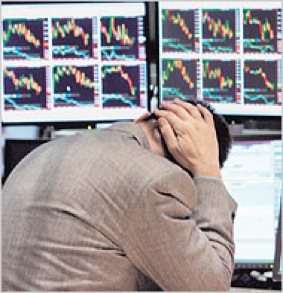
In late 2011, warning signs of an approaching worldwide economic meltdown were impossible to ignore. Western nations had accumulated sovereign debt at levels never before seen in modern history, while financial markets operated like overleveraged gambling operations perched on increasingly unstable foundations. The inevitable reckoning was not a matter of “if” but “when.”
Why Financial Experts Were Sounding the Alarm
Rather than offering yet another analysis, the most powerful way to understand the severity of the moment was to hear directly from the people working inside the global financial system. Their assessments, paraphrased below, painted a picture of extraordinary danger that most ordinary people were simply not aware of.
The epicenter of the looming crisis was Europe. Analysts across continents were pointing to the eurozone as the trigger point for a cascading collapse that could drag the entire Western banking system into chaos.
Meanwhile, the failure of the U.S. Congressional “supercommittee” to reach a deficit reduction deal only amplified global anxiety. Talk of further credit downgrades for American sovereign debt was already circulating. Leadership vacuums on both sides of the Atlantic made an already precarious situation far worse.
17 Expert Warnings That Revealed the Depth of the Crisis
#1 Credit Suisse’s Fixed Income Research team warned that the euro appeared to be entering its final phase in its existing form. While an outright breakup remained unlikely, they cautioned that extraordinary intervention would be needed within weeks to prevent sovereign bond markets across the eurozone from shutting down entirely, potentially triggering bank runs even at the strongest institutions.
#2 Willem Buiter, then serving as Citigroup’s chief economist, stated that time was rapidly running out. He estimated the window at perhaps a few months, possibly only weeks or days, before a major but entirely avoidable default by a country such as Spain or Italy could unleash a financial catastrophe engulfing European and North American banking systems alike.
#3 Jim Reid at Deutsche Bank offered a blunt assessment: if investors did not believe Angela Merkel’s stance would shift, the best investment strategy was essentially to take cover and wait out the storm.
#4 David Rosenberg, a senior economist at Gluskin Sheff in Toronto, observed that lenders were struggling to fund their daily operations through short-term markets. He compared the situation to the 2008 crisis but noted it carried additional layers of complexity.
#5 Christian Stracke, who led credit research at Pimco, described the dynamic as a replay of 2008, when market participants demanded that toxic assets be removed from bank balance sheets.
#6 Economist Paul Krugman, writing in the New York Times, predicted a scenario involving surging Italian bond yields that would trigger massive bank runs driven by both solvency concerns and fears of eurozone exit. He foresaw emergency bank closures leading to Italy abandoning the euro and reinstating the lira, with France potentially next in line.
#7 Paul Hickey of Bespoke Investment Group reported that both individual investors and professionals were increasingly describing the environment as the most challenging they had ever experienced, comparing market behavior to a fish thrashing on dry land.
#8 Bob Janjuah at Nomura International argued that Germany appeared firmly committed to full political and fiscal integration over the coming decade as the sole viable path forward, while ruling out ECB monetization of debt. Even if a policy reversal led to unlimited monetization, Janjuah maintained it would fail to address the eurozone’s fundamental insolvency and growth deficits, instead destroying the ECB’s balance sheet and forcing a recapitalization that would likely drive Germany and its northern partners to abandon the project entirely.
#9 Dan Akerson, then CEO of General Motors, drew a direct comparison between the European debt crisis and the 2008 recession. He characterized the earlier event as a credit bubble expressed through real estate markets, but described the current situation as considerably more serious in nature.
#10 Francesco Garzarelli of Goldman Sachs described how pressure on eurozone sovereign bond markets had been progressively intensifying and spreading with the speed and ferocity of a wildfire.
#11 Legendary investor Jim Rogers cautioned that conditions had deteriorated from bad in 2002 to worse in 2008, and warned that 2012 or 2013 would bring an even more severe downturn.
#12 Dr. Pippa Malmgren, founder of Principalis Asset Management and former adviser to President George W. Bush, provided the most detailed analysis. She noted that market forces were increasingly constraining the options available to policymakers. One scenario under active discussion involved allowing a country to temporarily exit the euro, revert to its national currency, devalue, and then rejoin at improved debt-to-GDP ratios and growth trajectories while retaining EU membership. Malmgren had proposed this possibility as early as 2009, when the idea was universally dismissed. She observed that Germany preferred to remain in the euro while encouraging weaker southern economies to depart. However, if Italy were to leave and devalue, markets would immediately target Spain, Portugal, and Greece. France would face particular vulnerability, given that its three largest banks held approximately 450 billion euros in Italian debt exposure. She concluded that further sovereign defaults were inevitable regardless of the path chosen, and would not have been surprised by a temporary shutdown of Europe’s banking system to work through losses, drawing a parallel to the “bank holidays” of the 1930s.
#13 Daniel Clifton, a policy strategist at Strategas Research Partners, anticipated additional downgrades of U.S. sovereign debt, including initial downgrades from Moody’s and Fitch and a possible second cut from S&P.
#14 Warren Buffett identified what he called a fundamental design flaw in the eurozone system. He argued that words alone would not fix the problem, and that Europe faced a binary choice between deeper integration or a fundamental restructuring of the monetary union.
#15 David Kostin, Goldman Sachs’ equity strategist, advised investors to prepare for worst-case outcomes while maintaining hope for the best, citing the enormous range of possible results from both the supercommittee process and the volatile European political economy.
#16 Mark Mobius, who headed the emerging markets division at Templeton Asset Management, stated with certainty that another financial crisis was approaching.
#17 Gerald Celente, founder of The Trends Research Institute, warned that the entire financial system was headed for collapse and urged people to withdraw their assets from major brokerage and investment accounts.
What These Warnings Meant for the Global Economy
When this many senior financial professionals simultaneously expressed alarm at this level, it deserved serious attention. Their collective message was unmistakable: time was running out, another crisis was certain, it would surpass 2008 in severity, and the entire system was at risk.
The approaching financial collapse was going to be devastating when it arrived. Like in 2008, the experience would feel catastrophic in the moment, but would not represent the final chapter. It would inflict severe damage on global financial systems and economies while still leaving room for eventual recovery.
The analogy of a sand castle being eroded by successive waves at the beach was apt. The once-mighty American economic engine was being progressively hollowed out. The 2008 crisis had delivered a powerful blow, but the country was still standing. The next crisis would leave it in worse condition. And further waves would follow.
The lesson was clear: preparing for economic disruption was not pessimism but prudence. The interconnected nature of modern finance meant that a collapse starting in European sovereign debt markets could rapidly cascade across the Atlantic, threatening jobs and livelihoods worldwide.
This article was originally published on January 27, 2012 and has been rewritten for clarity and originality. Expert assessments sourced from contemporary financial reporting by Bloomberg, CNBC, the New York Times, the Financial Times, and other outlets.