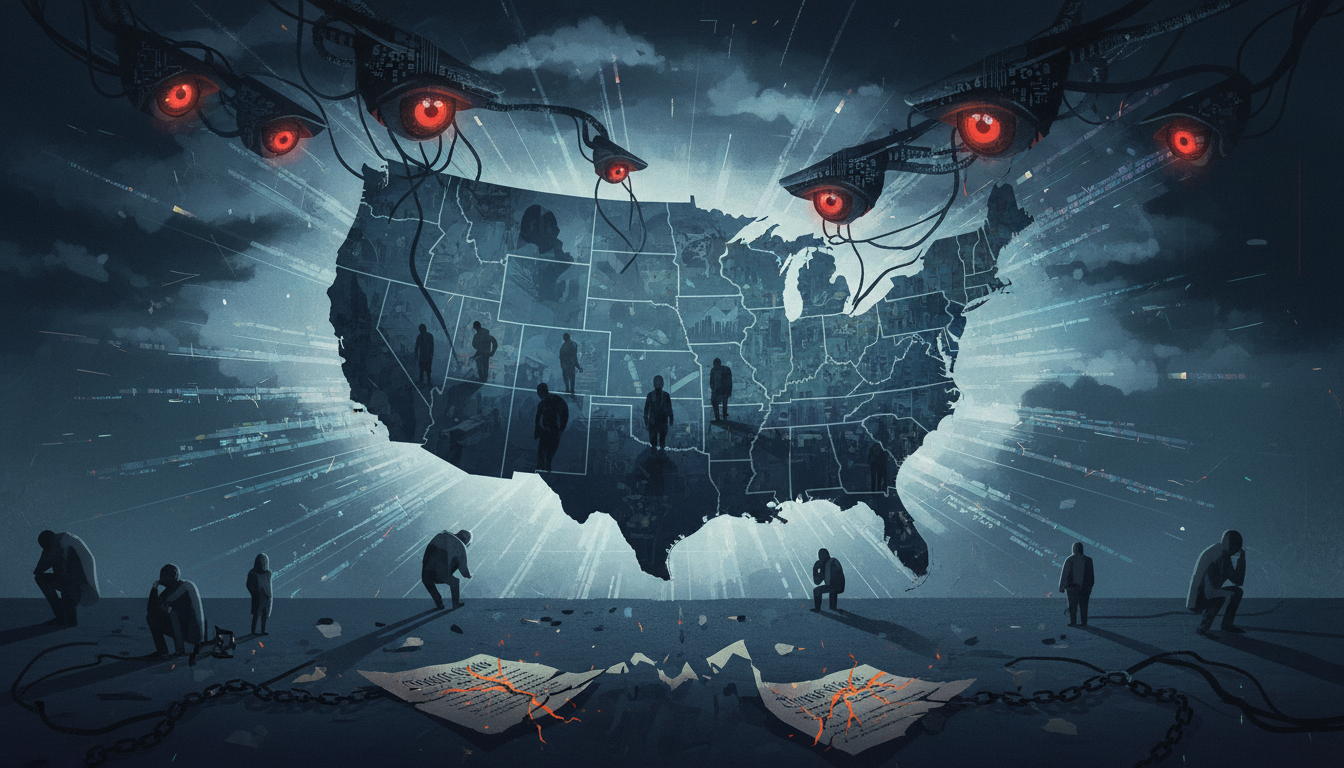
Recent investigations into federal surveillance programs have revealed a systematic transformation of America into what legal experts describe as a “nation of suspects,” where constitutional protections have been systematically eroded through warrantless surveillance operations conducted by multiple government agencies.
NSA’s Domestic Surveillance Network
The National Security Agency employs approximately 60,000 domestic spies, operating under authorities that fundamentally violate Fourth Amendment protections. While the NSA claims to seek warrants from the Foreign Intelligence Surveillance Court (FISA), this process serves as little more than a “fig leaf” for massive warrantless spying operations targeting American citizens.
The FISA Court operates under an unconstitutional standard, issuing warrants based on “probable cause of communicating with a foreign person” rather than the constitutionally required “probable cause of crime.” This lowered threshold has expanded surveillance to Americans who communicate with foreigners “out to the sixth degree,” potentially encompassing hundreds of millions of citizens.
Former NSA agents have publicly revealed that the agency captures “in real time all keystrokes on all digital devices and all fiber optic data transmitted into, out of and within the United States,” creating a comprehensive surveillance infrastructure that operates largely without judicial oversight.
DHS Location Tracking and Biometric Surveillance
The Department of Homeland Security, now a 250,000-person federal police force “nowhere countenanced by the Constitution,” employs sophisticated surveillance technologies that can read fingerprints at 15 feet and irises at 15 inches. When DHS agents interact with individuals in public, they can instantly access bank, health, legal, and commercial records through biometric identification systems.
A damning report from DHS’s Office of Inspector General revealed systematic violations of internal privacy policies in the agency’s use of Commercial Telemetry Data (CTD). The investigation found that Customs and Border Patrol, Immigration and Customs Enforcement, and the Secret Service purchased and used detailed location tracking data while bypassing required privacy impact assessments.
To avoid conducting proper privacy reviews, ICE falsely claimed that commercially available location data was “anonymized” and “not privacy sensitive,” despite the fact that this data creates detailed timelines of device locations using unique Advertising Identifiers linked to individual mobile devices.
Stingray Technology and Mobile Device Surveillance
Federal and local law enforcement agencies deploy devices called Stingrays that mimic cell tower signals to extract location and identifying information from mobile devices. This technology allows real-time tracking of any person carrying a mobile phone, constituting what legal experts characterize as an unconstitutional seizure of private information stored on device computer chips.
Intelligence Operations Target Political Activity
The Department of Homeland Security’s Office of Intelligence and Analysis has repeatedly crossed constitutional boundaries by targeting Americans based on their political activities and viewpoints. During 2020 racial justice demonstrations in Portland, I&A officers conducted broad social media monitoring and accessed immigration, travel, and undisclosed databases to compile dossiers on protesters.
The agency compiled intelligence reports on journalists covering government responses to protests and used a politically motivated presidential proclamation about graffiti to justify surveillance of activists protesting Confederate monuments. More recently, I&A has monitored Americans discussing abortion online and launched programs to identify “dangerous narratives and grievances” on the internet.
These surveillance operations often focus on constitutionally protected political speech, with I&A sharing largely unsubstantiated, and sometimes completely false, information with thousands of police departments nationwide. This dragnet approach sweeps up massive volumes of political information while potentially targeting individuals based purely on their viewpoints.
Systematic Policy Violations
The Inspector General’s investigation revealed a troubling pattern of agencies refusing to follow appropriate technology procurement protocols and lacking internal oversight mechanisms. Federal components systematically disregarded Privacy Impact Assessments required under the E-Government Act, allowing detailed surveillance to proceed without proper safeguards or legal review.
Constitutional Erosion in Practice
These surveillance programs represent a fundamental shift away from the Fourth Amendment’s requirement that government searches be based on individualized suspicion and judicial warrants. Instead, federal agencies have created a surveillance infrastructure that treats all Americans as potential suspects subject to continuous monitoring.
The courts have consistently ruled since the 1960s that surveillance constitutes a “search” and data capture represents a “seizure” under Fourth Amendment protections. However, federal agencies have developed sophisticated methods to circumvent these constitutional requirements through commercial data purchases, technological workarounds, and legal interpretations that stretch existing authorities far beyond their intended scope.
Legal experts note that even border regions are not “Constitution-free zones,” yet federal agencies continue to expand surveillance operations under authorities that directly contradict constitutional protections for all persons within American territory.
The Path Forward
The transformation of America into a nation of suspects reflects systematic failures in oversight and accountability within federal intelligence agencies. Congressional investigations have begun examining these programs, but meaningful reform will require comprehensive overhaul of surveillance authorities and implementation of robust constitutional safeguards.
The current surveillance infrastructure demonstrates how federal agencies can effectively nullify constitutional protections through technological capabilities and legal interpretations that would have been unimaginable to the Constitution’s framers. Without immediate action to restore Fourth Amendment protections, America risks permanent transformation into a surveillance state where privacy and political freedom become historical artifacts.
This article draws on reporting from Activist Post, Electronic Privacy Information Center, Brennan Center for Justice, and American Civil Liberties Union.