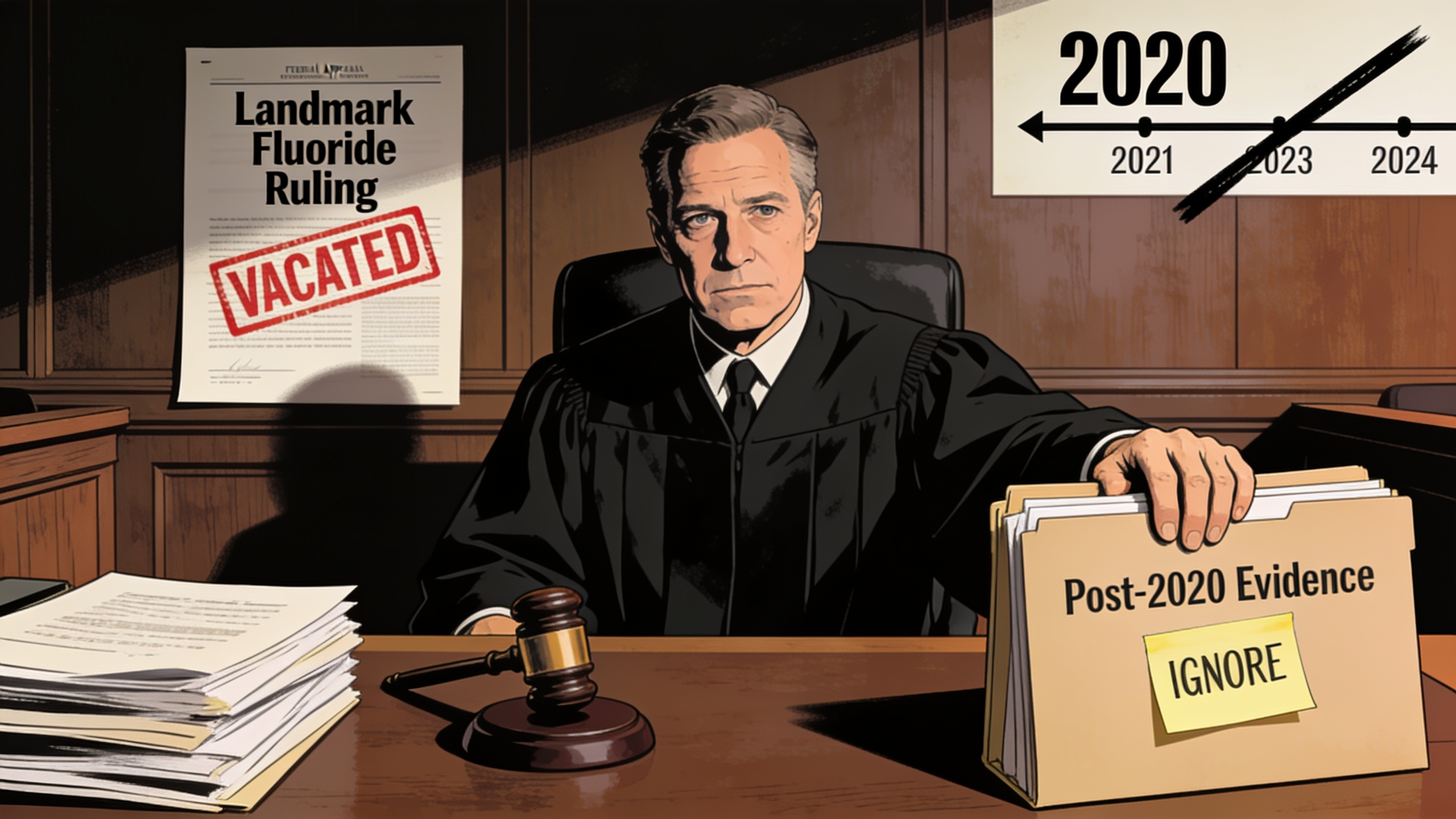
A federal appeals court has overturned a landmark 2024 decision that found fluoridated drinking water poses an “unreasonable risk” to children’s health, but not because of the science. The 9th U.S. Circuit Court of Appeals vacated the ruling on procedural grounds, ordering the lower court to re-decide the case while ignoring years of scientific evidence that emerged after 2020.
The Original Breakthrough Decision
In September 2024, U.S. District Judge Edward Chen made history when he ruled that fluoride at the federally recommended concentration of 0.7 milligrams per liter posed an “unreasonable risk of reduced IQ in children” under the Toxic Substances Control Act (TSCA). The decision came after consumer advocacy groups including Food & Water Watch, the Fluoride Action Network, and Moms Against Fluoridation sued the Environmental Protection Agency for refusing to consider their 2016 petition to regulate fluoride.
Chen’s ruling was unprecedented – marking the first time a federal court disagreed with EPA on fluoride science and ordered the agency to initiate rulemaking under TSCA Section 6(a) to address the identified risks.
Appeals Court Cites “Judicial Overreach”
The three-judge panel of the 9th Circuit found that Judge Chen had “commandeered” the case and violated the “party presentation principle” – a legal doctrine requiring courts to act as neutral arbiters rather than taking control of a case’s factual development. According to the unsigned memorandum disposition issued Thursday, the district court “abused its discretion” by postponing judgment and demanding new evidence through a second bench trial.
Critically, the appeals court did not challenge the substance of Chen’s scientific findings about fluoride’s toxicity to children. Instead, the decision focused entirely on procedural issues related to how the lower court handled the litigation process.
Restriction on Evidence
The case now returns to Judge Chen with strict limitations. The appeals court ordered him to exclude all scientific evidence that became available after 2020, including studies that have emerged in recent years and the final National Toxicology Program monograph that provided much of the evidence supporting the original decision.
Michael Connett, attorney for the plaintiffs, told The Defender that the court “instructed Judge Chen to travel back in time to 2020 and make this ruling based on a stale factual record.” Connett characterized this as “a very expansive and unprecedented application of the party presentation principle” that runs counter to TSCA’s intent to protect Americans from harmful substances.
Industry and Government Response
The American Dental Association applauded the appeals court decision, with ADA President Richard Rosato stating that “the lower court improperly overstepped its role and relied on a pending report, presented by neither party in the case was an abuse of discretion.” The ADA had successfully called for EPA to appeal Chen’s original ruling and filed an amicus brief supporting the agency’s position.
EPA’s press office said the agency “is reviewing the Ninth Circuit’s decision.” The ruling comes as EPA Administrator Lee Zeldin has already launched a separate review of fluoride science under the Safe Drinking Water Act, while Health and Human Services Secretary Robert F. Kennedy Jr. has long challenged federal science supporting water fluoridation.
Broader Implications for Chemical Regulation
The decision has significant implications beyond fluoride policy. This was the first instance of a court ordering EPA to initiate rulemaking under TSCA Section 6(a) in response to a denied citizen petition. Both industry and the federal government had previously argued that Section 21 does not authorize courts to order rulemaking, only fact-gathering risk evaluation processes.
The appeals court’s ruling effectively sidesteps this unprecedented legal question by sending the case back for reconsideration under the original, more limited evidentiary record.
The Science Remains Unaddressed
More than three-quarters of the U.S. population receives drinking water from fluoridated public sources, with the practice supported by the Centers for Disease Control and Prevention as a critical measure to control tooth decay. However, the appeals court’s decision leaves the underlying scientific questions about fluoride’s safety unresolved.
EPA permits public water systems to fluoridate drinking water up to an enforceable maximum contaminant level of 4.0 milligrams per liter under the Safe Drinking Water Act, while HHS recommends fluoridation at 0.7 mg/L for dental benefits.
Connett indicated that his legal team “will be reviewing our legal options in the coming days, including the potential of filing a petition for cert to the Supreme Court.” The attorney emphasized that “EPA did not challenge the factual merits of Judge Chen’s unreasonable risk determination, and, as such, the Ninth Circuit does not either.”
The case highlights the complex intersection of scientific evidence, legal procedure, and public health policy in federal chemical regulation. While the appeals court has reset the procedural timeline, the fundamental questions about fluoride’s safety and the scope of judicial authority in environmental cases remain unresolved.
This article draws on reporting from Activist Post, ADA News, E&E News, and Beveridge & Diamond.