The Official Account of the Fukushima Disaster
On March 11, 2011, a massive earthquake struck off the Pacific coast of Japan, followed by a devastating tsunami that overwhelmed the Fukushima Daiichi nuclear power plant. The event was rated a magnitude 9.0 by the United States Geological Survey, making it one of the most powerful earthquakes in recorded history. The resulting tsunami disabled the plant’s cooling systems, leading to three reactor meltdowns and hydrogen explosions that released radioactive material into the environment.
The disaster was classified as a Level 7 event on the International Nuclear Event Scale, the same rating as the 1986 Chernobyl disaster. It led to the evacuation of hundreds of thousands of residents and prompted Japan to shut down its entire fleet of nuclear reactors for safety reviews.
Questions Raised About the Official Narrative
Independent investigators began raising questions about the official account almost immediately. Several aspects of the disaster attracted scrutiny from researchers who examined high-resolution photographs, seismic data, and the sequence of events at the facility.
The Earthquake Magnitude Controversy
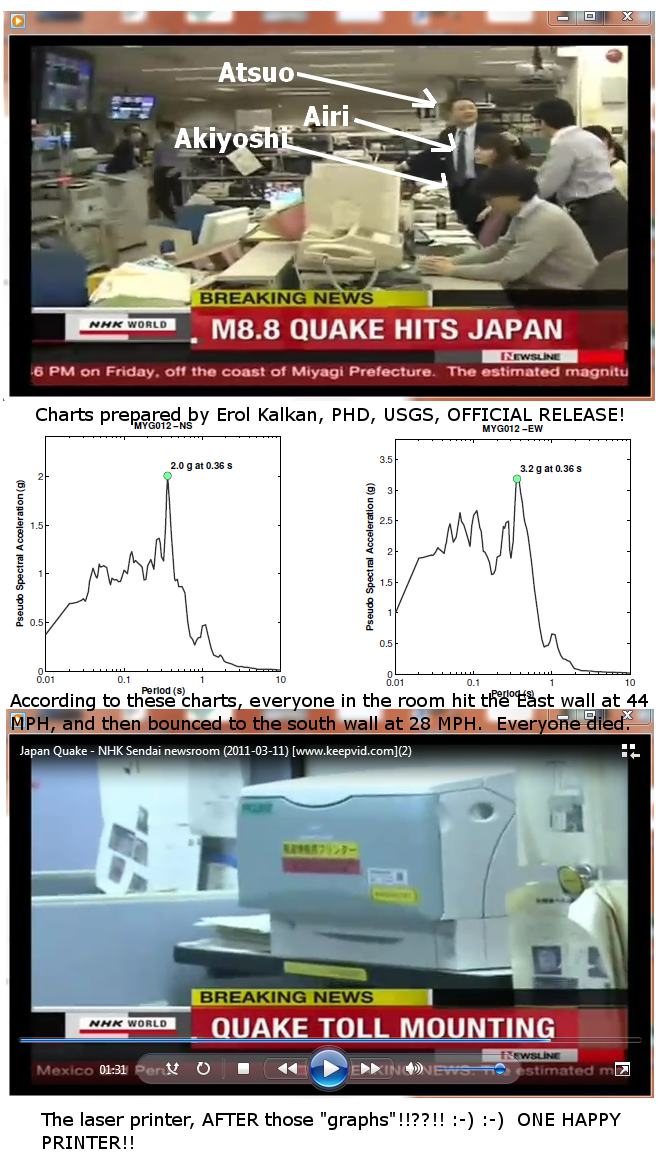
One of the central questions involves the reported magnitude of the earthquake itself. Video footage from an NHK newsroom in Sendai, one of the closest major cities to the reported epicenter, shows staff members experiencing shaking consistent with a moderate earthquake rather than a catastrophic 9.0 magnitude event. In the footage, many workers remain seated at their desks, some continue typing on their computers, and a laser printer remains on its table throughout the shaking.
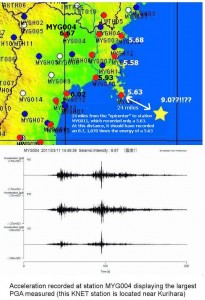
Researchers noted that the earthquake’s reported magnitude was revised upward multiple times in the days following the event: from an initial 6.8, to 7.9, then 8.4, 8.8, and finally 9.0. Each revision moved the epicenter further out to sea. Critics argued that seismic station MYG011, which was closest to the reported oceanic epicenter, recorded readings inconsistent with a 9.0 magnitude event.

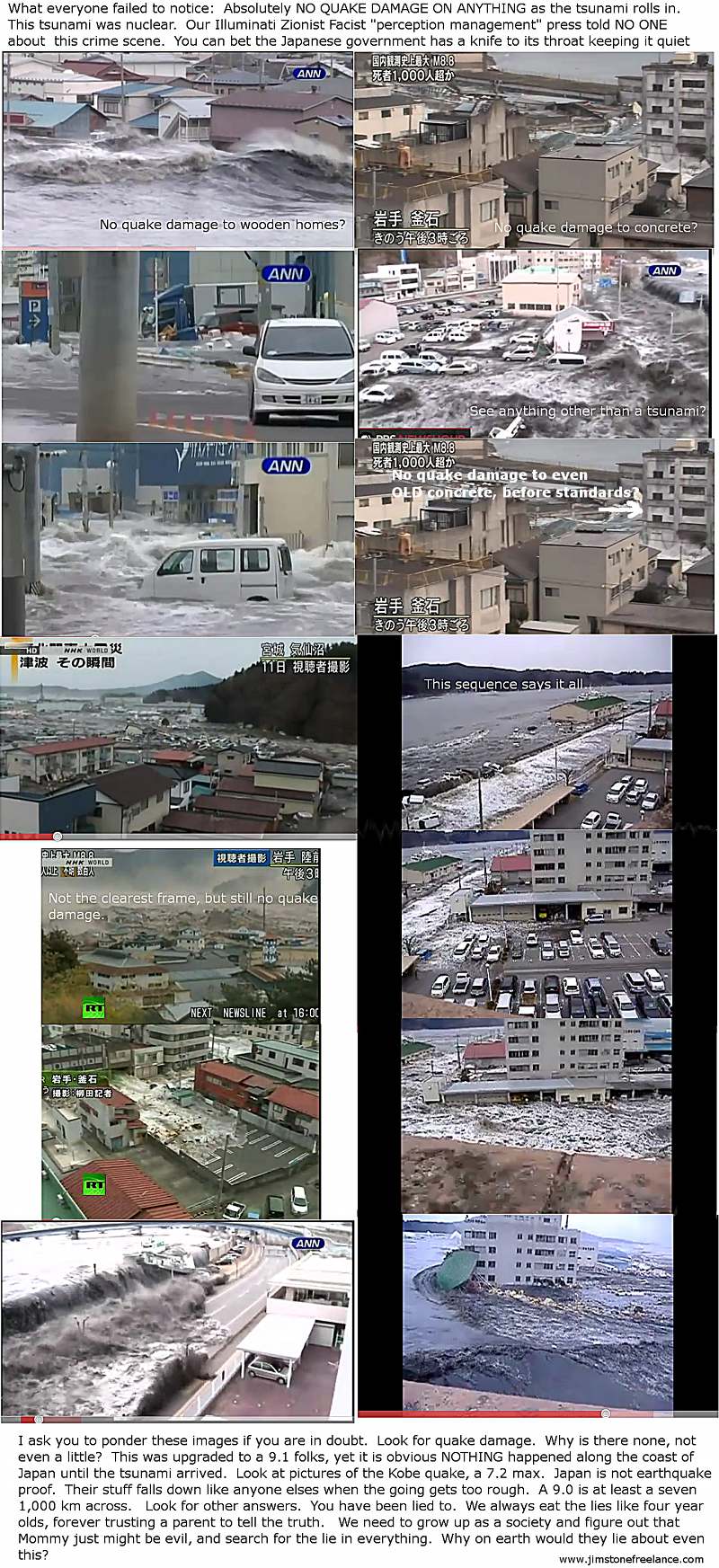
For context, the 1995 Kobe earthquake measured 6.9 and caused catastrophic structural damage throughout the city. A 9.0 earthquake releases roughly 1,000 times more energy than a 6.9. Yet outside the tsunami inundation zone, photographic evidence of structural damage comparable to what Kobe experienced has been difficult to document. Researchers challenged observers to produce photographs of collapsed buildings, downed infrastructure, or structural damage in Sendai or other coastal cities that could be attributed to the earthquake rather than the tsunami.
The Reactor 3 and Reactor 4 Anomalies
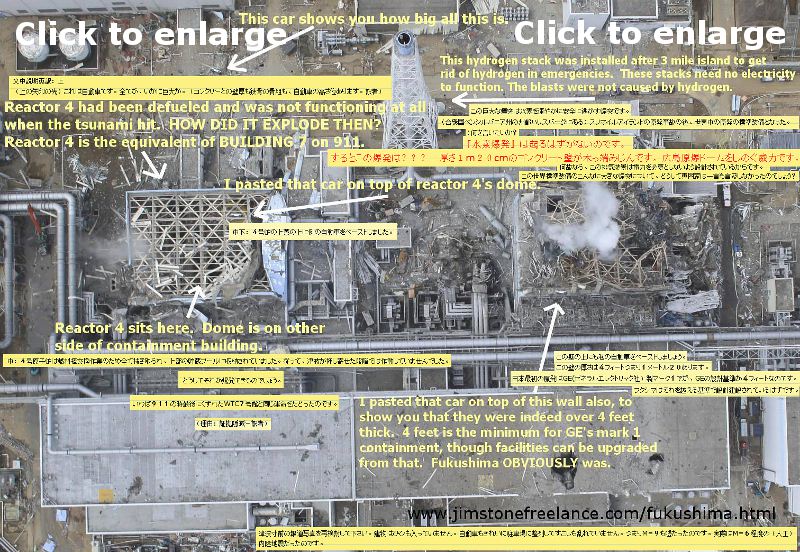
High-resolution drone photographs taken of the Fukushima Daiichi plant after the explosions raised additional questions. Reactor 3’s containment structure was virtually obliterated, with investigators noting that the level of destruction appeared inconsistent with a hydrogen gas explosion. The concrete walls, reinforced with rebar in columns estimated at 15 feet thick, were stripped apart in a manner that some analysts argued required blast forces far exceeding what hydrogen combustion could produce.
Reactor 4 presented an even more puzzling scenario. According to plant records, Reactor 4 had been defueled before the disaster and was undergoing replacement of its internal stainless steel shroud. With no fuel in the reactor vessel, the conventional explanation of a hydrogen explosion from overheated fuel rods interacting with water becomes problematic. In an open fuel pool, water boils off at 100 degrees Celsius, well below the approximately 2,000 degrees needed for the zirconium cladding reaction that produces hydrogen gas.
The Magna BSP Security Contract
Approximately four months before the disaster, an Israeli security firm called Magna BSP, based in the Arava district near Dimona, was contracted to install security systems at the Fukushima Daiichi plant. The company installed large camera units that investigators noted were unusually heavy, reportedly weighing over 1,000 pounds each. Magna BSP described them as “bi-scopic” (stereoscopic) cameras.
Researchers questioned why indoor security applications at a nuclear facility would require stereoscopic cameras of such massive proportions, noting that stereoscopic depth perception is typically needed for long-range outdoor applications, not indoor monitoring where focal lengths are short. Other security camera manufacturers offer stereoscopic units for indoor use that weigh only a few pounds.
It was also reported that Magna BSP had installed an unauthorized data connection to the facility, which the company acknowledged. This connection would theoretically have allowed remote access to facility systems.
The Stuxnet Connection
The Stuxnet computer worm, widely attributed to a joint U.S.-Israeli operation targeting Iran’s nuclear centrifuges at Natanz, was designed specifically to attack Siemens industrial control systems. Fukushima Daiichi used Siemens controllers for its operations. Researchers noted that Stuxnet was known to have spread beyond its intended Iranian targets and had been detected in industrial systems worldwide.
The theory proposed that a modified version of Stuxnet could have been used to interfere with Fukushima’s control systems, potentially displaying false readings to operators while actual conditions deteriorated. This remains speculative, as no direct evidence of Stuxnet infection at Fukushima has been publicly confirmed.
The Geopolitical Context
Investigators pointed to a significant geopolitical development that preceded the disaster. News reports from multiple international outlets, including Ynet News, Inside Japan News Network, The New American, RIA Novosti, Hindustan Times, and Zee News, reported that Japan had offered to enrich uranium for Iran. This offer would have put Japan at direct odds with Israeli strategic interests regarding Iran’s nuclear program.
The timeline is notable: Japan’s offer regarding Iranian uranium was reported, and approximately four months later, the Magna BSP security team arrived at Fukushima Daiichi.
Electromagnetic Weapons and Artificial Seismic Events
Some researchers cited a 1997 statement by then-Secretary of Defense William Cohen regarding the existence of technologies capable of triggering seismic events:
“Others are engaging even in an eco-type of terrorism whereby they can alter the climate, set off earthquakes, volcanoes remotely through the use of electromagnetic waves. So there are plenty of ingenious minds out there that are at work finding ways in which they can wreak terror upon other nations. It’s real, and that’s the reason why we have to intensify our efforts.”
While Cohen’s statement was made in the context of describing potential future threats, it has been cited by researchers as an official acknowledgment that such technologies were at least theoretically possible by 1997.
Assessing the Evidence
The questions raised about Fukushima fall into several categories of varying evidentiary strength:
- Documented facts: The magnitude was revised upward multiple times. Reactor 4 was defueled at the time of the disaster. Magna BSP, an Israeli firm from the Dimona area, installed security equipment at the plant. Japan had engaged in discussions about enriching uranium for Iran.
- Observable anomalies: The level of structural damage at the plant appears severe relative to what hydrogen explosions typically produce. Video footage from Sendai during the earthquake shows moderate rather than catastrophic shaking. An empty reactor (Unit 4) somehow experienced a violent explosion.
- Speculative conclusions: The theory that the earthquake and tsunami were artificially generated, that nuclear devices were disguised as security cameras, and that the disaster was retaliation for Japan’s Iran policy remain unproven hypotheses that go beyond what the available evidence can confirm.
The Fukushima disaster remains one of the worst nuclear accidents in history regardless of its cause. The questions raised here concern not the severity of the event itself, which is beyond dispute, but whether the chain of events that led to it unfolded entirely as officially described. Definitive answers may require the kind of independent, transparent investigation that has yet to be conducted.