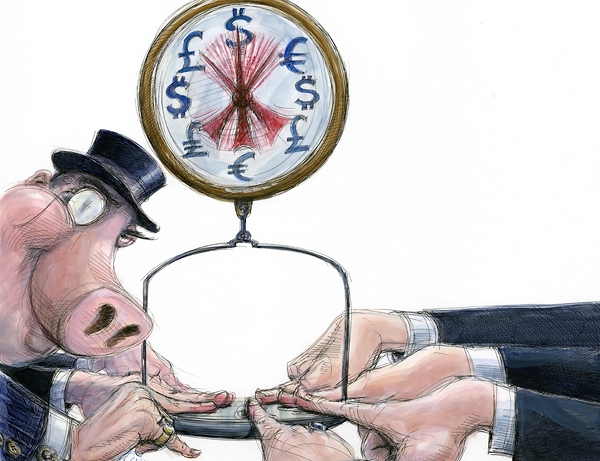
Wall Street’s Hidden Monopoly: How Major Banks Colluded to Rig Global Markets
For years, those who warned that global financial markets were secretly controlled by a small network of powerful institutions were dismissed as conspiracy theorists. But beginning in 2012 and accelerating into 2013, a cascade of regulatory investigations and legal proceedings vindicated many of those concerns. The evidence showed that the world’s most influential banks were not merely bending rules — they were systematically manipulating the benchmarks that underpin hundreds of trillions of dollars in financial transactions.
The Libor Scandal: Manipulating $500 Trillion in Financial Products
The first domino fell with the London Interbank Offered Rate, commonly known as Libor. Investigators discovered that at least three major banks — and potentially as many as sixteen — had been deliberately falsifying the interest rate submissions that determine Libor. Because this benchmark influences the pricing of an estimated $500 trillion in financial instruments worldwide, MIT professor Andrew Lo described the scheme as surpassing “by orders of magnitude any financial scam in the history of markets.”
Libor is supposed to reflect the real cost at which banks lend money to one another. Instead, traders at these institutions were coordinating their submissions to move the rate in directions that benefited their own trading positions — at the direct expense of every borrower, investor, and municipality whose financial products were tied to that number.
ISDAfix: A Second Layer of Market Rigging
As regulators untangled the Libor web, a parallel investigation emerged. The London-based brokerage ICAP, the largest intermediary for interest-rate swaps globally, came under scrutiny from American authorities. The allegation: a small team of brokers at ICAP had potentially conspired with as many as fifteen major banks to manipulate ISDAfix, the benchmark used worldwide to price interest-rate swaps.
The interest-rate swap market represents roughly $379 trillion in assets — approximately one hundred times the size of the entire United States federal budget. Cities, corporations, and sovereign governments rely on these instruments to manage their debt obligations. Any distortion of ISDAfix pricing would ripple through this enormous market, silently extracting wealth from participants who had no way of detecting the manipulation.
The banks under investigation were familiar names: Barclays, UBS, Bank of America, JPMorgan Chase, and the Royal Bank of Scotland — many of the same institutions already implicated in the Libor fraud. Several had previously paid multimillion-dollar penalties for other anticompetitive schemes, including a conspiracy to rig municipal-bond auctions.
Double Manipulation: Corruption Stacked on Corruption
What made the emerging picture particularly alarming was the relationship between these two benchmarks. Because Libor directly influences swap pricing, the simultaneous manipulation of both Libor and ISDAfix meant that customers were being victimized by two overlapping layers of fraud.
Michael Greenberger, a former director at the Commodity Futures Trading Commission (CFTC) and University of Maryland professor, called the situation “the height of criminality” — a compounding scheme where one rigged benchmark fed into another, amplifying the damage at every level.
Gold, Silver, and the Expanding Web of Benchmark Fraud
The revelations did not stop at interest rates and swaps. In March 2013, both the CFTC and the Madrid-based International Organization of Securities Commissions launched investigations into whether gold and silver prices had also been subject to collusive manipulation. CFTC Commissioner Bart Chilton stated publicly that given the coordinated rigging uncovered in Libor, “other benchmarks — many other benchmarks — are legit areas of inquiry.”
Gold prices at the time were determined through a teleconferencing process involving just five banks — a system originally established in part by N M Rothschild & Sons. Silver pricing involved only three banks. These opaque, club-like arrangements offered the same structural vulnerability that had been exploited in the Libor and ISDAfix schemes.
Courts Side with the Banks: A Landmark Dismissal
Perhaps the most troubling development came at the end of March 2013, when a federal judge dismissed a major class-action lawsuit brought against the banks for Libor-related damages. The defense argument that carried the day was remarkable in its audacity: the banks claimed that because the Libor submission process was inherently cooperative rather than competitive, there could be no antitrust violation — even if they had deliberately falsified their numbers.
Judge Naomi Buchwald accepted this reasoning, ruling that Libor was a “cooperative endeavor” that was “never intended to be competitive.” Antitrust attorney Sylvia Sokol of Constantine Cannon called the decision “incredible,” arguing that it completely ignored the competitive reality of the banking market that Libor was designed to reflect.
The ruling stood despite the fact that both American and British regulators had already secured billions of dollars in settlements from three banks that had admitted to improper manipulation.
Treasure Island: The Brokers Who Controlled a $379 Trillion Market
Further investigation into ICAP revealed that the interest-rate swap desk and the critical data entry screen — known internally as “19901” — were controlled by approximately twenty brokers in a New Jersey office. Some of these individuals earned millions of dollars annually, and the unit had acquired the nickname “Treasure Island.”
Roughly 6,000 subscribers worldwide depended on the data entered on that screen to make trading decisions. Unlike regulated exchanges where trade data is published nearly instantaneously, the swap market relied on these brokers to manually and honestly input pricing information. Any intentional delay in data entry would give connected banks a window to trade ahead of the published information — the financial equivalent of knowing the winner of a horse race before the results are announced to the public.
Bloomberg reported that a former ICAP broker witnessed colleagues deliberately delaying the publication of swap prices. ICAP stated it was “cooperating” with the CFTC inquiry and maintained policies prohibiting such conduct.
Systemic Vulnerability: Why Every Benchmark Is at Risk
The structural flaw exposed by these scandals extended far beyond Libor and ISDAfix. Benchmarks for jet fuel, diesel, electric power, coal, currencies, and numerous other commodities all shared the same fundamental weakness: prices determined by voluntary, unaudited submissions from the very institutions that stood to profit from their manipulation.
The European Federation of Financial Services Users warned in an official EU survey that “those markets which are based on non-attested, voluntary submission of data from agents whose benefits depend on such benchmarks are especially vulnerable of market abuse and distortion.”
David Frenk, director of research at Better Markets, a financial reform advocacy group, put it bluntly: “Any of these benchmarks is a possibility for corruption.”
Michael Hausfeld, a lead attorney for the Libor plaintiffs, described what the accumulated evidence revealed: “It’s now evident that there is a ubiquitous culture among the banks to collude and cheat their customers as many times as they can in as many forms as they can conceive.”
The Scale That Hides the Crime
In the United States alone, the top six banks — many of them the same institutions appearing on Libor and ISDAfix panels — held assets equivalent to sixty percent of the nation’s GDP. Their financial power, combined with an apparent willingness to coordinate rather than compete, created a reality that was difficult for ordinary people to fully grasp.
This was not conventional theft — not a hand reaching into a pocket. It was manipulation at the foundational level of the global economy, where a few keystrokes could silently diminish the value of assets held by pension funds, municipalities, corporations, and individual investors worldwide. The full scope of the damage was only beginning to come into view, and as Greenberger warned, the lack of meaningful criminal prosecution was ensuring that the pattern would continue: “There’s no therapy like sending those who are used to wearing Gucci shoes to jail. But when the attorney general says, ‘I don’t want to indict people,’ it’s the Wild West.”
This article is based on reporting originally published by Rolling Stone. All factual claims are attributed to the sources cited.