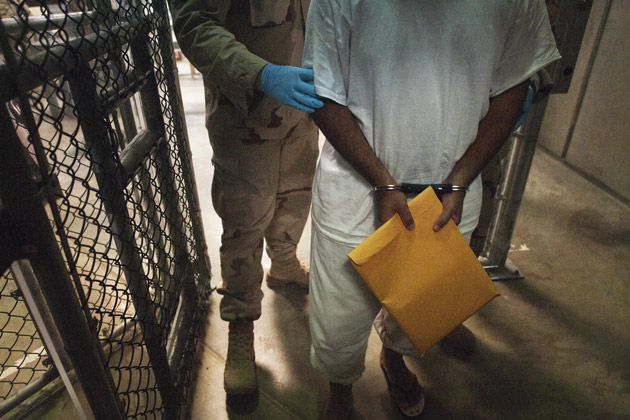
The Government’s Bid to Classify Detainees’ Own Experiences
In 2012, the U.S. government sought to prevent the defendants in the 9/11 military commission trial from publicly describing their own experiences in CIA custody. A newly unsealed motion proposed ground rules for classified information in the trial of Khalid Sheikh Mohammed and four co-defendants, explicitly stating that the accused could not discuss their “observations and experiences” of being held by the CIA — including the “enhanced interrogation techniques” applied to them.
This meant that waterboarding, sleep deprivation, stress positions, and other forms of treatment the defendants personally endured would be treated as classified national security information that the men themselves were prohibited from disclosing.
Presumptive Classification of Everything a Detainee Says
The protective order built on an earlier government position that was even more sweeping. A previous order filed in April 2012 stated that due to the defendants’ “exposure to classified sources, methods, or activities of the United States,” anything the men said was “presumed to contain information classified as TOP SECRET / SCI.”
Under that framework, defense attorneys would have needed approval from a security officer to disclose even basic biographical information — such as a date of birth — if it came from their client. The revised motion eliminated this blanket presumption, instead requiring attorneys to seek review only of information “they know or have a reason to know is classified.”
However, the revised order contained its own expansive provision: when it came to the CIA detention program specifically, the definition of classified “information” explicitly included “without limitation observations and experiences of the Accused.”
Legal Challenges to the Secrecy Framework
The ACLU, multiple news organizations, and defense attorney James Connell challenged the government’s authority to classify detainees’ own statements. The ACLU’s argument was straightforward: the government had forcibly “exposed” these men to the classified information by subjecting them to the interrogation program. The detainees had not volunteered for access to classified methods — they had been the objects of those methods. Binding them to secrecy about their own treatment was, the ACLU argued, legally indefensible.
The civil liberties organization further contended that since the CIA program had been officially discontinued and had been extensively discussed in public — including an official acknowledgment by President George W. Bush in 2006 — there was no compelling national security justification for maintaining the classification.
The 40-Second Broadcast Delay
The secrecy provisions extended beyond the courtroom itself. The government imposed a 40-second delay on all broadcasts of commission proceedings, ostensibly to allow officials to censor any classified information that might be spoken aloud. This delay had been in place since the arraignment proceedings and was opposed by both the ACLU and media organizations who argued it undermined public access to a trial of enormous national significance.
Implications for Transparency and Accountability
Defense attorney Connell described the revised proposal as an “important start” for the attorney-client relationship, acknowledging that the removal of the blanket presumption eased some of the burden on defense counsel. But ACLU attorney Hina Shamsi took a harder line, arguing that the new order “makes explicit what the government is seeking to do — prevent the public from hearing from the defendants’ own mouths their experiences of CIA torture.”
The judge presiding over the military commission, Army Colonel James Pohl, would need to approve the protective order for it to take effect. Pohl had already approved a similar order in the case of Abd al Rahim al Nashiri, charged in connection with the 2000 attack on the U.S.S. Cole. That order was also being challenged by news organizations.
The case raised a fundamental question about government secrecy: whether the state could classify not just its own methods and sources, but the personal experiences and memories of the people those methods were used against — effectively silencing the very individuals best positioned to provide testimony about what had been done to them.