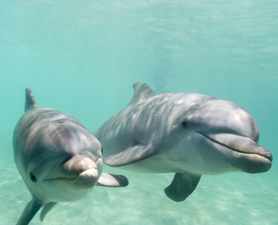
Signature Whistles Serve as Dolphin Introductions
Bottlenose dolphins exchange unique signature whistles when encountering other groups in the open ocean, according to research published in the Proceedings of the Royal Society B. The study provided the first evidence of how free-ranging wild dolphins use these vocalizations during at-sea meetings, revealing behavior that resembles a structured greeting ceremony.
Each dolphin develops its own signature whistle that functions much like a name. These whistles convey basic identifying information and may communicate details such as the individual’s size, age, health status, and intentions. When two groups of dolphins approach each other, one or more animals begin producing their signature whistles, and dolphins from the approaching group respond with their own.
Research Methods and Key Observations
Vincent Janik and Nicola Quick of the University of St. Andrews Sea Mammal Research Unit conducted the study by following wild bottlenose dolphins in St. Andrews Bay off the coast of northeast Scotland. Using a small, quiet boat, the researchers recorded the dolphins’ vocalizations during group encounters.
Their observations revealed a consistent pattern. Dolphin groups typically swam together quietly and at a slow pace. When another group approached, the whistle exchanges began. After this counter-calling period, the groups merged and continued swimming together, becoming noticeably quieter shortly after joining.
Evidence of Group Spokespeople and Complex Communication
One particularly notable finding was that usually only a single dolphin from each group emitted a signature whistle before the groups merged. This suggests dolphins may designate a representative to handle introductions on behalf of the entire group. Janik noted that the other dolphins may not be entirely silent but could be using echolocation rather than whistles during these encounters.
What sets dolphins apart from most other animals is their ability to invent and copy new sounds. Unlike non-human primates, which are limited to species-specific vocalizations, dolphins can create novel acoustic signals. A dolphin’s whistle can be detected by another dolphin from roughly six miles away, even with significant background noise, making acoustic communication especially well suited to their marine environment.
Implications for Understanding Marine Intelligence
Heidi Harley, a bottlenose dolphin expert and professor of psychology at the New College of Florida, described the findings as an important piece in the puzzle scientists have been assembling around signature whistles. She noted that confirming dolphins in groups use these whistles specifically before joining other groups was a significant advance.
The research adds to a growing body of evidence suggesting that dolphin communication systems rank among the most sophisticated in the animal kingdom. While researchers are careful to distinguish dolphin communication from human language, the complexity, flexibility, and social function of these whistle exchanges demonstrate a level of cognitive and social organization that continues to challenge assumptions about animal intelligence.