Rethinking the Legacy of Niccolo Machiavelli
The name Machiavelli has become synonymous with ruthless political manipulation, yet this popular characterization bears little resemblance to the actual writings of the Florentine thinker. Most people who invoke his name have never read his works. The widespread assumption that he championed the idea that any means are justified in pursuit of power is a distortion that overlooks both the depth and the nuance of his political philosophy.
As a product of the Italian Renaissance, Machiavelli was deeply engaged with the project of reviving classical Greek and Roman thought. His political analysis drew heavily from Aristotle, Livy, and the broader tradition of classical republicanism. Far from endorsing tyranny, his writings offer a rigorous examination of how states rise and fall, why leaders succeed or fail, and what role corruption plays in the disintegration of civil society. While The Prince remains his most recognized work, his Discourses on Livy and The Art of War contain equally important — and often overlooked — insights into governance, military strategy, and the mechanics of political conspiracy.
The Cycle of Government: From Order to Collapse
One of Machiavelli’s most enduring contributions is his analysis of the cyclical nature of government. Drawing on classical political theory, he identified six forms of governance — three constructive and three destructive — and argued that each good form carries within it the seeds of its own corruption.
Monarchy degenerates into tyranny when hereditary rulers prioritize personal indulgence over the welfare of their subjects. Aristocracy collapses into oligarchy as the privileged class grows insulated from accountability. Democracy descends into anarchy when individual passions override collective responsibility. This cyclical pattern, which echoes Aristotle’s classification in the Politics, suggests that no form of government is inherently permanent or immune to decay.
What makes this framework particularly relevant is Machiavelli’s insistence that the root cause of political collapse is never the structure of government itself but rather the moral character of the people who operate within it. Laws and constitutions cannot compensate for widespread corruption. When leaders and citizens alike abandon virtue in favor of self-interest, no institutional safeguard can prevent decline. This insight stands as a direct challenge to the modern assumption that political problems can be solved primarily through legislative reform or changes in leadership.
Human Nature and the Limits of Self-Governance
Machiavelli’s assessment of human nature was profoundly skeptical. While the Renaissance broadly celebrated human potential through its rediscovery of classical humanism, Machiavelli took a decidedly less optimistic view of the average person’s capacity for rational self-governance. Influenced significantly by St. Augustine’s theology of original sin, he regarded most people as driven primarily by self-interest, fear, and appetite rather than by reason or civic virtue.
This pessimism placed him firmly outside the democratic tradition. He favored a republican form of government — a mixed system incorporating elements of monarchy, aristocracy, and popular participation — precisely because he believed that no single group could be trusted with unchecked power. His influence on the American founding is well documented; the structure of checks and balances embedded in the U.S. Constitution reflects Machiavellian principles that James Madison and Alexander Hamilton engaged with directly through The Federalist Papers.
The Prince on Conspiracy and the Management of Power
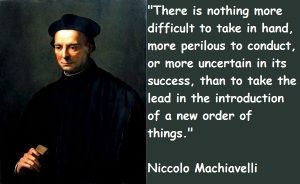
In The Prince, Machiavelli devoted significant attention to the mechanics of conspiracy — not as something to be celebrated, but as a perennial reality of political life that rulers must understand in order to survive. His analysis reveals that conspiracies against a ruler are most likely to succeed when the populace despises its leader. A prince who maintains the genuine goodwill of his people has little to fear from plotters, because any conspirator who moves against a popular ruler risks turning public opinion against himself rather than against the throne.
The dynamics Machiavelli described remain strikingly applicable. A conspirator acts in isolation, relying on secrecy that becomes more fragile with every person brought into confidence. The moment a discontented associate is given knowledge of a plot, that person gains the option of betraying the conspiracy in exchange for personal advantage. The odds, Machiavelli argued, overwhelmingly favor the established ruler — provided that ruler has not made himself odious through cruelty or incompetence.
This is perhaps the most commonly misunderstood aspect of Machiavelli’s thought. He did not advocate that rulers should do anything and everything to cling to power. Rather, he argued that power is most effectively maintained through a calibrated balance of mercy and severity, generosity and discipline. A ruler whose reputation rests on genuine virtue — not merely the appearance of it — creates conditions under which conspiracy becomes irrational and rebellion unprofitable.
The Art of War: Strategy, Deception, and Intelligence
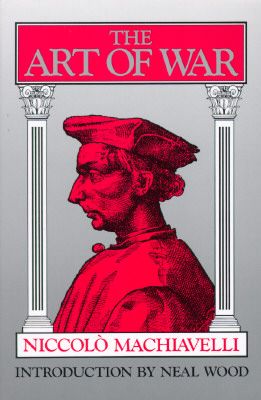
Machiavelli’s Art of War was the first modern treatise to systematically organize military thought, covering everything from camp layout and unit structure to the use of music, flags, and hierarchical command. Its influence on European military doctrine was enormous, establishing organizational standards that would persist for centuries.
Beyond logistics, the work contains penetrating observations about psychological warfare, espionage, and strategic deception that remain instructive for understanding how power operates in any era. Among the tactics Machiavelli catalogued:
- Consulting a potential adversary or internal critic to create the impression of openness while gathering intelligence on their intentions
- Dispatching skilled observers disguised as attendants of a fabricated dignitary to assess enemy capabilities
- Planting false defectors within an opponent’s organization to serve as intelligence assets
- Capturing enemy commanders to extract information about opposing strategies
- Distributing different pieces of false information to suspected informants, then observing which version reaches the enemy, thereby identifying the leak
- Sacrificing a minor position or asset to lull an adversary into overconfidence
- Leveraging religious or superstitious beliefs to bolster troop morale
- Disguising forces as the enemy to create confusion during operations
- Simulating retreat to draw an opponent into a prepared ambush
- Abandoning a position stocked with supplies that have been rendered harmful
- Avoiding pushing an enemy to total desperation, which only produces more ferocious resistance
- Feigning weakness through rumored illness or disorder to invite an overconfident enemy attack
- Employing coded communications that adversaries cannot intercept or decipher
- Using stories and narratives strategically to elevate the fighting spirit of one’s own forces
For Machiavelli, these were legitimate instruments of warfare between states — not tools to be turned against one’s own citizens. The distinction is important. His framework assumed that deception was an unavoidable element of conflict between rival powers, but he simultaneously insisted that a ruler’s relationship with his own people should be built on genuine merit and earned trust.
Corruption, Degeneracy, and the Loss of Power
One of the strongest threads running through all of Machiavelli’s works is his contempt for leaders who mistake luxury for strength and cleverness for wisdom. In his concluding passages on Italian politics, he delivered a withering indictment of the rulers of his own era — men who believed that composing elegant letters, adorning themselves with jewels, surrounding themselves with sycophants, and treating their subjects with arrogant contempt constituted effective governance.
These leaders, Machiavelli wrote, were preparing themselves to become prey for anyone bold enough to challenge them. Their indolence and vanity had hollowed out whatever authority they once possessed, leaving only the outward trappings of power without any of its substance. The lesson was unambiguous: corruption and moral decay in leadership do not merely invite defeat — they guarantee it.
Relevance for Understanding Modern Power Structures
Reading Machiavelli in the context of contemporary geopolitics reveals how little the fundamental dynamics of power have changed since the sixteenth century. The tactics of intelligence gathering, strategic deception, media manipulation, and manufactured public perception that define modern statecraft are refined versions of techniques he documented five hundred years ago.
What Machiavelli could not have anticipated is the scale at which these methods now operate. The nation-state system that formed the basis of his analysis has been supplemented — and in many cases overshadowed — by transnational networks of financial, intelligence, and corporate power that operate across borders with minimal accountability. The surveillance capabilities available to modern governments dwarf anything conceivable in the Renaissance, and the capacity for information manipulation through digital media has created tools of influence that would have astonished even the most imaginative strategist of Machiavelli’s era.
Yet the core principles he articulated remain valid. Conspiracies are not aberrations in political life — they are intrinsic to it. The health of any political system depends not on its formal structure but on the character of the individuals who wield power within it. And rulers who mistake fear for respect, or cruelty for strength, invariably create the conditions for their own downfall. These insights, drawn from classical wisdom and sharpened by Renaissance observation, continue to offer a clear-eyed framework for understanding how power truly operates.