
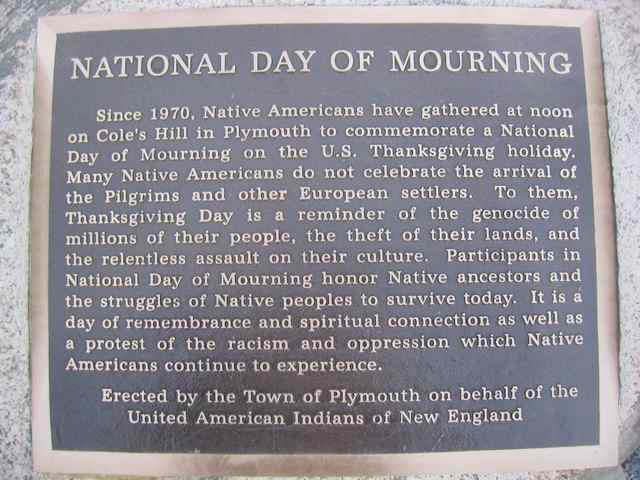
Every fourth Thursday in November, while most Americans sit down for Thanksgiving dinner, a different kind of gathering takes place in Plymouth, Massachusetts. Since 1970, Native Americans from across New England have assembled for the National Day of Mourning, a solemn observance that reframes the Thanksgiving narrative through the lived experience of Indigenous peoples.
Organized by the United American Indians of New England (UAINE), the event serves as both a memorial to Native ancestors and a platform for addressing the ongoing struggles of Indigenous communities. Far from a simple counter-celebration, the Day of Mourning represents decades of activism aimed at correcting what its organizers describe as fundamental distortions in how American history is taught and understood.
The Thanksgiving Story Most Americans Learned
The familiar Thanksgiving narrative, Pilgrims and Native Americans sharing a harmonious meal of turkey, became deeply embedded in American culture during the early twentieth century. As millions of immigrants arrived from southern and eastern Europe, educators and civic organizations used the Pilgrim story as an assimilation tool, presenting the Plymouth colonists as models for new citizens to emulate.
This simplified version of events emphasized mutual cooperation and gratitude while omitting the broader consequences of European colonization. The result was a foundational national myth that persisted largely unchallenged for generations, shaping how Americans understood the relationship between settlers and Indigenous peoples.
What the Historical Record Actually Shows
UAINE has consistently pointed out that the Pilgrims did not arrive in an empty land. Every acre they claimed was already inhabited by Indigenous peoples, primarily the Wampanoag, who had lived in the region for thousands of years. The colonists arrived as part of a commercial enterprise, not merely a quest for religious freedom, and their settlement initiated profound changes in the social structures and power dynamics of the region.
The first official “Day of Thanksgiving” was proclaimed by Governor John Winthrop in 1637, not to celebrate a peaceful harvest meal but to mark the return of colonial soldiers from Mystic, Connecticut, where more than 700 Pequot men, women, and children were killed in what the Pequot people have called a massacre. President Abraham Lincoln later formalized the holiday in 1863 during the Civil War.
UAINE representatives have also noted that the Jamestown colony, established before Plymouth, was never adopted as the basis for a national founding myth. The circumstances there, which included starvation so severe that settlers reportedly resorted to cannibalism, were too grim to serve as the foundation for a unifying national story. Even within the Plymouth narrative, historians acknowledge that the Pilgrims would not have survived their first years without direct assistance from the Wampanoag.
The Speech That Launched a Movement
The National Day of Mourning originated in 1970, the 350th anniversary of the Pilgrims’ arrival on Wampanoag land. Massachusetts planned an elaborate celebration of what it framed as the friendly relationship between English colonists and Native peoples. Wampanoag leader Wamsutta (Frank James) was invited to speak at the official ceremony.
When anniversary organizers reviewed his prepared remarks in advance, they rejected the speech. According to UAINE, the stated reason was that “the theme of the anniversary celebration is brotherhood and anything inflammatory would have been out of place.” Wamsutta’s speech drew directly from a Pilgrim’s own written account of the first year, which documented the opening of Native graves, the seizure of corn and bean supplies, and the sale of Wampanoag people into slavery.
Rather than deliver the sanitized replacement speech prepared by a public relations representative, Wamsutta and his supporters gathered at nearby Cole’s Hill, overlooking Plymouth Harbor and a replica of the Mayflower. There, beside the statue of Massasoit, the Wampanoag leader who had greeted the Pilgrims, Wamsutta delivered his original remarks. This act of dignified defiance became the first National Day of Mourning.
Decades of Continued Observance
The observance has continued every Thanksgiving since 1970, typically drawing several hundred participants to Cole’s Hill. Wamsutta’s son later took up an active role in the annual gatherings, which follow a consistent format: a midday march through Plymouth’s historic district, followed by invited speeches from Native leaders and a communal gathering.
The protests have not always proceeded peacefully. In 1997, state troopers and police confronted participants at the 28th National Day of Mourning. Accounts describe pepper spray being used on children and elderly attendees. Twenty-five people were arrested on charges including battery on an officer and assembling without a permit. The confrontation led to a formal settlement in October 1998, in which authorities agreed that UAINE could march without a permit as long as advance notice was provided.
The 35th National Day of Mourning in 2004 was dedicated to Leonard Peltier, a Native American activist serving two consecutive life sentences for the killing of two FBI agents, a case that many Indigenous rights advocates have long argued involved serious procedural injustices.
A Question That Remains Open
When asked whether the protests would ever end, UAINE co-leader Moonanum James offered a comprehensive answer at the 1998 observance. The protests would stop, he said, when Plymouth merchants no longer profited from the legacy of colonization, when Native nations could exercise genuine sovereignty without federal interference, when corporations stopped polluting the earth, when racism was eradicated, when homelessness was eliminated, and when political prisoners were freed.
The breadth of those conditions reflected the Day of Mourning’s evolution from a single act of historical correction into a broader platform for social justice advocacy. For its organizers, the event was never solely about Thanksgiving. It was about challenging Americans to confront uncomfortable truths about the nation’s founding and the ongoing consequences of those foundational acts.
Whether one agrees with UAINE’s framing or not, the National Day of Mourning has succeeded in its original educational mission. The simplistic Thanksgiving narrative that went virtually unchallenged for most of the twentieth century is now routinely examined, debated, and supplemented in schools, media, and public discourse across the country.