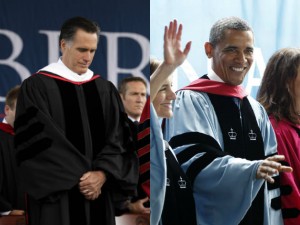
The 2012 Election Offered Voters No Real Alternative
The 2012 presidential race presented American voters with one of the most disheartening electoral choices in modern history. At a moment when the country desperately needed a genuine shift in leadership direction, both major parties ensured that would not happen. Democrats put forward an incumbent with a deeply problematic record, while Republicans nominated the candidate who most closely mirrored him on virtually every major policy question.
Projections at the time suggested that as many as 90 million eligible Americans might sit out the election entirely, a staggering figure that reflected growing disillusionment with the two-party system’s habit of presenting voters with a “lesser of two evils” scenario every four years.
Despite the attack ads and heated debate performances, Obama and Romney represented two sides of the same political establishment. The following forty policy positions demonstrated just how indistinguishable they truly were.
Economic and Fiscal Policy Overlap
- Both Obama and Romney voiced support for the Troubled Asset Relief Program (TARP), the massive Wall Street bailout enacted during the 2008 financial crisis.
- Romney backed Obama’s economic stimulus legislation, breaking from the Republican orthodoxy that opposed government spending programs.
- Romney went so far as to claim the Obama administration’s auto industry rescue was originally his concept, attempting to take credit for a policy he had publicly criticized.
- Neither candidate put forward a plan to immediately balance the federal budget, with both proposing continued deficit spending for the foreseeable future.
- Both men demonstrated a preference for expansive government. Their respective records in office showed consistent patterns of heavy spending on government programs.
- Obama and Romney were unified in their full-throated support for the Federal Reserve system and its central role in monetary policy.
- Both men stated publicly that sitting presidents should not question or challenge the operational independence of the Federal Reserve.
- Each candidate praised Federal Reserve Chairman Ben Bernanke’s handling of the 2008 financial meltdown, despite widespread criticism of the Fed’s role in enabling the crisis.
- Both believed Bernanke deserved reappointment to a second term leading the nation’s central bank.
- Neither Obama nor Romney supported conducting a comprehensive audit of the Federal Reserve’s operations and balance sheet.
- Both candidates went on record saying Treasury Secretary Timothy Geithner — a figure closely associated with Wall Street’s revolving door — had performed his duties well.
Healthcare, Taxes, and Wall Street Connections
- Obama and Romney both championed universal healthcare coverage throughout their political careers, making their debate-stage disagreements ring hollow.
- Romney designed the Massachusetts healthcare framework that served as the direct blueprint for the Affordable Care Act, making his opposition to “Obamacare” fundamentally contradictory.
- Wall Street financial firms showered both campaigns with enormous donations, ensuring that regardless of the winner, the banking industry would maintain its privileged access to the Oval Office.
- Neither candidate proposed eliminating the federal income tax or disbanding the Internal Revenue Service.
- Both men’s tax proposals would have kept personal income tax rates unchanged for the overwhelming majority of working Americans.
- Obama and Romney each expressed openness to implementing a Value Added Tax — an entirely new federal consumption tax that would burden everyday consumers.
Civil Liberties and National Security Agreements
- Both candidates praised the Transportation Security Administration’s airport screening procedures, despite widespread public frustration with invasive pat-downs and body scanners.
- Obama and Romney jointly supported the National Defense Authorization Act (NDAA), including its controversial provisions for military detention of civilians.
- Both backed renewal of the Patriot Act’s sweeping surveillance authorities, extending government power to monitor communications without traditional warrant requirements.
- Each candidate maintained that the federal government should retain the authority to hold American citizens indefinitely without charge if they were designated as terrorism suspects.
- Both men accepted the principle that a sitting president could authorize the killing of American citizens suspected of terrorism without any judicial proceeding or trial.
- Obama failed to fulfill his campaign promise to close the Guantanamo Bay detention facility, while Romney advocated expanding it to hold twice as many prisoners.
- Both candidates endorsed the practice of extraordinary rendition — secretly transferring detainees to foreign countries where interrogation methods banned under U.S. law could be applied.
Trade, Immigration, and Foreign Policy Alignment
- Obama and Romney both championed the corporate-backed “free trade” agenda that critics argued accelerated American job losses to lower-wage countries.
- Each campaign accused the other of outsourcing American jobs overseas — and both accusations had merit, as each candidate’s record included support for policies that facilitated offshoring.
- Neither candidate proposed meaningful enforcement measures against illegal immigration, maintaining what critics described as deliberately permissive policies.
- The 2012 contest marked the first presidential election since 1944 in which neither major-party nominee had any personal military service experience.
- Both candidates held degrees from Harvard University, reinforcing the perception of an insular political elite drawn from the same institutions.
Environment, Social Issues, and Executive Power
- Obama and Romney both publicly accepted the scientific consensus on human-caused climate change, though Romney hedged his position repeatedly on the campaign trail.
- Romney indicated willingness to support a cap-and-trade carbon pricing system — the same market-based emissions reduction approach that Obama favored — provided it was adopted globally.
- Both candidates maintained lengthy records supporting restrictive gun control measures, despite Romney’s later attempts to court Second Amendment voters.
- Each man spent most of his political career supporting abortion access. Romney’s late-career conversion to a pro-life stance drew skepticism, particularly given that Bain Capital — the private equity firm he founded — had profited from an investment in Stericycle, a company that disposed of aborted fetal tissue from reproductive health clinics.
- Both candidates publicly opposed the Boy Scouts of America’s policy prohibiting openly gay individuals from serving as troop leaders.
- Obama and Romney each endorsed the two-state framework as the path to resolving the Israeli-Palestinian conflict.
- Both had track records of appointing or nominating judges widely considered to be ideologically liberal.
- Romney, like Obama, planned to attach presidential signing statements to legislation — interpretive documents that effectively allow the executive branch to redefine the scope of laws passed by Congress.
- Neither candidate could point to a strong record on job creation during their respective tenures in office.
- Both asserted that the president possessed the constitutional authority to initiate military action abroad without first obtaining congressional authorization.
- Obama and Romney each proposed budgets that would continue adding to the national debt, which had already surpassed $16 trillion at the time of the election.
What the 2012 Election Revealed About American Politics
The striking overlap between these two candidates on forty major policy questions exposed a fundamental problem in American electoral politics. Voters were presented with the appearance of choice while the underlying policy direction remained essentially fixed. Whether labeled Republican or Democrat, the 2012 nominees shared a commitment to Federal Reserve independence, expansive executive power, interventionist foreign policy, Wall Street-friendly economics, and the erosion of civil liberties in the name of national security.
The projected 90 million non-voters were not simply apathetic — many had correctly identified that the system was not offering them a meaningful alternative.
Originally adapted from analysis published at The End of the American Dream and White Owl Conspiracy (August 2012). Content has been independently rewritten and expanded by DecryptedMatrix editorial staff.