What Was Operation Mockingbird?
Operation Mockingbird was a large-scale CIA program that began in the early years of the Cold War and sought to influence American and international media for propaganda purposes. The operation recruited leading journalists, funded student and cultural organizations, and used front groups to shape public opinion in ways favorable to U.S. foreign policy objectives.
The program’s existence came to light through a combination of investigative journalism, congressional investigations, and declassified government documents, though the full scope of the operation remains a subject of historical debate.
Origins and Early Operations
According to author Deborah Davis, whose 1979 biography of Washington Post owner Katharine Graham first brought widespread attention to the program, Operation Mockingbird was created by Frank Wisner, director of the Office of Policy Coordination, a covert operations unit established in 1948 by the National Security Council.
The program was reportedly developed as a response to Soviet propaganda efforts, including the International Organization of Journalists, which Davis described as a Communist front organization that “received money from Moscow and controlled reporters on every major newspaper in Europe, disseminating stories that promoted the Communist cause.”
Wisner recruited Phil Graham, publisher of the Washington Post, to help manage the program within the American media industry. Davis claimed that by the early 1950s, Wisner had cultivated relationships with influential figures at the New York Times, Newsweek, CBS, and other major media outlets. After Cord Meyer joined the CIA in 1951, he reportedly became the operation’s principal coordinator.
The Scale of CIA-Media Relationships
In a landmark 1977 Rolling Stone article titled “The CIA and the Media,” reporter Carl Bernstein documented the extent of the agency’s media network. By 1953, under CIA Director Allen Dulles, the operation had significant influence over 25 newspapers and wire agencies.
The standard method of operation involved placing reports developed from CIA-provided intelligence with cooperating or unwitting reporters. Those reports would then be repeated, cited, and amplified throughout the media ecosystem via wire services and cross-publication referencing.
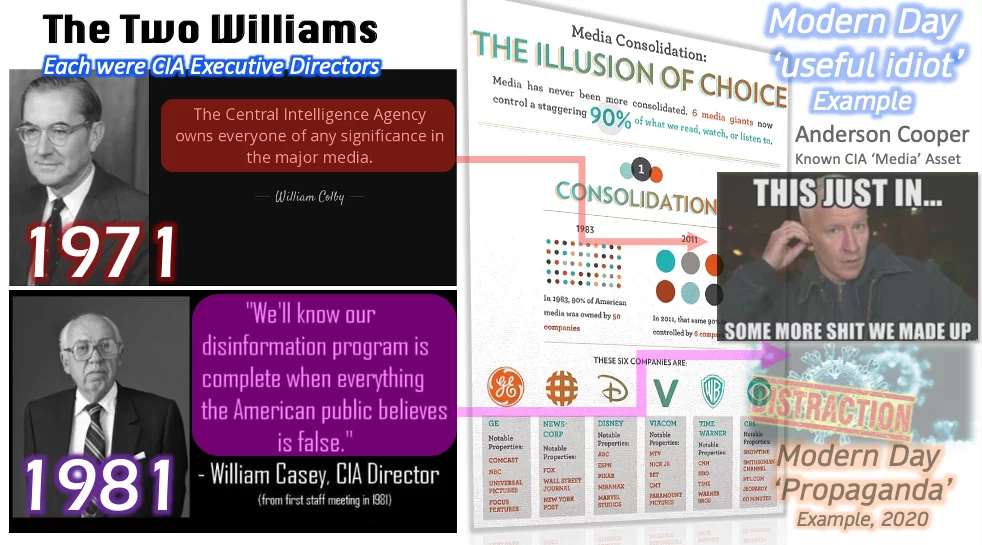
The network was managed through relationships with media figures who held pro-American and anti-Soviet views, including William S. Paley of CBS, Henry Luce of Time and Life magazines, Arthur Hays Sulzberger of the New York Times, Alfred Friendly of the Washington Post, and executives at several other major newspapers, press services, and news agencies across the country.
The Church Committee Investigation
Following the Watergate scandal and Seymour Hersh’s 1975 expose of CIA domestic surveillance, Congress authorized a series of investigations into CIA activities from 1975 to 1976. The most comprehensive examination of CIA-media relationships came from the Church Committee, whose final report was published in April 1976.
Regarding foreign media, the Church Committee concluded that “the CIA currently maintains a network of several hundred foreign individuals around the world who provide intelligence for the CIA and at times attempt to influence opinion through the use of covert propaganda. These individuals provide the CIA with direct access to a large number of newspapers and periodicals, scores of press services and news agencies, radio and television stations, commercial book publishers, and other foreign media outlets.”
On the domestic front, the report found that approximately 50 CIA assets were “individual American journalists or employees of U.S. media organizations,” with fewer than half holding formal credentials from their media employers. More than a dozen American news organizations and commercial publishing houses had provided cover for CIA agents operating abroad, with some of these organizations unaware they were being used for this purpose.
Notably, none of the congressional reports from this period explicitly referenced an “Operation Mockingbird” by name, though the activities described aligned with what researchers and journalists had attributed to the program.
CIA Response and Policy Changes
Even before the Church Committee published its findings, the CIA had begun restricting its use of journalists. In 1973, CIA Director William Colby issued instructions that “as a general policy, the Agency will not make any clandestine use of staff employees of U.S. publications which have a substantial impact or influence on public opinion.”
In February 1976, Director George H.W. Bush announced a more restrictive policy: “Effective immediately, CIA will not enter into any paid or contractual relationship with any full-time or part-time news correspondent accredited by any U.S. news service, newspaper, periodical, radio or television network or station.”
By the time the Church Committee completed its work, the CIA had reportedly terminated all contacts with accredited journalists. However, the committee noted a significant loophole: the policy defined “accredited correspondent” narrowly to include only individuals formally authorized by contract or press credentials to represent themselves as correspondents. Stringers, freelancers, and non-contract media workers were not covered by the ban.
The Declassified Family Jewels
In 2007, the CIA declassified a report known as the “Family Jewels,” originally compiled in 1973 at the request of then-CIA Director James Schlesinger. This document contained a reference to a “Project Mockingbird,” describing it as a telephone intercept operation conducted between March 12 and June 15, 1963, that targeted two Washington-based journalists who had been publishing articles based on classified Agency materials, including Top Secret and Special Intelligence.
The wiretap was authorized by CIA Director John A. McCone “in coordination with the Attorney General (Mr. Robert Kennedy), the Secretary of Defense (Mr. Robert McNamara), and the director of the Defense Intelligence Agency (Gen. Joseph Carroll).”
An internal CIA biography later identified the two targeted reporters as Robert S. Allen and Paul Scott, whose syndicated column “The Allen-Scott Report” appeared in as many as 300 newspapers at its peak circulation.
The Bernstein Investigation
Carl Bernstein’s 1977 Rolling Stone investigation went further than the Church Committee’s published findings. Bernstein argued that the committee’s report had “covered up” the full extent of CIA relationships with the news media and named specific journalists who he said had worked directly with the agency.
Bernstein’s reporting established that the CIA’s media influence operated at multiple levels: from fully recruited agents within newsrooms to informal arrangements where journalists provided information or published stories based on agency guidance without formal compensation. The system’s effectiveness rested on its ability to shape narratives through seemingly independent and credible news sources.
Legacy and Ongoing Questions
The revelations about Operation Mockingbird fundamentally altered public understanding of the relationship between intelligence agencies and the press. The program demonstrated that during the Cold War, the boundary between independent journalism and government propaganda was far more permeable than the public had been led to believe.
The key policy changes announced in the 1970s established a formal separation between the CIA and accredited journalists. However, the narrow definition of “accredited” left open the possibility of continued relationships with freelancers and non-credentialed media workers. Whether similar programs have operated in any form since the official restrictions were imposed remains a subject of speculation and periodic investigative scrutiny.
The broader question raised by Operation Mockingbird, how much of what the public consumes as independent journalism may actually reflect intelligence agency objectives, continues to resonate in contemporary debates about media credibility, information warfare, and the role of government in shaping public narratives.