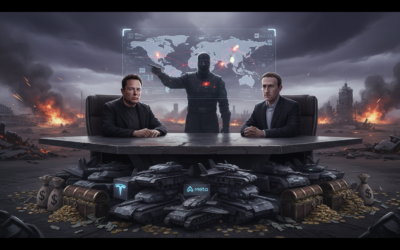
Oracle co-founder Larry Ellison has articulated a chilling vision of America’s technological future, one where artificial intelligence systems monitor citizens through ubiquitous recording devices, promising that “citizens will be on their best behavior” under constant surveillance. This dystopian blueprint is now becoming reality as Oracle deepens its integration with government operations under the Trump administration.
At Oracle’s financial analyst meeting in September 2024, Ellison outlined his surveillance state philosophy with remarkable candor. “We’re going to have supervision,” he declared. “Every police officer is going to be supervised at all times, and if there’s a problem, AI will report that problem and report it to the appropriate person. Citizens will be on their best behavior because we are constantly recording and reporting everything that’s going on.”
The Stargate Initiative: Oracle’s Government Partnership
These surveillance ambitions gained concrete form on Trump’s second day back in the White House, when he announced the controversial $500 billion Stargate AI project. Ellison stood alongside the president as Oracle pledged $100 billion toward building new data centers to power AI initiatives, including development of mRNA “cancer vaccines.” The tech billionaire, now the fourth richest man in the world, has been positioned to lead America’s AI infrastructure program.
The Stargate announcement marked a significant escalation in Oracle’s government entanglement, cementing the company among the leading Big Tech firms gaining influence under the second Trump administration. This partnership raises profound questions about the merger of corporate surveillance capabilities with state power.
Ratepayer Protection Pledge: Expanding the Surveillance Network
Oracle’s government ties deepened further in March 2025, when company executives joined other Big Tech leaders at the White House to sign the “Ratepayer Protection Pledge.” While ostensibly aimed at preventing AI data center costs from impacting Americans, the gathering of Amazon, Google, Meta, Microsoft, OpenAI, xAI, and Oracle executives represented something more significant, the formal coordination of the surveillance infrastructure.
Trump praised the agreement, stating that “Big Tech companies are committing to fully cover the cost of increased electricity production required for AI data centers, and that would mean prices for American communities will not go up, but in many cases, will actually come down.” However, critics note the absence of public consultation about whether communities actually want these surveillance-enabling data centers in their neighborhoods.
TikTok and Social Media Control
Oracle’s influence extends beyond infrastructure into social media control. The company has emerged as a major player in the deal for TikTok’s U.S. operations, positioning it to influence one of the country’s most popular video-sharing platforms. This development takes on ominous implications when viewed through Ellison’s surveillance philosophy.
The company’s role in social media comes as it has also secured a stunning $300 billion deal with OpenAI to provide computing power, demonstrating Oracle’s central position in the AI ecosystem that Ellison envisions will monitor American citizens.
Community Resistance and Water Concerns
Despite the corporate-government coordination, communities across the nation are beginning to resist the data center invasion. Oracle’s pledge to protect “local water resources” acknowledges growing opposition from communities experiencing strain on water supplies due to data center construction. From Charlotte to rural areas nationwide, citizens are organizing against AI data centers, though their voices remain largely excluded from the planning process.
This resistance highlights a fundamental tension: while Ellison and government officials assume Americans want omnipresent AI surveillance, actual communities are pushing back against the infrastructure required to implement it.
The Technocratic Vision
Ellison’s surveillance predictions describe a future where AI processes “vast amounts of footage recorded by cameras placed on everything from car dashboards and front doors to security systems and cops.” This vision extends far beyond traditional law enforcement, encompassing a comprehensive monitoring system that would track citizen behavior in real-time.
The Oracle chairman’s matter-of-fact presentation of this surveillance society reveals how normalized mass monitoring has become among tech elites. His assumption that constant recording will improve behavior reflects a fundamentally authoritarian worldview that prioritizes control over privacy and constitutional rights.
The Broader Surveillance Architecture
Oracle’s rise parallels that of other surveillance-focused tech companies like Palantir, founded by Peter Thiel. While Palantir has drawn significant public criticism for its government contracts, Oracle has operated more quietly, building surveillance capabilities under the guise of database management and cloud services.
The company’s integration with government operations represents a critical component of what researchers describe as the emerging “technocratic state,” where AI systems assume increasingly authoritative roles in governance and social control.
Constitutional Implications
The normalization of Ellison’s surveillance vision raises profound constitutional questions. The Fourth Amendment’s protection against unreasonable searches and seizures was never intended to accommodate a society where every citizen action is recorded, analyzed, and reported by artificial intelligence systems.
Yet the seamless integration of Oracle’s technology with government operations suggests these constitutional considerations are being swept aside in favor of technological determinism, the assumption that because surveillance is technically possible, it is therefore inevitable and desirable.
As Oracle continues expanding its government partnerships and Ellison’s surveillance vision moves from prediction to implementation, Americans face a critical choice about the kind of society they want to inhabit. The current trajectory points toward a future where privacy becomes obsolete and citizen behavior is continuously monitored by AI systems designed to ensure compliance.
This article draws on reporting from Activist Post and Fortune.