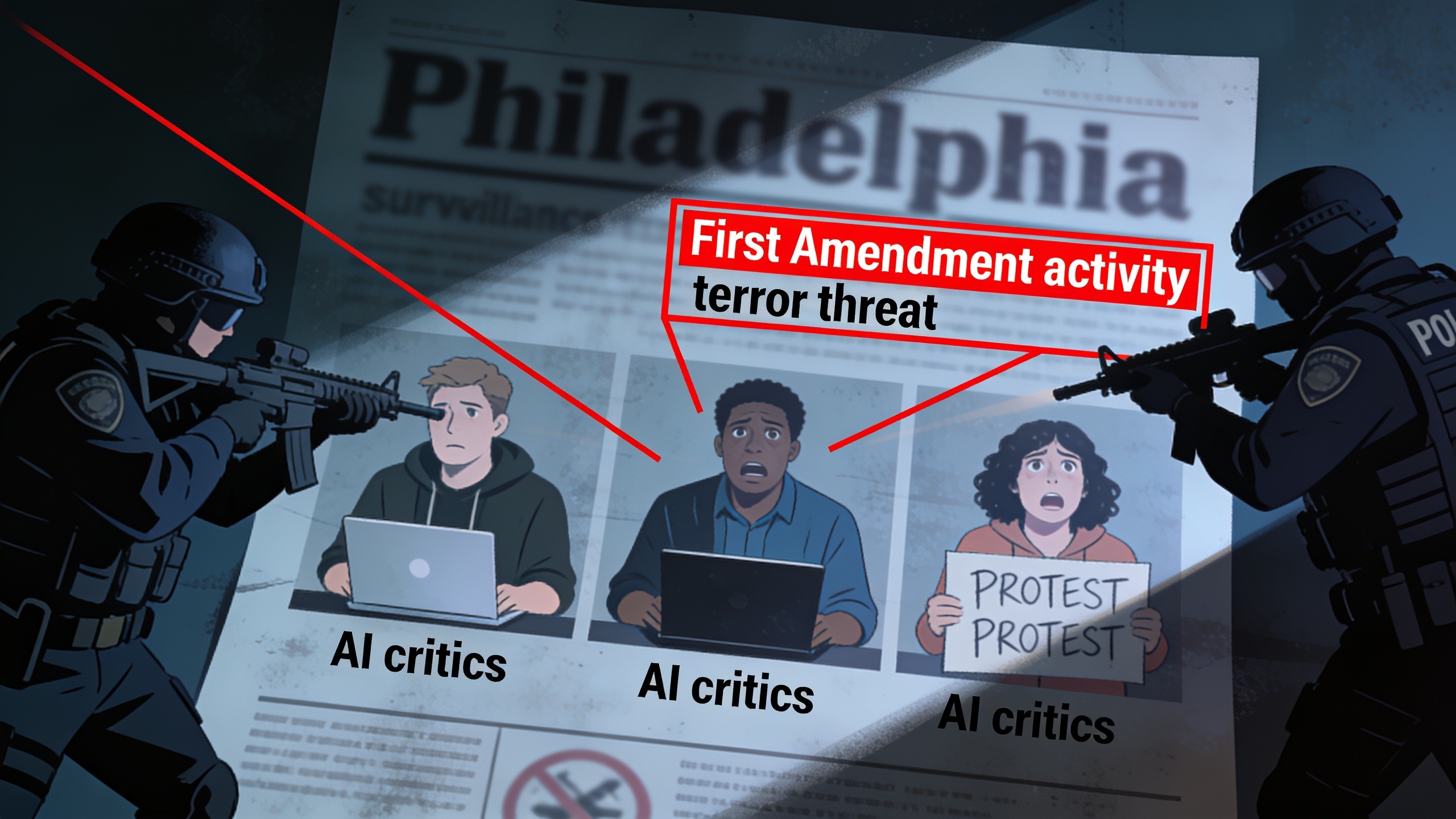
A confidential law enforcement bulletin obtained by The Intercept reveals that Philadelphia police are systematically monitoring Americans who criticize artificial intelligence data centers on social media, categorizing their constitutionally protected speech as potential domestic terrorism.
The Delaware Valley Intelligence Center, housed within the Philadelphia Police Department, distributed a December alert marked “for official use only” warning that “domestic violent extremists” pose a growing threat to AI infrastructure. The fusion center’s report combed through social media posts from AI critics and concluded there is an escalating risk of physical violence against data centers from groups ranging from white supremacists to anarchists.
Fusion Centers Transform Critics into Suspected Terrorists
The bulletin exemplifies how fusion centers, intelligence hubs created after September 11, 2001, have evolved into mechanisms for surveilling lawful political dissent. The Philadelphia fusion center acknowledged “a lack of specific information on plans to target AI data centers in the Philadelphia area” yet still distributed warnings about three planned data center facilities in the region becoming targets of future protests.
Most troubling, the report explicitly identifies “disruptive First Amendment activity” as an “indicator” of risk from “Domestic Violent Extremists,” a broad FBI designation that has been used to criminalize environmental activists, racial justice protesters, and other political dissidents.
The evidence presented in the bulletin consists primarily of hyperbolic anti-AI rhetoric commonly found across social media platforms. Examples include an unnamed internet user who “indicated a desire to ‘burn down’ data centers,” references to a fictional anti-robot movement from the science fiction novel “Dune,” and a Facebook meme.
Pattern of Political Surveillance
This surveillance operation fits a documented pattern of fusion centers targeting legitimate advocacy groups. These intelligence hubs have previously warned local law enforcement about supposed threats from Black Lives Matter protesters, Keystone XL pipeline opponents, and Line 3 pipeline activists. Pennsylvania itself has a troubling history in this area, in 2010, then-Governor Ed Rendell apologized after the state Department of Homeland Security contracted with a private firm to produce surveillance reports on anti-fracking activists.
The Brennan Center for Justice has extensively documented how law enforcement agencies use social media monitoring to conduct widespread surveillance of Americans’ political activities. Their research of hundreds of police departments found that only about half have public policies governing social media surveillance, and existing policies contain serious deficiencies that threaten constitutional rights.
Social Media Dragnet Operations
The Philadelphia case demonstrates how police departments are expanding beyond targeted investigations into broad social media monitoring programs. According to the Electronic Frontier Foundation, law enforcement agencies including the Department of Homeland Security routinely monitor social media posts, collecting intimate details about users’ political views, religious beliefs, and personal associations.
This surveillance extends far beyond individuals suspected of criminal activity. Internal documents obtained by the Brennan Center revealed that LAPD officers were ordered to record social media information from every civilian they questioned, including those never arrested or accused of any crime.
Constitutional Concerns and Chilling Effects
Civil rights attorney Paul Hetznecker, who has long represented clients in Philadelphia, expressed alarm at the fusion center’s characterization of AI skeptics as potential terrorists. “Those are legitimate, popular political concerns that are raised by local communities,” Hetznecker stated, calling the report “a very dangerous attempt to characterize that protected” political activity as extremist.
The surveillance of AI critics is particularly concerning given the highly contextual nature of social media posts. Police frequently misinterpret innocuous language, song lyrics, or inside jokes, leading to criminal consequences for individuals who may not even realize they’re under surveillance.
Legal Framework for Protest Surveillance
While the First Amendment provides robust protection for political speech and assembly, these protections are not absolute. The FBI has acknowledged that certain circumstances can generate legitimate law enforcement attention during protests. However, the Philadelphia bulletin appears to cross constitutional lines by treating protected political criticism as inherently suspicious.
The fusion center’s approach of monitoring “First Amendment activity” as a terrorism indicator directly conflicts with established legal principles that protect political dissent. Courts have consistently held that the government cannot surveil citizens solely for exercising their constitutional rights to criticize government policies or corporate activities.
Implications for Democratic Participation
The targeting of AI critics reflects broader concerns about how surveillance technologies are being weaponized against legitimate political movements. As artificial intelligence and data centers become increasingly central to American infrastructure and economic policy, public debate about their impacts should be encouraged, not criminalized.
The Delaware Valley Intelligence Center’s bulletin represents a troubling expansion of post-9/11 surveillance powers into the realm of domestic political criticism. By labeling routine First Amendment activity as potential terrorism, fusion centers are creating a chilling effect that may discourage citizens from participating in democratic discourse about emerging technologies.
This surveillance program raises fundamental questions about the balance between security and constitutional rights in an era of expanding artificial intelligence infrastructure. As communities across the nation grapple with the environmental, economic, and social impacts of massive data centers, the Philadelphia case serves as a stark reminder that exercising constitutional rights to criticize these developments may result in government monitoring and potential criminalization.
This article draws on reporting from The Intercept, Brennan Center for Justice, Electronic Frontier Foundation, and FBI Law Enforcement Bulletin.