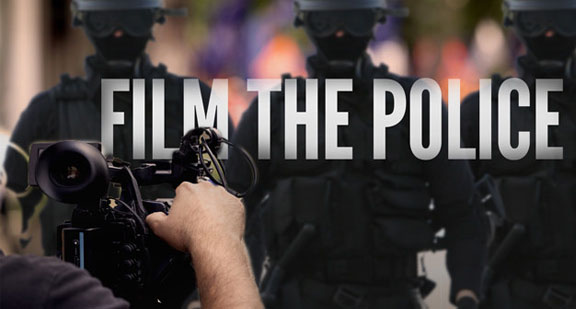
Across the United States, organized groups of citizens have taken to filming police officers on duty as a form of community accountability. Operating under names like CopWatch, Cop Block, and the Peaceful Streets Project, these decentralized organizations use police scanners, knowledge of checkpoint locations, and scheduled patrols to monitor law enforcement activity with cameras. Courts at every level have upheld the legal right to film police in public, yet participants in these groups report facing systematic retaliation from the departments they monitor.
How Organized Cop Watching Works
Unlike bystanders who happen to record a police encounter, organized cop watch groups conduct proactive patrols. Members go out at scheduled times, often on weekend nights, equipped with cameras and knowledge of their legal rights. They position themselves at a distance from police activity and record what they observe.
The growth of these groups accelerated dramatically after the 2014 shooting of Michael Brown in Ferguson, Missouri. What had been a scattered collection of local organizations evolved into a nationwide network of citizens trained in both their First Amendment rights and the practical techniques of documenting police encounters.
The legal foundation for their activities is well established. The American Civil Liberties Union has successfully litigated numerous cases affirming the right to photograph and film police officers performing their duties in public. The Supreme Court has ruled that police cannot search an individual’s cellphone data without a warrant, and officers have no legal authority to delete photos or video from a citizen’s device under any circumstances.
Arrests and Intimidation in Texas
In September 2014, three cop watchers were arrested while monitoring a traffic stop in Arlington, Texas. Approximately 20 people, some affiliated with the Tarrant County Peaceful Streets Project, gathered at an intersection to film police during a Saturday night traffic stop. Arlington police charged Janie Lucero and her husband Kory Watkins with obstruction of a highway, while Joseph Tye was arrested for refusing to identify himself.
The watchers maintained they were not interfering with police work and were ordered to move 150 feet away, around a building corner where they could no longer see the officers. Notably, the group had already monitored two other traffic stops that same evening without any confrontation.
Watkins described an escalating pattern. When his group first began cop watching, officers seemed mildly bothered. As the group grew in size and visibility, police responses intensified, with departments deploying additional officers to routine traffic stops when watchers were present.
The Peaceful Streets Project and Government Surveillance
The Peaceful Streets Project (PSP) originated after a New Year’s Day 2012 incident in Austin, Texas. Antonio Buehler, a West Point graduate and former military officer, witnessed two Austin police officers assaulting a woman and began photographing the encounter. Officers arrested Buehler and charged him with spitting in an officer’s face, a felony. Two witness videos surfaced showing no such act occurred, and a grand jury declined to indict.
Buehler subsequently co-founded the Peaceful Streets Project, an all-volunteer organization dedicated to police accountability through community patrols, legal rights training, and public education. As the organization grew and chapters appeared in other cities, police retaliation escalated in parallel.
Documents obtained through a Freedom of Information Act request revealed that Austin Police Department officers had been monitoring Buehler’s social media accounts, coordinating efforts to arrest him and other PSP members, and even consulting with the District Attorney’s office about whether members could be incarcerated for their activism. One internal email explored charging Buehler with felony online impersonation over an obviously satirical Facebook post.
Most significantly, an internal email from APD senior officer Justin Berry classified the Peaceful Streets Project as a “domestic extremist” organization. Berry attempted to link police accountability groups including PSP, CopWatch, and Cop Block to what he described as a “national domestic extremism trend,” grouping them with sovereign citizens movements whose activities the FBI classifies as domestic terrorism.
Buehler stated that the APD was working with a Department of Homeland Security fusion center to associate PSP with sovereign citizen groups, potentially tagging its members as domestic terrorism-connected in federal intelligence databases.
A Pattern Across Multiple Cities
Austin was not an isolated case. In 2002, leaked internal files from the Denver Police Department’s Intelligence Unit revealed that the department had been conducting surveillance on several activist groups, including three police accountability organizations: Denver CopWatch, End the Politics of Cruelty, and Justice for Mena. All were falsely branded as “criminal extremist” organizations in what became widely known as Denver’s “spy files” scandal.
Similarly, from October 2003 through the 2004 Republican National Convention, intelligence digests produced by the New York City Police Department classified participants in “Operation CopWatch” as criminal extremists. Those participants had been attempting to identify undercover officers who might provoke violence during demonstrations and to document any police misconduct against protesters.
Retaliation against cop watchers in New York became so pervasive that the NYPD eventually issued an official memo reminding officers that civilians have every legal right to photograph and film police on duty.
Community Support as a Shield Against Retaliation
Veteran police accountability activist Jose Martin, who organized cop watch patrols in both New York and Chicago, described how community relationships could serve as protection against police retaliation. After a CopWatch group became established in Chicago’s Pilsen neighborhood, Martin was detained by an officer following a patrol one evening in 2009. Neighborhood residents who had witnessed the group’s regular patrols gathered around the officer, calling for Martin’s release. He was let go shortly after.
The key factor, according to Martin, was that the cop watchers were members of the community they patrolled, not outsiders. When strong relationships existed between organized watchers and local residents, communities had the collective power to resist escalating retaliation.
In Ferguson, Missouri, Oakland-based We Copwatch co-founder Jacob Crawford raised $6,000 to distribute 110 cameras to organizers and residents and train them in monitoring police activity. The effort reflected a broader strategy of embedding accountability tools directly within affected communities rather than relying solely on external advocacy organizations.
The Tension Between Accountability and Authority
The conflict between cop watch organizations and police departments highlighted a fundamental tension in American civic life. Citizens exercising clearly established constitutional rights to observe and record public servants faced institutional pushback ranging from arrest on questionable charges to classification as extremist threats in federal intelligence systems.
The pattern suggested that some law enforcement agencies viewed civilian oversight not as a constitutionally protected activity but as an adversarial challenge to institutional authority. Whether through direct confrontation at traffic stops or through intelligence-sharing networks designed to track organized dissent, the response to cop watching groups raised serious questions about the boundaries between public safety and the suppression of lawful civic participation.