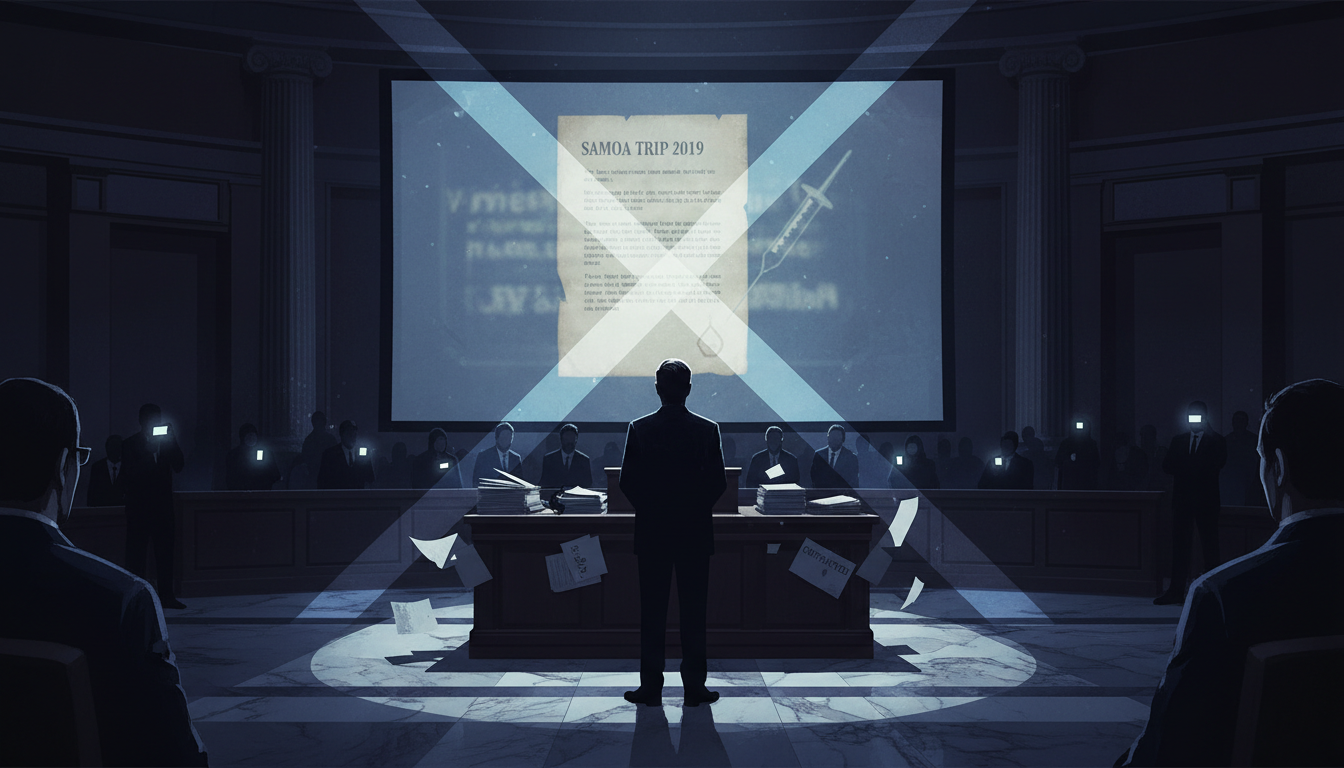
Newly obtained documents directly contradict sworn statements made by U.S. Health and Human Services Secretary Robert F. Kennedy Jr. during his Senate confirmation hearings, raising serious legal and ethical questions about one of the nation’s most powerful public health officials. Letters and emails secured by The Guardian and the Associated Press reveal that Kennedy’s 2019 trip to Samoa, which he told Congress twice had “nothing to do with vaccines”, was, in fact, explicitly organized around investigating the measles, mumps, and rubella (MMR) vaccine.
The Testimony vs. The Documents
During his January 30, 2025 Senate confirmation hearing before the Health, Education, Labor, and Pensions (HELP) Committee, Kennedy was directly questioned by Senator Edward Markey of Massachusetts about the nature of his 2019 Samoa visit. Kennedy’s response was unambiguous: “My purpose in going down there had nothing to do with vaccines.” When Senator Markey pressed again, asking whether the trip had “nothing to do with vaccines” as Kennedy had told Senate Finance Committee members the day prior, Kennedy repeated: “Nothing to do with vaccines.”
The documents obtained through an open records lawsuit, brought with the assistance of the Reporters Committee for Freedom of the Press, tell a different story. A letter Kennedy wrote directly to the Samoan prime minister before the trip stated explicitly that he wanted to study the MMR vaccine in the Pacific island nation. The word “vaccine” or “vaccination” appears eight times in that letter alone.
“I would propose my team conduct detailed health informatics assessment in Samoa of what happened with your MMR vaccines,” Kennedy wrote in the letter, adding that he believed the deaths of two children there following MMR vaccination could have resulted from manufacturing issues.
Emails sent by staffers at the U.S. Embassy and the United Nations, also obtained through the records request, provide additional contemporaneous accounts suggesting Kennedy’s concerns about vaccine safety were central to the visit’s planning. The documents further reveal that a U.S. Embassy employee helped Kennedy’s team connect with Samoan officials.
The Samoa Measles Outbreak and Its Human Cost
Kennedy’s 2019 visit to Samoa took place just months before a measles outbreak swept through the island nation. That outbreak sickened thousands of people and killed 83, the majority of them children under the age of five. Samoan officials later stated that Kennedy’s presence in the country had bolstered the credibility of anti-vaccine activists ahead of the outbreak.
At the time of his visit, Kennedy was serving as chair and chief legal counsel of Children’s Health Defense (CHD), a nonprofit known for its anti-vaccine activism. CHD had turned its attention to Samoa in July 2018, following the deaths of two young children after MMR vaccination, the same deaths Kennedy referenced in his letter to the Samoan prime minister.
Kennedy met with Samoan officials during the trip, including the health minister at the time, who told NBC News that Kennedy shared his view that vaccines were not safe. Kennedy has maintained that he went to Samoa to introduce a medical data system, and that conversations about vaccines were incidental.
Legal Implications and Political Fallout
Knowingly giving material false testimony to Congress is a federal crime that carries a possible prison sentence, though prosecution in such cases is rare. Legal experts note a significant procedural detail: Kennedy was not under oath during either of the two confirmation hearings where he made the statements about Samoa.
The Department of Health and Human Services issued a statement defending Kennedy: “Secretary Kennedy’s visit to Samoa in 2019 was unrelated to vaccines. Any claim or insinuation based on these letters that Secretary Kennedy lied under oath or to Congress is not only false but outright defamatory.” When The Guardian asked HHS to specifically explain the contradiction between Kennedy’s congressional testimony and the contents of his own letter to the Samoan prime minister, which used the words vaccine or vaccination eight times, the department did not respond to that question. The White House also did not respond to a request for comment.
Senator Markey, who directly questioned Kennedy during the HELP Committee hearing, responded sharply to the new documents. “Today’s revelations make clear what we suspected during Robert F. Kennedy Jr.’s confirmation hearing last year: he lied to Congress,” Markey said in a February 2026 statement. “We now know that was a lie with deadly consequences.”
Attorneys with expertise in Senate procedure noted that if Democrats win control of the House or Senate in November’s elections, Kennedy’s statements could be used as grounds for hearings, an impeachment inquiry, or other formal challenges to his continued leadership of HHS.
A Broader Pattern: Confirmation Pledges vs. Conduct in Office
The Samoa documents are not the only area where Kennedy’s confirmation testimony has come under scrutiny. Beyond his statements about the 2019 trip, Kennedy also pledged during the confirmation process to maintain existing vaccine policies, pledges that, once he took office, he moved to reverse.
Since becoming HHS Secretary, Kennedy has worked to overhaul federal immunization guidance and has used his platform to raise public suspicion about vaccine safety, including the measles vaccine specifically. This has occurred against a backdrop of escalating domestic measles outbreaks. According to Senator Markey’s February 2026 statement, over 2,200 measles cases were recorded in 2025, the highest number in 34 years, and the United States is on the verge of losing its measles elimination status. Separately, PBS News reported that more than 875 people in South Carolina alone had been infected in a single outbreak at the time the documents were disclosed.
Inside the Document Trail
The records that contradict Kennedy’s testimony were not voluntarily disclosed. The State Department released emails, many of them heavily redacted, only as the result of an open records lawsuit. The emails from U.S. Embassy and United Nations staffers offer what investigators describe as the first inside view of how Kennedy’s 2019 Samoa trip was organized, with contemporaneous accounts from officials on the ground indicating that vaccine safety concerns drove the visit.
Senator Ron Wyden of Oregon, another senator who questioned Kennedy about Samoa during the confirmation process, also responded to the newly disclosed records, though the full details of his response were not available in the documents reviewed for this report.
What the Record Shows
Taken together, the available documentation presents a clear sequence: Kennedy wrote to Samoa’s prime minister proposing a vaccine safety investigation, traveled there months before a deadly measles outbreak, met with anti-vaccine activists and health officials, and then told Congress, twice, in two separate hearings, that the trip had nothing to do with vaccines. The letter bearing his name and his own words contradicts those statements directly.
Whether or not Kennedy was under oath at the time, the discrepancy between his congressional testimony and his own written correspondence raises fundamental questions about the reliability of the information lawmakers were given during the confirmation process, information that shaped their votes on who would oversee the health of the American public.
This article draws on reporting from The Guardian, PBS NewsHour and the Associated Press, and a statement from Senator Edward Markey’s office.