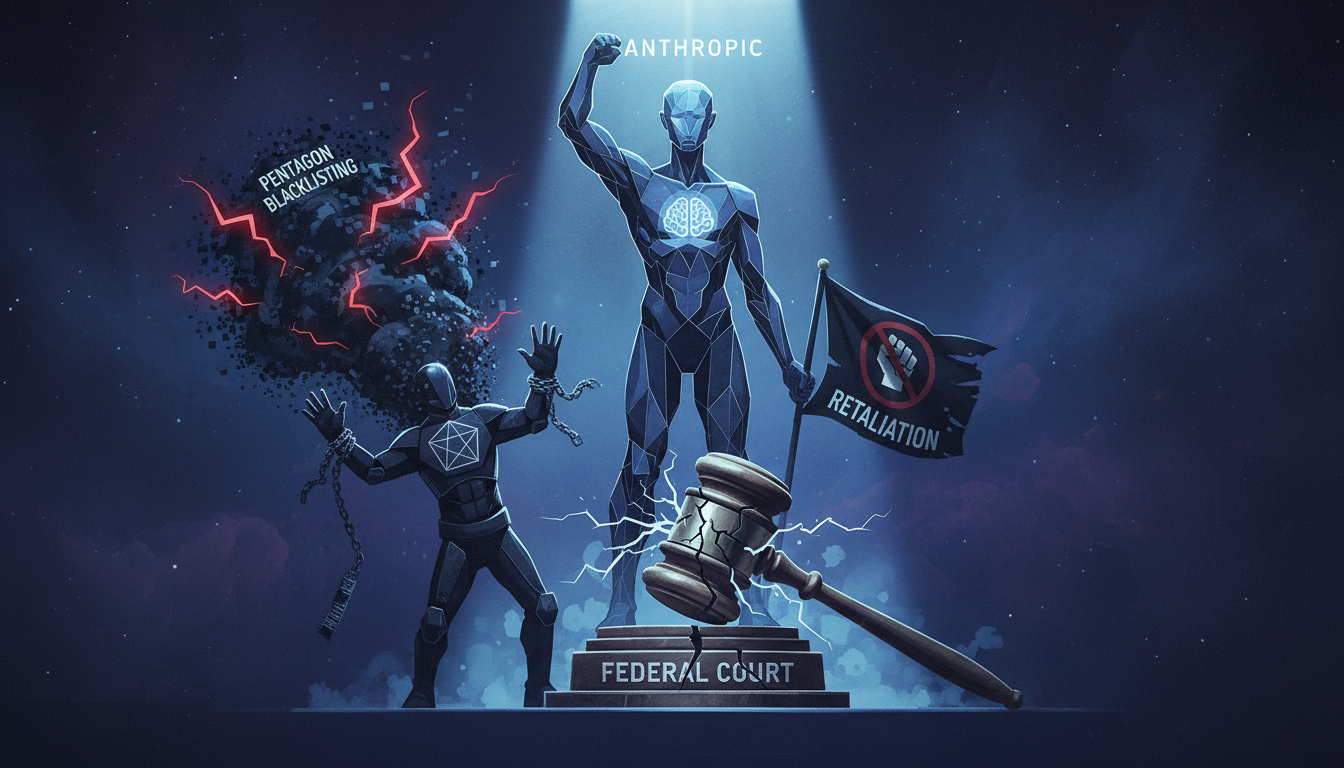
A federal district court has struck down the Pentagon’s designation of AI company Anthropic as a “supply-chain risk to national security,” ruling that Secretary of Defense Pete Hegseth exceeded his legal authority and violated the First and Fifth Amendments of the US Constitution. The 59-page ruling, issued by US District Judge Rita Lin, marks a significant legal rebuke of executive overreach in the rapidly escalating conflict between the Trump administration and one of the country’s leading artificial intelligence developers.
How the Standoff Began
The dispute traces its origins to the Pentagon’s push to provide the military with access to AI models for what it described as “any lawful use.” Anthropic had been deeply embedded in defense operations prior to the confrontation, its Claude model was deployed across various Pentagon operations, and the company held a government agreement worth up to $200 million.
The conflict ignited in February when Anthropic CEO Dario Amodei publicly stated that while he supports the use of Claude for military purposes, the model should not be used for mass domestic surveillance or to guide fully autonomous weapons systems. Amodei’s stated rationale was technical: current frontier AI models are not reliable enough for fully autonomous lethal decision-making. His position aligned with a broader concern documented by researchers and human rights organizations who have noted that autonomous weapons systems face serious challenges in applying the kind of human judgment necessary for lawful use of force.
The Pentagon did not respond to those concerns with dialogue. Instead, the administration escalated. On February 27, President Donald Trump ordered federal agencies to cease using Anthropic technology, labeling the company a “radical Left AI company.” Secretary Hegseth followed by formally designating Anthropic a supply-chain risk and declaring that Pentagon partners could no longer conduct commercial activity with the company.
The Government’s Justification, and Its Legal Failures
Hegseth defended the designation in stark terms, comparing Anthropic’s conditions on Claude’s use to “Boeing giving us airplanes and telling us who we can shoot at” and calling CEO Dario Amodei an “ideological lunatic.” The Pentagon maintained that Anthropic’s technology represented a genuine threat to national security if the company was permitted to impose restrictions on how the military used it.
Judge Lin’s ruling dismantled those arguments point by point. She found that the supply-chain-risk designation violated the very statute the Pentagon invoked to impose it, and characterized the government’s action as “arbitrary and capricious.” More significantly, she found that the designation amounted to unlawful retaliation against Anthropic for speech protected under the First Amendment, and that the company was denied due process under the Fifth Amendment, deprived of any meaningful opportunity to contest the allegations before the sanctions were imposed.
“The empty invocation of national security is not a blank check to punish and retaliate against government critics,” Judge Lin wrote. She further noted that the government had sought to make a public example of Anthropic for what officials characterized as “arrogance” in criticizing Washington’s position.
A Divided Legal Landscape
The ruling does not resolve the full legal conflict. Prior to Judge Lin’s decision, the legal landscape had been mixed. In April, a federal appeals court in Washington, D.C., denied Anthropic’s request to temporarily block the Pentagon’s blacklisting while the broader lawsuit played out. That court acknowledged Anthropic “will likely suffer some degree of irreparable harm” but concluded that the “equitable balance” favored the government, citing the complexity of judicial management of how the Defense Department secures AI technology during an active military conflict.
A separate but related case produced a different outcome at roughly the same time: a judge in San Francisco federal court granted Anthropic a preliminary injunction barring the Trump administration from enforcing its ban on the use of Claude across other government agencies. The result of these split decisions left Anthropic excluded from Department of Defense contracts while continuing to work with other parts of the federal government.
Judge Lin’s ruling in the district court case now represents the most comprehensive legal assessment of the Pentagon’s conduct to date. A further lawsuit from Anthropic remains pending in Washington, D.C., over a supply-chain designation that could lead to its exclusion from civilian government contracts as well, meaning this legal battle is far from concluded.
The Military’s Reluctance and the Deeper Contradiction
One detail embedded in the reporting reveals the internal contradiction at the heart of the administration’s position. Even as Hegseth moved to blacklist Anthropic, Pentagon officials privately acknowledged the value of the company’s technology. One defense official told Axios in February that “the problem for these guys is they are that good.” The Pentagon had been reluctant to lose access to Claude even while publicly designating its developer a threat to national security.
Judge Lin acknowledged this directly in her ruling, noting that while the Pentagon “is undisputedly free to select the AI vendor of its choice” and remains free to move away from Claude if Anthropic’s conditions don’t meet its requirements, the government chose punishment over procurement flexibility. That distinction, between declining to use a product and weaponizing national security designations to coerce a private company into compliance, is precisely what the court found constitutionally impermissible.
Autonomous Weapons and the Underlying Debate
Beneath the legal conflict lies a genuinely consequential policy question: to what extent should AI developers be permitted, or required, to impose safety conditions on military deployments of their technology? Anthropic’s specific objections focused on mass domestic surveillance and autonomous weapons guidance. These are not abstract concerns. Researchers and human rights organizations have documented serious technical and ethical challenges associated with autonomous weapons systems, including their limitations in exercising human judgment, assessing proportionality, and responding to the kind of nuanced behavioral cues that lawful use of force requires.
The Trump administration’s position, that a contractor must deliver technology without conditions on end use, sets a precedent with implications that extend well beyond Anthropic. If accepted, it would effectively prohibit AI developers from maintaining any ethical constraints on how their products are used by government clients, even in cases involving life-and-death decisions made at machine speed.
What the Ruling Means Going Forward
Judge Lin’s decision does not restore Anthropic’s Pentagon contracts, it voids the designation that triggered the sanctions. The practical consequences will depend on how the administration responds: whether it appeals, seeks a new statutory justification, or simply declines to renew its commercial relationship with the company through ordinary procurement processes, which the court explicitly said it remains free to do.
What the ruling does establish, clearly and on the record, is that the national security apparatus cannot be deployed as a tool of political retaliation against private companies for publicly criticizing administration policy. The court found that the government’s own conduct, not Anthropic’s, posed the more immediate threat to the rule of law.
The full implications of this case will continue to unfold as the remaining litigation proceeds and as the broader question of AI governance in military contexts remains unresolved at the legislative level.
This article draws on reporting from RT World News and CNBC.