An Interview with Police Militarization Expert Radley Balko:How Cops Became Soldiers
Non-Violent Marijuana Arrests surpass Violent Crime Arrests- Prison Industry Profits Running Wild! GMO’s making it into ‘Natural’ vitamins & supplements
Monsanto (the Fox) buys Beelogics (The Henhouse). Nature in jeopardy of getting Hi-jacked!
Dick Cheney finally admits he lied on 9/11… kind of.
Beekeepers on the south coast have lost up to a thousand hives in a series of poison attacks.
South coast beekeepers are reeling from the senseless destruction of hundreds of hives across the region yesterday.
A toxic poison was sprayed into over 740 honey producing hives in the Batemans Bay area, decimating the local industry.
Police say the attacks on the region’s biggest producers caused an estimated $150,000 damage, but local producers say the poison will continue to destroy hives over coming weeks.
Beekeepers on the NSW south coast lost about 750 hives after bees were poisoned. Owner of Australian Rainforest Honey, Steve Roberts, lost about 230 hives, south of Pebbly Beach. Photo: Graham Tidy
One of the hardest hit was south coast producer Australian Rainforest Honey.
The company had 240 hives poisoned at its two sites on the south coast, causing tens of thousands of dollars in damage.
One of the company’s directors, Stephen Roberts, was at his site just south of Pebbly Beach today, sifting through piles of dead bees and attempting to save those that hadn’t been lost.
Owner of Australian Rainforest Honey, Steve Roberts, at left, with employee, Adlei Baldo, south of Pebbly Beach.
Mr Roberts says the poisoning was a senseless, inexplicable act, and is working with rural police and the NSW Department of Primary Industries to catch those responsible.
Mr Roberts bees are also used to pollinate almonds, and the attacks may have a secondary impact on that industry.
The attacks appear targeted, with the offenders poisoning a series of hidden, remote bushland sites, some up to 40km apart.
“It’s not right, it’s just not right,” Mr Roberts said.
“We’ll have to start up the hives from scratch again, and it’ll be well over $100,000,” he said.
Investigators from the Department of Primary Industries were at the hives today taking samples of the poison, but a spokeswoman said it would take a number of days to determine an exact cause of death.
The beekeeping business is highly competitive and has been described as cutthroat, but there is no indication that any rival honey producer was responsible.
But while authorities try and track down the culprits, there’s little left for Australian Rainforest Honey to do but mop up and start all over again.
“We’re just lucky that we’ve got a few more loads of bees than others have,” Mr Roberts said.
“We’ll feel it, we’ll definitely feel it, but what can you do?”
Anyone with information should contact Crime Stoppers on 1800 333 000.
Read more: CanberraTimes.com
See Also:
Vanishing of the Bees – Beekeeper Leaks EPA Document
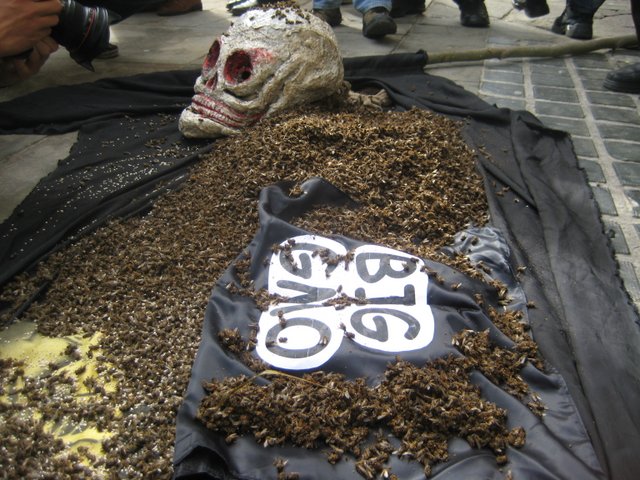
On March 15, over 1,500 beekeepers and anti-GMO protesters marched through the streets of Warsaw, depositing thousands of dead bees on the steps of the Ministry of Agriculture in protest of genetically modified foods and their pesticides which are together largely responsible for the killing off of bees, butterflies, moths and other beneficial pollinators in great numbers.
Later that day the Minister of Agriculture, Marek Sawicki, announced plans to ban MON810, which has already produced millions of hectares of pesticide resistant “superweeds” in the US.
The Polish Beekeepers Association organized the protest, joining forces with International Coalition to Protect the Polish Countryside (ICPPC) and the Coalition for a GMO Free Poland. Targeting Monsanto’s MON810 GM corn in particular, they also called for a complete ban on all genetically engineered crops as well as the pesticides found to be most damaging to the environment (and particularly to bees).
In 2008, the Polish Parliament banned GM feed, including both the planting and importing of GM crops. “Despite this progressive step,” reports Food Travels, “the European Commission has refused to accept regional bans on GMOs, keeping Polish farmers, producers, and activists on the offensive.”
Regardless, says the ICPPC, “None of the nine European Union countries that have already prohibited MON 810 did so by asking the permission of the EU.”
There was a great variety of attire as beekeepers dressed in their work bee suits and masks and ran their hive smoke guns as they marched, many wore yellow jackets with the famous Einstein quote, and many more original signs, props, and costumes. Go here for more photos.
The ICPPC is asking Polish residents to write Minister of Agriculture Marek Sawicki, demanding that he implement an immediate moratorium on GM crops, without waiting for EU approval.
Monsanto only cares about bee’s so they can figure out how to make them only pollinate Monsanto GMO crops. Whistle-blower testimony and supporting evidence will confirm that Monsanto seeks ultimate agricultural world domination through most incomprehensible and nefarious means. -Anonymous
Monsanto, the massive biotechnology company being blamed for contributing to the dwindling bee population, has bought up one of the leading bee collapse research organizations. Recently banned from Poland with one of the primary reasons being that the company’s genetically modified corn may be devastating the dying bee population, it is evident that Monsanto is under serious fire for their role in the downfall of the vital insects. It is therefore quite apparent why Monsanto bought one of the largest bee research firms on the planet.
It can be found in public company reports hosted on mainstream media that Monsanto scooped up the Beeologics firm back in September 2011. During this time the correlation between Monsanto’s GM crops and the bee decline was not explored in the mainstream, and in fact it was hardly touched upon until Polish officials addressed the serious concern amid the monumental ban. Owning a major organization that focuses heavily on the bee collapse and is recognized by the USDA for their mission statement of “restoring bee health and protecting the future of insect pollination” could be very advantageous for Monsanto.
In fact, Beelogics’ company information states that the primary goal of the firm is to study the very collapse disorder that is thought to be a result — at least in part — of Monsanto’s own creations. Their website states:
While its primary goal is to control the Colony Collapse Disorder (CCD) and Israeli Acute Paralysis Virus (IAPV) infection crises, Beeologics’ mission is to become the guardian of bee health worldwide.
What’s more, Beelogics is recognized by the USDA, the USDA-ARS, the media, and ‘leading entomologists’ worldwide. The USDA, of course, has a great relationship with Monsanto. The government agency has gone to great lengths to ensure that Monsanto’s financial gains continue to soar, going as far as to give the company special speed approval for their newest genetically engineered seed varieties. It turns out that Monsanto was not getting quick enough approval for their crops, which have been linked to severe organ damage and other significant health concerns.
Steve Censky, chief executive officer of the American Soybean Association, states it quite plainly. It was a move to help Monsanto and other biotechnology giants squash competition and make profits. After all, who cares about public health?
“It is a concern from a competition standpoint,” Censky said in a telephone interview.
It appears that when Monsanto cannot answer for their environmental devastation, they buy up a company that may potentially be their ‘experts’ in denying any such link between their crops and the bee decline.





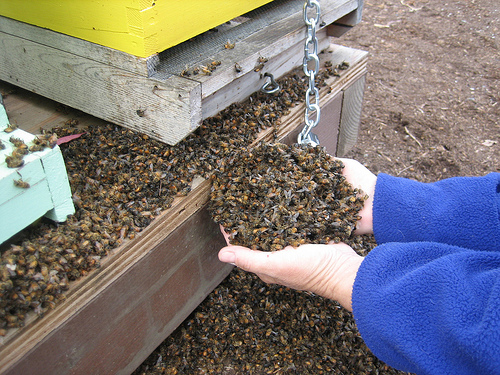
 Beekeepers on the NSW south coast lost about 750 hives after bees were poisoned. Owner of Australian Rainforest Honey, Steve Roberts, lost about 230 hives, south of Pebbly Beach. Photo: Graham Tidy
 Owner of Australian Rainforest Honey, Steve Roberts, at left, with employee, Adlei Baldo, south of Pebbly Beach.