Dec 11, 2013 | Nature Body Mind
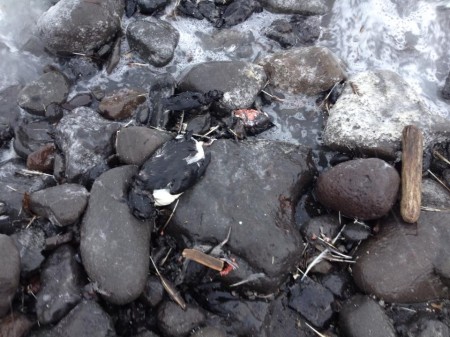
 Why are huge numbers of dead birds dropping dead and washing up along the coastlines of Alaska? It is being reported that many of the carcases of the dead birds are “broken open and bleeding”. The photo of some of these dead birds at the top of this article was originally posted by Alaska native David Akeya on Facebook. You can find more photos of these dead birds right here. And of course it isn’t just birds that are dying. As you will see below, something is causing mass death events among various populations of fish as well. In addition, it has been reported that large numbers of polar bears, seals and walruses in Alaska are being affected by hair loss and “oozing sores”. So precisely what is causing all of this? Could Fukushima be responsible? Authorities are claiming that all of this is being caused by “disease” or “harsh weather”, but are they actually telling us the truth? Evaluate the evidence that I have shared below and decide for yourself…
#1 Something is causing large numbers of dead birds to wash up on shores all over Alaska. The following is a report from Alaska Public Media about just one of these incidents…
Hundreds of dead birds washed up on the shores of St. Lawrence Island towards the end of November. And though the cause of the die off isn’t yet known, the quick response demonstrates a mounting capacity for dealing with unexpected environmental events in the region.
Scientists do not know why this is happening. Some of them are blaming “harsh weather”.
#2 Something is causing large numbers of seals and walruses to lose hair and develop “oozing sores”…
For example, while skin ulcers and other conditions — hair loss, lethargy, oozing sores, bloody mucous, congested lungs — are affecting seals and walruses, it’s not known if the two species are suffering from the same sickness. And although much studying has been done to determine whether it’s the result of a virus or radiation, and no tests have linked these origins to the illness, it’s not yet known what the root cause is. Toxins and environmental factors, like harmful algae blooms and thermal burns, are under consideration. As is whether allergy, hormone or nutritional problems might play a role.
Once again, scientists do not know why this is happening.
#3 Polar bears along the Alaska coastlines are also suffering from fur loss and open sores…
Wildlife experts are studying whether fur loss and open sores detected in nine polar bears in recent weeks is widespread and related to similar incidents among seals and walruses.
The bears were among 33 spotted near Barrow, Alaska, during routine survey work along the Arctic coastline. Tests showed they had “alopecia, or loss of fur, and other skin lesions,” the U.S. Geological Survey said in a statement.
Once again, scientists do not know why this is happening.
#4 The population of sockeye salmon along the coastlines of Alaska is at a “historic low”…
Aboriginal people in British Columbia who rely on Skeena River sockeye are facing some extremely difficult decisions as sockeye salmon returns plunge to historic lows.
Lake Babine Chief Wilf Adam was on his way to Smithers, B.C., on Monday for a discussion about whether to entirely shut down the food fishery on Lake Babine, something he said would be drastic and unprecedented – but may ultimately be necessary.
Authorities say that the number of sockeye salmon has dropped by more than 80 percent since last year…
Mel Kotyk, North Coast area director for the Department of Fisheries and Oceans, said the department’s monitoring activities were finding one of the lowest runs in 50 years.
Only 453,000 sockeye are expected to swim along the Skeena this year, Kotyk said, compared to approximately 2.4 million last year, forcing all commercial and recreational Skeena sockeye fisheries to be closed.
Once again, scientists do not know why this is happening.
#5 Something is causing Pacific herring to bleed from their gills, bellies and eyeballs…
Independent fisheries scientist Alexandra Morton is raising concerns about a disease she says is spreading through Pacific herring causing fish to hemorrhage.
Ms. Morton has called on the federal Department of Fisheries and Oceans to investigate, saying it could cause large-scale herring kills and infect wild salmon, which feed heavily on herring.
“I’ve been seeing herring with bleeding fins,” Ms. Morton said Monday. “Two days ago I did a beach seine on Malcolm Island [near Port McNeill on northern Vancouver Island] and I got approximately 100 of these little herring and they were not only bleeding from their fins, but their bellies, their chins, their eyeballs. These are very, very strong disease symptoms.”
Once again, scientists do not know why this is happening.
#6 Some residents of Alaska are absolutely convinced that Fukushima is to blame for the rapidly declining fish populations. For example, just check out the following excerpt from a recent editorial in one Alaskan newspaper…
We are concerned this hazardous material is hitching a ride on marine life and making its way to Alaska.
Currents of the world’s oceans are complex. But, generally speaking, two surface currents — one from the south, called the Kuroshio, and one from the north, called the Oyashio — meet just off the coast of Japan at about 40 degrees north latitude. The currents merge to form the North Pacific current and surge eastward. Fukushima lies at 37 degrees north latitude. Thousands of miles later, the currents hit an upwelling just off the western coast of the United States and split. One, the Alaska current, turns north up the coast toward British Columbia and Southeast Alaska. The other, the California current, turns south and heads down the western seaboard of the U.S.
The migration patterns of Pacific salmon should also be taken into consideration. In a nutshell, our salmon ride the Alaska current and follow its curve past Sitka, Yakutat, Kodiak and the Aleutian Islands. Most often, it’s the chinook, coho and sockeye salmon migration patterns that range farthest. Chum and pink salmon seem to stay closer to home. Regardless of how far out each salmon species ventures into the Pacific, each fish hitches a ride back to its home rivers and spawning grounds on the North Pacific current, the same one pulling the nuclear waste eastward.
We all know too much exposure to nuclear waste can cause cancer. And many understand that certain chemicals, such as cesium-137 and strontium-9, contained in said waste products can accumulate in fish by being deposited in bones and muscle permanently.
We are concerned our Alaska salmon are being slowly tainted with nuclear waste. We are worried about the impact this waste could have on our resources, and especially the people who consume them.
#7 Something also seems to be causing a substantial spike in the death rate for killer whales living off of the coast of British Columbia…
A Vancouver Aquarium researcher is sounding the alarm over “puzzling” changes he’s observed in the killer whale pods that live off the southern British Columbia coast.
Dr. Lance Barrett-Lennard says he fears changes in the ocean environment are prompting odd behaviour and an unusually high mortality rate.
Barrett-Lennard says the southern resident orca pod, which is found in the Salish Sea between Vancouver Island and the B.C. mainland, has lost seven matriarchs over the past two years, and he’s noticed a lack of vocalizations from the normally chatty mammals.
Once again, scientists do not know why this is happening.
These kinds of things are happening further south along the Pacific coast as well.
For example, the recent death of thousands of birds down in Oregon is absolutely baffling scientists…
Residents have reported groups ranging from 10 to 200 dead or dying barn and violet-green swallows in barns and around other structures where they perch. The Oregon Department of Fish and Wildlife said the dieoffs appear to be worst close to rivers and standing water where the birds tend to gather.
The toll, estimated in the thousands, has stunned Fish and Wildlife specialists. “This type of mortality event is unprecedented and considered a rare and unusual event,” said Colin Gillin, wildlife veterinarian for the agency. “The effect on bird populations is unknown.”
Some scientists are blaming these deaths on “harsh weather”.
Do you buy that?
Clearly something very unusual is happening, and it should not be unreasonable to ask if Fukushima is at least partially responsible for all of this.
Without a doubt, the Pacific Ocean appears to be a much different place than it was before the Fukushima disaster. In fact, one very experienced Australian adventurer said that he felt as though “the ocean itself was dead” as he journeyed from Japan to San Francisco recently…
The next leg of the long voyage was from Osaka to San Francisco and for most of that trip the desolation was tinged with nauseous horror and a degree of fear.
“After we left Japan, it felt as if the ocean itself was dead,” Macfadyen said.
“We hardly saw any living things. We saw one whale, sort of rolling helplessly on the surface with what looked like a big tumour on its head. It was pretty sickening.
“I’ve done a lot of miles on the ocean in my life and I’m used to seeing turtles, dolphins, sharks and big flurries of feeding birds. But this time, for 3000 nautical miles there was nothing alive to be seen.”
In place of the missing life was garbage in astounding volumes.
“Part of it was the aftermath of the tsunami that hit Japan a couple of years ago. The wave came in over the land, picked up an unbelievable load of stuff and carried it out to sea. And it’s still out there, everywhere you look.”
What in the world would cause the Pacific Ocean to be “dead” like that?
Where did all the life go?
Hopefully we will start to get some answers to these questions.
For much more on all of this, please see my previous articles entitled “28 Signs That The West Coast Is Being Absolutely Fried With Nuclear Radiation From Fukushima” and “Something Is Killing Life All Over The Pacific Ocean – Could It Be Fukushima?”
Meanwhile, radiation levels around Fukushima just continue to increase. The following is from a recent RT article…
Outdoor radiation levels have reached their highest at Japan’s Fukushima nuclear plant,warns the operator company.Radiation found in an area near a steel pipe that connects reactor buildings could kill an exposed person in 20 minutes,local media reported.
The plant’s operator and the utility responsible for the clean-up Tokyo Electric Power Company (TEPCO) detected record radiation levels on a duct which connects reactor buildings and the 120 meter tall ventilation pipe located outside on Friday. TEPCO measured radiation at eight locations around the pipe with the highest estimated at two locations – 25 Sieverts per hour and about 15 Sieverts per hour, the company said. This is the highest level ever detected outside the reactor buildings, according to local broadcaster NHK.
And every single day, another 400 tons of very highly radioactive water gets released into the Pacific Ocean. The total amount of radioactive material in the Pacific is constantly rising, and because many of these radioactive particles have a half-life of 30 years or longer, much of this material is going to be with us for a very, very long time.
This is turning out to be the greatest environmental disaster in modern history, and it is very far from over.
About the author: Michael T. Snyder is a former Washington D.C. attorney who now publishes The Truth. His new thriller entitled “The Beginning Of The End” is now available on Amazon.com.
via TheTruthWins
Oct 18, 2012 | News

“The restructuring of media in the United States is creating forms of censorship that are as potentially damaging as overt censorship.”
“Media corporations have been undergoing a massive merging process that is realigning our sources of information in America,”
The 11 largest or most influential media corporations in the United States – General Electric Company (NBC), Viacom Inc. (cable), The Walt Disney Company (ABC), Time Warner Inc.(CNN), Westinghouse Electric Corporation (CBS), The News Corporation Ltd. (Fox), Gannett Co. Inc., Knight-Ridder Inc., New York Times Co., Washington Post Co. and the Times Mirror Co. – represent the interests of corporate America, and that the media elite are the watchdogs of acceptable ideological messages, the parameters of news and information content and the general use of media resources. Your Mainstream Media is manipulating the news you are allowed to see.
Project Censored has been documenting inadequate media coverage of crucial stories since it began in 1967 at Sonoma State University.
Each year, the group considers hundreds of news stories submitted by readers, evaluating their merits. Students search Lexis Nexis and other databases to see if the stories were underreported, and if so, the stories are fact-checked by professors and experts in relevant fields.
.” Project Censored Director Mickey Huff told us the idea was to show how various undercovered stories fit together into an alternative narrative, not to say that one story was more censored than another.
Here’s Project Censored’s Top 10 list for 2013:

1. Signs of an emerging police state
President George W. Bush is remembered largely for his role in curbing civil liberties in the name of his “war on terror.” But it’s President Obama who signed the 2012 NDAA, including its clause allowing for indefinite detention without trial for terrorism suspects.
Obama promised that “my administration will interpret them to avoid the constitutional conflict” — leaving us adrift if and when the next administration chooses to interpret them otherwise.
Another law of concern is the National Defense Resources Preparedness Executive Order that Obama issued in March 2012. That order authorizes the president, “in the event of a potential threat to the security of the United States, to take actions necessary to ensure the availability of adequate resources and production capability, including services and critical technology, for national defense requirements.”
The president is to be advised on this course of action by “the National Security Council and Homeland Security Council, in conjunction with the National Economic Council.” Journalist Chris Hedges, along with co-plaintiffs including Noam Chomsky and Daniel Ellsberg, won a case challenging the NDAA’s indefinite detention clause on Sept. 1, when a federal judge blocked its enforcement, but her ruling was overturned on Oct. 3, so the clause is back.
People who get their information exclusively from Mainstream Media sources may be surprised at the lack of enthusiasm on the left for President Barack Obama in this crucial election.
But that’s probably because they weren’t exposed to the full online furor sparked by Obama’s continuation of his predecessor’s (George Bush) overreaching approach to national security, such as Obama signing the 2012 National Defense Authorization Act, which allows the indefinite detention of those accused of supporting terrorism, even U.S. citizens.

2. Oceans in peril
Big banks aren’t the only entities that our country has deemed “too big to fail.” But our oceans won’t be getting a bailout anytime soon, and their collapse could compromise life itself. In a haunting article highlighted by Project Censored, Mother Jones reporter Julia Whitty paints a tenuous seascape — overfished, acidified, warming — and describes how the destruction of the ocean’s complex ecosystems jeopardizes the entire planet, not just the 70 percent that is water.
Whitty compares ocean acidification, caused by global warming, to acidification that was one of the causes of the “Great Dying,” a mass extinction 252 million years ago.
Life on Earth took 30 million years to recover. In a more hopeful story, a study of 14 protected and 18 non-protected ecosystems in the Mediterranean Sea showed dangerous levels of biomass depletion.
But it also showed that the marine reserves were well-enforced, with five to 10 times larger fish populations than in unprotected areas. This encourages establishment and maintenance of more reserves.

3. U.S. deaths from Fukushima
A plume of toxic fallout floated to the U.S. after Japan’s tragic Fukushima nuclear disaster on March 11, 2011. The U.S. Environmental Protection Agency found radiation levels in air, water and milk that were hundreds of times higher than normal across the United States.
One month later, the EPA announced that radiation levels had declined, and they would cease testing. But after making a Freedom of Information Act request, journalist Lucas Hixson published emails revealing that on March 24, 2011, the task of collecting nuclear data had been handed off from the U.S. Nuclear Regulatory Commission to the Nuclear Energy Institute, a nuclear industry lobbying group.
And in one study that got little attention, scientists Joseph Mangano and Jeanette Sherman found that in the period following the Fukushima meltdowns, 14,000 more deaths than average were reported in the U.S., mostly among infants. Later, Mangono and Sherman updated the number to 22,000.

4. FBI agents responsible for terrorist plots
We know that FBI agents go into communities such as mosques, both undercover and in the guise of building relationships, quietly gathering information about individuals.
This is part of an approach to finding what the FBI now considers the most likely kind of terrorists, “lone wolves.” Its strategy: “seeking to identify those disgruntled few who might participate in a plot given the means and the opportunity. And then, in case after case, the government provides the plot, the means, and the opportunity,” writes Mother Jones journalist Trevor Aaronsen.
The publication, along with the Investigative Reporting Program at the University of California-Berkeley, examined the results of this strategy, 508 cases classified as terrorism-related that have come before the U.S. Department of Justice since the 9/11 terrorist attacks of 2001. In 243 of these cases, an informant was involved; in 49 cases, an informant actually led the plot.
And “with three exceptions, all of the high-profile domestic terror plots of the last decade were actually FBI stings.” facilitated by the F.B.I., whose undercover agents and informers posed as terrorists offering a dummy missile, fake C-4 explosives, a disarmed suicide vest and rudimentary training. Suspects naïvely played their parts until they were arrested.

5. Federal Reserve loaned trillions to major banks
The Federal Reserve, the U.S.’s quasi-private central bank, was audited for the first time in its history this year. The audit report states, “From late 2007 through mid-2010, Reserve Banks provided more than a trillion dollars … in emergency loans to the financial sector to address strains in credit markets and to avert failures of individual institutions believed to be a threat to the stability of the financial system.” These loans had significantly less interest and fewer conditions than the high-profile TARP bailouts, and were rife with conflicts of interest. Some examples: the CEO of JP Morgan Chase served as a board member of the New York Federal Reserve at the same time that his bank received more than $390 billion in financial assistance from the Fed. William Dudley, who is now the New York Federal Reserve president, was granted a conflict of interest waiver to let him keep investments in AIG and General Electric at the same time the companies were given bailout funds. The audit was restricted to Federal Reserve lending during the financial crisis. On July 25, 2012, a bill to audit the Fed again, with fewer limitations, authored by Rep. Ron Paul, passed the House of Representatives. H.R. 459 was expected to die in the Senate, but the movement behind Paul and his calls to hold the Fed accountable, or abolish it altogether, seem to be growing.
Read More: /economy/2012/09/first-audit-in-the-federal-reserves-nearly-100-year-history-were-posted-today-the-results-are-startling-2449770.html

6. Small network of corporations run the global economy
Reporting on a study by researchers from the Swiss Federal Institute in Zurich didn’t make the rounds nearly enough, according to Censored 2013. They found that, of 43,060 transnational companies, 147 control 40 percent of total global wealth. The researchers also built a model visually demonstrating how the connections between companies — what it calls the “super entity” — works. Some have criticized the study, saying control of assets doesn’t equate to ownership. True, but as we clearly saw in the 2008 financial collapse, corporations are capable of mismanaging assets in their control to the detriment of their actual owners. And a largely unregulated super entity like this is vulnerable to global collapse.

7. The International Year of Cooperative
Can something really be censored when it’s straight from the United Nations? According to Project Censored evaluators, the corporate media underreported the U.N. declaring 2012 to be the International Year of the Cooperative, based on the co-op business model’s stunning growth. The U.N. found that, in 2012, 1 billion people worldwide are co-op member-owners, or one in five adults over age 15. The largest is Spain’s Mondragon Corporation, with more than 80,000 member-owners. The U.N. predicts that by 2025, worker-owned co-ops will be the world’s fastest growing business model. Worker-owned cooperatives provide for equitable distribution of wealth, genuine connection to the workplace, and, just maybe, a brighter future for our planet.

8. NATO war crimes in Libya
In January 2012, the BBC “revealed” how British Special Forces agents joined and “blended in” with rebels in Libya to help topple dictator Muammar Gadaffi, a story that alternative media sources had reported a year earlier. NATO admits to bombing a pipe factory in the Libyan city of Brega that was key to the water supply system that brought tap water to 70 percent of Libyans, saying that Gadaffi was storing weapons in the factory. In Censored 2013, writer James F. Tracy makes the point that historical relations between the U.S. and Libya were left out of mainstream news coverage of the NATO campaign; “background knowledge and historical context confirming Al-Qaeda and Western involvement in the destabilization of the Gadaffi regime are also essential for making sense of corporate news narratives depicting the Libyan operation as a popular ‘uprising.’”

9. Prison slavery in the U.S.
On its website, the UNICOR manufacturing corporation proudly proclaims that its products are “made in America.” That’s true, but they’re made in places in the U.S. where labor laws don’t apply, with workers often paid just 23 cents an hour to be exposed to toxic materials with no legal recourse. These places are U.S. prisons. Slavery conditions in prisons aren’t exactly news.
It’s literally written into the Constitution; the 13th Amendment, which abolished slavery, outlaws “slavery nor involuntary servitude, except as a punishment for crime whereof the party shall have been duly convicted.” But the articles highlighted by Project Censored this year reveal the current state of prison slavery industries, and its ties to war.
The majority of products manufactured by inmates are contracted to the Department of Defense. Inmates make complex parts for missile systems, battleship anti-aircraft guns and landmine sweepers, as well as night-vision goggles, body army and camouflage uniforms.
Of course, this is happening in the context of record high imprisonment in the U.S., where grossly disproportionate numbers of African Americans and Latinos are imprisoned, and can’t vote even after they’re freed. As psychologist Elliot D. Cohen puts it in this year’s book: “This system of slavery, like that which existed in this country before the Civil War, is also racist, as more than 60 percent of U.S. prisoners are people of color.”

10. H.R. 347 criminalizes protest
H.R. 347, sometimes called the “criminalizing protest” or “anti-Occupy” bill, made some headlines. But concerned lawyers and other citizens worry that it could have disastrous effects for the First Amendment right to protest. Officially called the Federal Restricted Grounds Improvement Act, the law makes it a felony to “knowingly” enter a zone restricted under the law, or engage in “disorderly or disruptive” conduct in or near the zones.
The restricted zones include anywhere the Secret Service may be — places such as the White House, areas hosting events deemed “National Special Security Events,” or anywhere visited by the president, vice president and their immediate families; former presidents, vice presidents and certain family members; certain foreign dignitaries; major presidential and vice presidential candidates (within 120 days of an election); and other individuals as designated by a presidential executive order.
These people could be anywhere, and NSSEs have notoriously included the Democratic and Republican National Conventions, Super Bowls and the Academy Awards. So far, it seems the only time H.R. 347 has kicked in is with George Clooney’s high-profile arrest outside the Sudanese embassy.
Clooney ultimately was not detained without trial — information that would be almost impossible to censor — but what about the rest of us who exist outside of the mainstream media’s spotlight?

 Why are huge numbers of dead birds dropping dead and washing up along the coastlines of Alaska? It is being reported that many of the carcases of the dead birds are “broken open and bleeding”. The photo of some of these dead birds at the top of this article was originally posted by Alaska native David Akeya on Facebook. You can find more photos of these dead birds right here. And of course it isn’t just birds that are dying. As you will see below, something is causing mass death events among various populations of fish as well. In addition, it has been reported that large numbers of polar bears, seals and walruses in Alaska are being affected by hair loss and “oozing sores”. So precisely what is causing all of this? Could Fukushima be responsible? Authorities are claiming that all of this is being caused by “disease” or “harsh weather”, but are they actually telling us the truth? Evaluate the evidence that I have shared below and decide for yourself…