The “God particle” is the nickname of a super particle called the Higgs boson. In layman’s terms, different subatomic particles are responsible for giving matter different properties. One of the most mysterious and important properties is mass. Some particles, like protons and neutrons, have mass. Others, like photons, do not. The Higgs boson, or “God particle,” is believed to be the particle which gives mass to matter. The “God particle” nickname grew out of the long, drawn-out struggles of physicists to find this elusive piece of the cosmic puzzle. What follows is a very brief, very simplified explanation of how the Higgs boson fits into modern physics, and how science is attempting to study it.
Discover the cosmos! Each day a different image or photograph of our fascinating universe is featured, along with a brief explanation written by a professional astronomer.
2011 November 8
Jumping Sundogs Over Thunderclouds Image Credit: abrigatti, YouTube
Explanation: What’s happening above those clouds? In the past few years, videos have appeared on the web detailing an unusual but little known phenomenon: rapid light changes over clouds. Upon inspection and contemplation, a leading hypothesis for its cause has now emerged. In sum, this hypothesis holds that a lightning discharge in a thundercloud can temporarily change the electric field above the cloud where charged ice crystals were reflecting sunlight. The new electric field quickly re-orients the geometric crystals to a new orientation that reflects sunlight differently. In other words, a lightning discharge can cause a sundog to jump. Soon, the old electric field may be restored, causing the ice crystals to return to their original orientation. To help this curious phenomenon become better studied, sky enthusiasts with similar jumping or dancing sundog videos are encouraged to share them.
The powerful stellar winds of this nebula, located in the constellation of Sagittarius, generate waves 100 billion kilometers high. The waves are caused by supersonic shocks, formed when the local gas is compressed and heated in front of the rapidly expanding lobes. The atoms caught in the shock emit the spectacular radiation seen here. (more…)
The Known Universe takes viewers from the Himalayas through our atmosphere and the inky black of space to the afterglow of the Big Bang. Every star, planet, and quasar seen in the film is possible because of the world’s most complete four-dimensional map of the universe, the Digital Universe Atlas that is maintained and updated by astrophysicists at the American Museum of Natural History. The new film, created by the Museum, is part of an exhibition, Visions of the Cosmos: From the Milky Ocean to an Evolving Universe, at the Rubin Museum of Art in Manhattan through May 2010.
A time-lapse taken from the front of the International Space Station as it orbits our planet at night. This movie begins over the Pacific Ocean and continues over North and South America before entering daylight near Antarctica. Visible cities, countries and landmarks include (in order) Vancouver Island, Victoria, Vancouver, Seattle, Portland, San Francisco, Los Angeles. Phoenix. Multiple cities in Texas, New Mexico and Mexico. Mexico City, the Gulf of Mexico, the Yucatan Peninsula, El Salvador, Lightning in the Pacific Ocean, Guatemala, Panama, Columbia, Ecuador, Peru, Chile, Lake Titicaca, and the Amazon. Also visible is the earths ionosphere (thin yellow line), a satellite (55sec) and the stars of our galaxy.

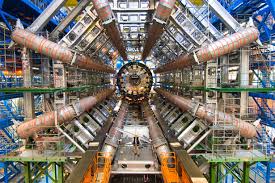
 The “God particle” is the nickname of a super particle called the Higgs boson. In layman’s terms, different subatomic particles are responsible for giving matter different properties. One of the most mysterious and important properties is mass. Some particles, like protons and neutrons, have mass. Others, like photons, do not. The Higgs boson, or “God particle,” is believed to be the particle which gives mass to matter. The “God particle” nickname grew out of the long, drawn-out struggles of physicists to find this elusive piece of the cosmic puzzle. What follows is a very brief, very simplified explanation of how the Higgs boson fits into modern physics, and how science is attempting to study it.

