The Edward Snowden guide to encryption: Secret 12-minute homemade video

The Edward Snowden guide to encryption: Secret 12-minute homemade video

  • Snowden made video to teach reporter how to speak with him securely
  • It explains how to use Public Key Encryption to scramble online messages
  • Privacy campaigners call on ordinary people to learn how to use the method

snowdenWhistleblower: The tutorial Edward Snowden made for reporters on to avoid NSA email surveillance has been made public for the first time

Ordinary people must learn to scramble their emails, privacy campaigners said today, as an encryption how-to video made by Edward Snowden was made public for the first time.

The former NSA employee who blew the whistle on the agency’s all-pervasive online surveillance made the video to teach reporters how to communicate with him in secret.

The 12-minute clip, in which Mr Snowden has used software to distort his voiceover, explains how to use free software to scramble messages using a technique called Public Key Encryption (PKE).

The video’s description on Vimeo says: ‘By following these instructions, you’ll allow any potential source in the world to send you a powerfully encrypted message that ONLY YOU can read even if the two of you have never met or exchanged contact information.’

Mr Snowden made the video last year for Glenn Greenwald in an effort to get the then-Guardian reporter to communicate securely with him online so he could send over documents he wanted to leak.

Viewers may find the video difficult to follow. Mr Greenwald himself admitted he wasn’t able to finish it. It took him seven weeks and help from experts to finally gather the expertise to get back to Snowden.

The video’s publication comes as more and more internet users are adopting encryption techniques after the alarm caused by Mr Snowden’s revelations about communications surveillance.

He leaked documents which showed the NSA and its UK counterpart GCHQ were able to spy on virtually anybody’s communications and internet usage, monitor social network activity in real time, and track and record the locations of billions of mobile devices.

There was outrage when it emerged that, contrary to promises the NSA made to Congress, these technologies were being used to track U.S. citizens without warrants and to tap the communications of leaders of allied countries.

One answer to the risks to freedom that such surveillance pose is to scramble online communications so that government agencies can no longer eavesdrop at will.

However, the encryption technologies currently available can be difficult to use and privacy activists have called on internet companies to include them in their products at the source.

Meanwhile, the campaign to end blanket surveillance continues as experts warn encryption tools are unlikely to make their way into the mainstream while internet firms continue to make their profits on the back of users’ personal information.

Scroll down for video


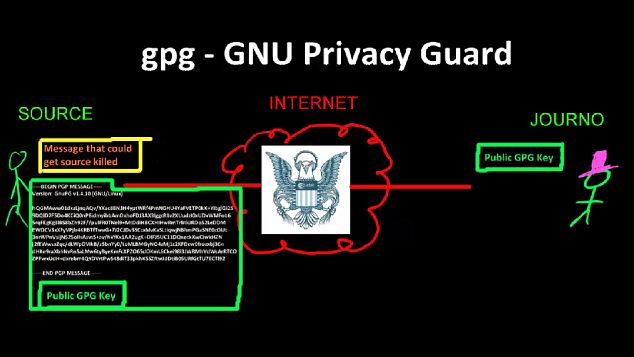
How-to guide: The video begins with a basic outline of the theory behind Public Key Encryption. It is voiced over by Mr Snowden, who has disguised his voice to avoid detection by NSA or GCHQ spies

GPG For Journalists - Grabs

Detailed: The video then explains how to use a free program called GPG4Win to scramble messages using Public Key Encryption then send them over Tor, software that allows people to use the internet anonymously

In Mr Snowden’s video, he explains how traditional emails are sent as plain text – unencrypted by default – across the internet, allowing anyone able to intercept them to easily read their contents.

‘Any router you cross could be monitored by an intelligence agency or other adversary [such as] a random hacker. So could any end points on the way there, a mail server or a service provider such as Gmail.

‘If the journalist uses a web mail service personally or its provisioned by their company, the plain text could always be retrieved later on via a subpoena or some other mechanism, legal or illegal, instead of catching it during transit. So that’s doubly dangerous

‘The solution to that is to actually encrypt the message. Now one of the problems with encryption typically  is that it requires a shared secret, a form of key or password that goes between the journalist and the source.

‘But if the source sends an encypted file across the internet to the journalist and says “Hey, here’s an encrypted file. The passwork is cheesecake,” the internet is going to know the password is cheesecake.

‘But public key encryption such as GPG allows the journalist to publish a key that anyone can have based on the design of the algorithm, and it doesn’t provide any advantage to the adversary.’

The video goes on to specifically explain how to use a free program called GPG4Win to scramble messages using Public Key Encryption then send them over Tor, a piece of software that allows people to use the internet anonymously.

It’s lessons, as well as help from experts, allowed Mr Greenwald to communicate securely with Mr Snowden to publish what has since been called the most significant leak in U.S. history. It has been made public to coincide with the release of Mr Greenwald’s book, No Place To Hide, in which he tells the story of the scoop.

Privacy campaigners told MailOnline today that all internet users should be now using encryption technology to preserve their privacy and maintain freedom of speech in the face of government spying.

Javier Ruiz, director of policy at the Open Rights Group, said: ‘Emails are like postcards and encryption is a tamper-proof envelope.

‘It’s probably obvious that journalists, MPs, doctors, lawyers or anyone transmitting confidential information online should always encrypt their emails to keep that information secure.

http://youtu.be/jo0L2m6OjLA

‘But since the Snowden revelations, more and more ordinary citizens are adopting encryption software to help keep their emails private.

‘If encryption is to be used on a mass scale, it will require companies like Google, Apple and Microsoft to embed encryption in their tools.’

But TK Keanini, chief technology officer at internet security firm Lancope, said that it was unlikely that major internet companies would begin including encryption functions in their services as standard.

‘PGP and similar programs are just too complicated for the masses,’ he said. ‘Managing key pairs, understanding revocation and all that stuff is too complicated for most, and thus adoption over the past 20 years has been limited to the highly technical – the uber geeks.

‘Now, if a service like gmail.com had an option in there to perform digital signing and encryption in a way that most people could use it, that would have a huge impact; but it will never happen because Google and other ‘free’ services make their money on the fact that your data is in the clear and they can use it to market services to you.

‘People need to understand that when people offer free services, you and your information are the payment.’

‘While people can use technology to empower themselves, we must also challenge the policies of Government and intelligence agencies to end the unlawful mass surveillance of people around the world’

Mike Rispoli, a spokesman for Privacy International, echoed those sentiments, but added that there needs to be more pressure on government to stop them from snooping on the private lives of ordinary people.

‘It is critical that people use all technology at their disposal to keep their communications private and secure,’ he said.

‘We should all support the creation and widespread use of these tools. Ultimately, however, people should never have to do more or go to extra lengths to protect their rights.

‘This is why we need political, legal, as well as technological, solutions to ensure that our privacy rights are protected.

‘While people can use technology to empower themselves, we must also challenge the policies of Government and intelligence agencies to end the unlawful mass surveillance of people around the world.’

By DAMIEN GAYLE


via Dailymail.co.uk

No Place to Hide: #PayPal14, Glenn Greenwald, PayPal Billionaire

No Place to Hide: #PayPal14, Glenn Greenwald, PayPal Billionaire

guillermo_jimenez-stanley_cohen

* Use the hashtag #PayPal14. Respond to tweets from @Pierre and @ggreenwald. Don’t forget Greenwald’s Facebook page: https://www.facebook.com/glenn.greenwald.5

PRESS RELEASE

The PayPal14 were arrested nearly three years ago on the front lines of the digital information war, helping put the hacktivist movement and specifically Anonymous on the map. Now the whistleblower/hacktivist culture they helped launch into the global spotlight is being co-opted by journalists and “tech bros” all over to advance their careers, most notably journalist Glenn Greenwald’s.

As Greenwald gets a book tour, the PayPal14 get sentencing hearings. He is traveling the world to promote his book about Snowden’s NSA leaks, and the 14 are struggling to raise more than $80,000 in court-ordered restitution for eBay/PayPal, companies ultimately overseen by Greenwald’s billionaire backer, Pierre Omidyar. The brand that popularized Pierre-Greenwald’s Snowden leaks is only so “edgy” and “cool” because heroes like the PayPal14 took direct action.

paypal-14


When PayPal, part of Pierre’s eBay, blocked donations to WikiLeaks, the 14 and many others saw that the company wasn’t just a means of transferring money. It was also a means of control. PayPal’s blockade attacked our ability to vote with our dollars. Bank of America, VISA, MasterCard, and Western Union also participated in the financial blockade, a blatant corporate attempt at silencing dissent and suppressing information. The blockade destroyed 95% of WikiLeaks’ revenue.

The 14 along with countless others bravely launched DDOS attacks, the digital equivalent of sit-ins, against PayPal to protest the unjust blockade. They shut down PayPal’s public website briefly without interfering with backend financial transactions or causing lasting harm, contrary to Department of “Justice” claims in court. After having their lives disrupted for years, 11 of the PayPal14 still face federal charges. Greenwald faces applause.

Sure, Greenwald and Pierre occasionally express tepid “support” for the PayPal14. But where’s the $80,000? That’s lunch money to Greenwald or Pierre. For the PayPal14, it’s a crushing financial burden. Pierre, according to Forbes, rakes in $7.8 billion per year while the PayPal14 struggle to stay afloat. Pierre started off First Look, Greenwald’s news media outlet, with $50 million in funding–tens of millions more than $80,000.

Greenwald and Pierre aren’t just riding the hacktivist movement–they’re watering it down. As a consequence, most of Snowden’s NSA leaks go unpublished. What is published is heavily redacted, preventing more aggressive, non-celebrity journalists from finding answers and pro-freedom hackers from building better defenses.

Ask yourself, Why isn’t Greenwald facing charges? Why isn’t he asking countries for asylum?

The PayPal14 put themselves on the front lines for something genuinely revolutionary. They grabbed the mainstream media’s attention and helped establish the “digital information war” culture that boosts this new kind of journalism. But the mainstream media has finished enjoying the spectacle of the PayPal14’s arrests. Now they’re watching Greenwald sign books, while the PayPal14, largely forgotten, sign plea deals.

Some rising players in the digital information war have confided that they believe we should make noise for the
PayPal14 at Greenwald’s book tour stops. But they’ve also confessed that doing so would put their financial interests in jeopardy. The tentacles of Greenwald/Pierre/First Look are spreading and snatching up people right and left. Thanks to Jeremy Hammond’s Stratfor leak, we better understand how corporate interests isolate radicals who try to create change. The “Duchin formula,” continued by the private intelligence firm Stratfor, states that opportunists “by definition … take the opportunity to side with the powerful for career gain” and bring the realists and idealists along with them, leaving the radicals exposed and unsupported.

We ask you to support the radicals and not the careerists. Your worst enemy is not the person in opposition to you. It is the person occupying the spot you would be fighting from and doing nothing.

The goal is to raise that $80,000. If we do that, we win this battle. For now, everything else is secondary. Supporting the PayPal14 doesn’t just mean one tweet and you’re done. It means constant effort.

Specifically, attend Greenwald’s book tour stops listed below. If they’re sold out–and most are NOT–still go and make noise outside (or get inside anyway!). For sold-out events, there are often stand-by lines in case extra seats become available. Take the steps below, inside or outside the event–or both!

1. This is crucial: Make sure people are equipped to record videos of the protest, including Greenwald’s responses, and upload them as soon as possible. Share them with the hashtag #PayPal14. If possible, videos should include the donation link – http://www.gofundme.com/PayPal14 – and text accompanying the video should include the link also.

2. Explain why you’re protesting the book tour, by mic-checking, passing out fliers, waving signs, or any other useful method. Get creative! “Pay Back the PayPal14” and “Obey eBay” and “Glenn Greenbacks” would make good slogans. Above all, make sure people get the donation link: http://www.gofundme.com/PayPal14 This can be done online, but it is critical that it be done in person at the book tour stops as well, making as much noise as possible. Occupy the book tour stops!

3. When are Greenwald and Pierre donating? You find out!

BOOK TOUR STOPS AND LINKS FOR ADDITIONAL INFORMATION ON THE PAYPAL14:

1. New York City, Tuesday May 13. 7:00-8:30 pm

Cooper Union’s Great Hall, in the Foundation Building
7 East 7th Street, between Third and Fourth Avenues
East Village in Manhattan
May 13, 2014 7:00 pm
Admission is free and open the public on a first-come first-served basis.
http://www.cooper.edu/events-and-exhibitions/events/authors-talk-glenn-greenwald-edward-snowden-and-nsa

2. Washington DC, Wednesday May 14. Doors at 6 pm, event at 7 pm.

Politics & Prose Bookstore
5015 Connecticut Ave. NW
Washington, DC 20008
May 14, 2014 7:00 pm
Doors and Will-call open at 6pm
1 General Admission Ticket: $17.00
http://www.brownpapertickets.com/event/639084

3. Boston, Thursday May 15. 7 pm.

First Parish Church
1446 Massachusetts Avenu
Cambridge, MA 02138
May 15, 2014 7:00 pm
Ticket costs $5, stand-by only
http://www.harvard.com/event/glenn_greenwald2/
http://www.harvard.com/about/sold_out_event_faq/

4. Amsterdam, Tuesday May 20. 20:00-21:30
Stadsschouwburg Amsterdam – Rabozaal
Leidseplein 26
1017 PT Amsterdam
May 20, 2014 20:00 – 21:30
http://www.ssba.nl/page.ocl?pageid=3&ev=56684
https://shop.ticketscript.com/channel/web2/get-dates/rid/CC235T4A/eid/210218/language/nl/format/html
Tickets range from € 18,27 to € 26,27

5. Seattle, Los Angeles, San Fransisco, and San Diego: Mid-June. (No information available yet.)

* Updated book tour information may become available here https://twitter.com/ggreenwald here https://www.facebook.com/glenn.greenwald.5 or here https://www.facebook.com/glenn.greenwald.5/posts/10152804684159112

MOST IMPORTANTLY, ask people to donate to the PayPal14 by going here:
http://www.gofundme.com/PayPal14

PayPal 14 Homepage (in progress):
http://thepaypal14.com/support.htm

Microfinancing by Pierre’s Omidyar Network is loan-sharking the world’s most vulnerable:
https://www.nsfwcorp.com/dispatch/extraordinary-pierre-omidyar/

News articles about the PayPal14:
https://medium.com/quinn-norton/66077450917e
http://www.thedailybeast.com/articles/2013/12/05/inside-the-paypal-14-trial.html

Pierre Omidyar profile on Forbes:
http://www.forbes.com/profile/pierre-omidyar/

The “Duchin formula” and Stratfor:

How To Win The Media War Against Grassroots Activists: Stratfor’s Strategies

WikiLeaks on the financial blockade:
https://wikileaks.org/Banking-Blockade.html

Pierre started off First Look with $50 million in funding:
http://omidyargroup.com/firstlookmedia/pierre-omidyar-provides-initial-funding-of-50m-to-establish-first-look-media/

SPECIAL NOTE: This press release is intended to make sure people’s voices are heard in a way that educates the public.

From 9/11 To PRISMgate – How The Carlyle Group LBO’d The World’s Secrets

From 9/11 To PRISMgate – How The Carlyle Group LBO’d The World’s Secrets

prism-gate

The short but profitable tale of how 483,000 private individual have “top secret” access to the nation’s most non-public information begins in 2001. “After 9/11, intelligence budgets were increased, new people needed to be hired, it was a lot easier to go to the private sector and get people off the shelf,” and sure enough firms like Booz Allen Hamilton – still two-thirds owned by the deeply-tied-to-international-governments investment firm The Carlyle Group – took full advantage of Congress’ desire to shrink federal agencies and their budgets by enabling outside consultants(already primed with their $4,000 cost ‘security clearances’) to fulfill the needs of an ever-more-encroaching-on-privacy administration.

Booz Allen (and other security consultant providing firms) trade publicly with a cloak of admitted opacity due to the secrecy of their government contracts (“you may not have important information concerning our business, which will limit your insight into a substantial portion of our business”) but the actions of Diane Feinstein who promptly denounced “treasonous” Edward Snowden, “have muddied the waters,” for the stunning 1.1 million (or 21% of the total) private consultants with access to “confidential and secret” government information.

Perhaps the situation of gross government over-spend and under-oversight is summed up best, “it’s very difficult to know what contractors are doing and what they are billing for the work — or even whether they should be performing the work at all.”

First, Diane Feinstein’s take on it all…

“I don’t look at this as being a whistleblower. I think it’s an act of treason,” the chairwoman of the Senate Intelligence Committee told reporters. The California lawmaker went on to say that Snowden had violated his oath to defend the Constitution. “He violated the oath, he violated the law. It’s treason.”

So how did all this get started?… (via AP)

The reliance on contractors for intelligence work ballooned after the 9/11 attacks. The government scrambled to improve and expand its ability to monitor the communication and movement of people who might threaten another attack.

“After 9/11, intelligence budgets were increased, new people needed to be hired,” Augustyn said. “It was a lot easier to go to the private sector and get people off the shelf.”

The reliance on the private sector has grown since then, in part because of Congress’ efforts to limit the size of federal agencies and shrink the budget.

Which has led to what appears to be major problems.

But critics say reliance on contractors hasn’t reduced the amount the government spends on defense, intelligence or other programs.

Rather, they say it’s just shifted work to private employers and reduced transparency. It becomes harder to track the work of those employees and determine whether they should all have access to government secrets.

“It’s very difficult to know what contractors are doing and what they are billing for the work — or even whether they should be performing the work at all,”

… And to the current PRISMgate whistleblowing situation:

Of the 4.9 million people with clearance to access “confidential and secret” government information, 1.1 million, or 21 percent, work for outside contractors, according to a report from Clapper’s office.

Of the 1.4 million who have the higher “top secret” access, 483,000, or 34 percent, work for contractors.

Because clearances can take months or even years to acquire, government contractors often recruit workers who already have them.

Why not – it’s lucrative!!

Snowden says he accessed and downloaded the last of the documents that detailed the NSA surveillance program while working in an NSA office in Hawaii for Booz Allen, where he says he was earning $200,000 a year.

Analysts caution that any of the 1.4 million people with access to the nation’s top secrets could have leaked information about the program – whether they worked for a contractor or the government.

For individuals and firms alike.

Booz Allen has long navigated those waters well.

The firm was founded in 1914 and began serving the U.S. government in 1940, helping the Navy prepare for World War II. In 2008, it spun off the part of the firm that worked with private companies and abroad. That firm, called Booz & Co., is held privately.

Booz Allen was then acquired by the Carlyle Group, an investment firm with its own deep ties to the government. In November 2010, Booz Allen went public.  The Carlyle Group still owns two-thirds of the company’s shares.

Or, a full-majority stake.

Curiously once public, The Booz Allens of the world still operate like a psuedo-private company, with extensive confidential cloaks preventing the full disclosure of financial data. But don’t worry – we should just trust them. Via Bloomberg’s Jonathan Weil.

Psst, here’s a stock tip for you. There’s a company near Washington with strong ties to the U.S. intelligence community that has been around for almost a century and has secret ways of making money — so secret that the company can’t tell you what they are. Investors who buy just need to have faith.

To skeptics, this might seem like a pitch for an investment scam. But as anyone who has been paying attention to the news might have guessed, the company is Booz Allen Hamilton Holding Corp.

“Because we are limited in our ability to provide information about these contracts and services,” the company said in its latest annual report, “you may not have important information concerning our business, which will limit your insight into a substantial portion of our business, and therefore may be less able to fully evaluate the risks related to that portion of our business.”

This seems like it would be a dream arrangement for some corporations: Not only is Booz Allen allowed to keep investors uninformed, it’s required to. I suppose we should give the company credit for being transparent about how opaque it is.

And while the media and popular attention is currently focused on who, if anyone else, may be the next Snowden struck by a sudden pang of conscience, perhaps a better question is what PE behemoth Carlyle, with a gargantuan $170 billion in AUM, knows, and why it rushed to purchase Booz Allen in the months after the Bear Stearns collapse, just when everyone else was batting down the hatches ahead of the biggest financial crash in modern history.

From Bloomberg, May 2008:

Carlyle Group, the private-equity firm run by David Rubenstein, agreed to acquire Booz Allen Hamilton Inc.’s U.S. government-consulting business for $2.54 billion, its biggest buyout since the credit markets collapsed in July.

The purchase would be Carlyle’s biggest since it agreed to buy nursing-home operator Manor Care Inc. last July for $6.3 billion. Deal-making may be rebounding from a 68 percent decline in the first quarter as investment banks begin writing new commitments for private-equity transactions. Buyouts ground to a halt last year because of a global credit freeze triggered by record U.S. subprime-mortgage defaults.

The Booz Allen government-consulting unit has more than 18,000 employees and annual sales of more than $2.7 billion. Its clients include branches of the U.S. military, the Department of Homeland Security and the World Bank.

Carlyle, based in Washington, manages $81.1 billion in assets [ZH: that was 5 years ago – the firm now boasts $170 billion in AUM]. Rubenstein founded the firm in 1987 with William Conway and Daniel D’Aniello. The trio initially focused on deals tied to government and defense.

Carlyle and closely held Booz Allen have attracted high-level officials from the government. Carlyle’s senior advisers have included former President George H.W. Bush, former British Prime Minister John Major, and Arthur Levitt, the ex-chairman of the U.S. Securities and Exchange Commission.

R. James Woolsey, who led the U.S. Central Intelligence Agency from 1993 to 1995, is a Booz Allen executive. Mike McConnell, the U.S. director of national intelligence, is a former senior vice president with the company.

Carlyle last year sold a minority interest in itself to Mubadala Development Co., an investment fund affiliated with the government of Abu Dhabi, capital of the United Arab Emirates.

And in addition to the UAE, who can possibly forget Carlyle’s Saudi connection. From the WSJ circa 2001:

If the U.S. boosts defense spending in its quest to stop Osama bin Laden’s alleged terrorist activities, there may be one unexpected beneficiary: Mr. bin Laden’s family.

Among its far-flung business interests, the well-heeled Saudi Arabian clan — which says it is estranged from Osama — is an investor in a fund established by Carlyle Group, a well-connected Washington merchant bank specializing in buyouts of defense and aerospace companies.

Through this investment and its ties to Saudi royalty, the bin Laden family has become acquainted with some of the biggest names in the Republican Party. In recent years, former President Bush, ex-Secretary of State James Baker and ex-Secretary of Defense Frank Carlucci have made the pilgrimage to the bin Laden family’s headquarters in Jeddah, Saudi Arabia. Mr. Bush makes speeches on behalf of Carlyle Group and is senior adviser to its Asian Partners fund, while Mr. Baker is its senior counselor. Mr. Carlucci is the group’s chairman.

Osama is one of more than 50 children of Mohammed bin Laden, who built the family’s $5 billion business, Saudi Binladin Group, largely with construction contracts from the Saudi government. Osama worked briefly in the business and is believed to have inherited as much as $50 million from his father in cash and stock, although he doesn’t have access to the shares, a family spokesman says. Because his Saudi citizenship was revoked in 1994, Mr. bin Laden is ineligible to own assets in the kingdom, the spokesman added.

People familiar with the family’s finances say the bin Ladens do much of their banking with National Commercial Bank in Saudi Arabia and with the London branch of Deutsche Bank AG. They also use Citigroup Inc. and ABN Amro, the people said.

“If there were ever any company closely connected to the U.S. and its presence in Saudi Arabia, it’s the Saudi Binladin Group,” says Charles Freeman, president of the Middle East Policy Council, a Washington nonprofit concern that receives tens of thousands of dollars a year from the bin Laden family. “They’re the establishment that Osama’s trying to overthrow.”

A Carlyle executive said the bin Laden family committed $2 million through a London investment arm in 1995 in Carlyle Partners II Fund, which raised $1.3 billion overall. The fund has purchased several aerospace companies among 29 deals. So far, the family has received $1.3 million back in completed investments and should ultimately realize a 40% annualized rate of return, the Carlyle executive said. But a foreign financier with ties to the bin Laden family says the family’s overall investment with Carlyle is considerably larger. He called the $2 million merely an initial contribution. “It’s like plowing a field,” this person said. “You seed it once. You plow it, and then you reseed it again.”

The Carlyle executive added that he would think twice before accepting any future investments by the bin Ladens. “The situation’s changed now,” he said. “I don’t want to spend my life talking to reporters.”

We can clearly see why. We can also clearly see why nobody has mentioned Carlyle so far into the Booz Allen fiasco.

A U.S. inquiry into bin Laden family business dealings could brush against some big names associated with the U.S. government. Former President Bush said through his chief of staff, Jean Becker, that he recalled only one meeting with the bin Laden family, which took place in November1998. Ms. Becker confirmed that there was a second meeting in January 2000, after being read the ex-president’s subsequent thank-you note. “President Bush does not have a relationship with the bin Laden family,” says Ms. Becker. “He’s met them twice.”

Mr. Baker visited the bin Laden family in both 1998 and 1999, according to people close to the family. In the second trip, he traveled on a family plane. Mr. Baker declined comment, as did Mr. Carlucci, a past chairman of Nortel Networks Corp., which has partnered with Saudi Binladin Group on telecommunications ventures.

As one can imagine the rabbit hole just gets deeper and deeper the more one digs. For now, we will let readers do their own diligence. We promise the results are fascinating.

Going back to the topic at hand, we will however ask just how much and what kind of confidential, classified, and or Top Secret information is shared “behind Chinese walls” between a Carlyle still majority-owned company and the private equity behemoth’s employees and advisors, among which are some of the most prominent political and business luminaries currently alive.  The following is a list of both current and former employees and advisors. We have used Wiki but anyone wishing to comb through the firm’s full blown roster of over 1,000 employees and advisors, is welcome to do so at the firm’s website.

Business

Political figures

North America
Europe
Asia
  • Anand Panyarachun, former Prime Minister of Thailand (twice), former member of the Carlyle Asia Advisory Board until the board was disbanded in 2004  
  • Fidel V. Ramos, former president of the Philippines, Carlyle Asia Advisor Board Member until the board was disbanded in 2004  
  • Peter Chung, former associate at Carlyle Group Korea, who resigned in 2001 after 2 weeks on the job after an inappropriate e-mail to friends was circulated around the world    
  • Thaksin Shinawatra, former Prime Minister of Thailand (twice), former member of the Carlyle Asia Advisory Board until 2001 when he resigned upon being elected Prime Minister.  

Media

  • Norman Pearlstine – editor-in-chief of Time magazine from (1995–2005), senior advisor telecommunications and media group 2006-

and across the entire globe?

Here is Carlyle, straight from the horse’s recently IPOed mouth, courtesy of its most recent public presentation

Perhaps Bloomberg’s Jonathan Weil sums it up best:

There’s no easy solution here, aside from the obvious point that the government keeps way too many secrets.

So what happens when one corporation, owned and controlled by the same government’s former (and in some cases current) top power brokers, potentially has access to all of the same government’s secrets?

via ZeroHedge

February 5, 2013 – Decrypted Matrix Radio: You’ve Felt It.. Joe Rogan’s American Ideal, The Holographic Reality, Humanitarian ‘Wars’, Paul Harvey Thoughts, Charlie Chaplin Speech

February 5, 2013 – Decrypted Matrix Radio: You’ve Felt It.. Joe Rogan’s American Ideal, The Holographic Reality, Humanitarian ‘Wars’, Paul Harvey Thoughts, Charlie Chaplin Speech

Joe Rogan and The American Ideal

You’ve Felt It Your Entire Life…

Newtown Father Blasts Gun Control Hearing!

Greatest Speech Ever Made Charlie Chaplin The Great Dictator

Prodigy (of Mobb Deep) on ‘the Illuminati’

Journalist Glenn Greenwald Speech on “Humanitarian” Wars

FLASHBACK: Paul Harvey Wise Whistleblower – “If I Were The Devil”


2-5

Every Week Night 12-1am EST (9-10pm PST)

– Click Image to Listen LIVE –

Journalist Glenn Greenwald Speech on “Humanitarian” Wars

Journalist Glenn Greenwald Speech on “Humanitarian” Wars

http://youtu.be/MMirTxSlhBA

Greenwald is that increasingly rare commodity in the US, a true journalist. I don’t agree with him on a lot of things, but he is definitely correct here in debunking the hogwash about “humanitarian” wars. Nobody goes to war for humanitarian reasons. There may be an unplanned byproduct of humanitarianism, but it is never the objective. The objective of war is always the acquisition of land and resources or the defense thereof. That’s it.