In the small West Yorkshire mill town of Todmorden, something extraordinary has been unfolding. Vegetable beds line the streets, herbs grow outside the health centre, and fruit trees dot supermarket car parks. Residents are encouraged to harvest whatever they find — no questions asked, no payment required. It is the centerpiece of an ambitious grassroots movement called Incredible Edible, and its goal is nothing short of making the town entirely self-sufficient in food.
Free Food Growing Outside the Police Station
Outside the Todmorden police station, three large raised beds have been overflowing with curly kale, carrots, lettuces, and spring onions. Passersby regularly walk up and dig up whatever they need. The police not only allow it — they watch it happen on security cameras with amusement.
“I watch them on camera as they come up and pick them,” desk officer Janet Scott has said with a grin. The vegetables are not being stolen. They are part of the town’s communal food experiment, which has placed roughly 70 large planting beds throughout Todmorden, all free for public picking.
How Two Women Launched a Food Revolution
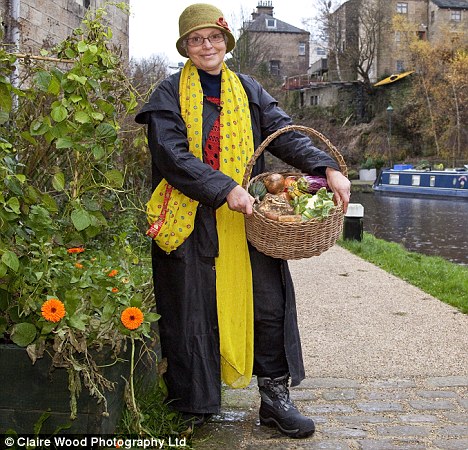
Incredible Edible was co-founded by Mary Clear, a grandmother of ten, and Pam Warhurst, former owner of the town’s Bear Cafe. The two began discussing the state of the world and concluded that meaningful change had to start locally.
They gathered a group of like-minded residents — mostly women — in the cafe and began planning. “There’s so much blame in the world — blame local government, blame politicians, blame bankers, blame technology — we thought, let’s just do something positive instead,” Mary has explained.
The project launched with a bold objective: make Todmorden the first town in England that is entirely self-sufficient in food. The original target date was 2018, which Mary acknowledged was ambitious. “But if you don’t aim high, you might as well stay in bed,” she said.
A Community Built on Trust and Generosity
The Incredible Edible model operates entirely on an honor system. There are no fences, no locks, and no limits on what people can take. When asked what prevents someone from showing up with a large bag and taking everything, Mary’s answer is simple: nothing.
“We trust people. We truly believe — we are witness to it — that people are decent,” she has said. While the occasional strawberry patch gets cleaned out, it does not dampen the spirit of the project. Mary describes Incredible Edible as “a revolution” led by “gentle revolutionaries” where “everything we do is underpinned by kindness.”
Raspberries on the Towpath and Broccoli at the Train Station
The plantings extend throughout the town in creative and sometimes sentimental ways. Raspberries, apricots, and apples grow along the canal towpath. Blackcurrants and strawberries are planted beside the doctor’s surgery. Beans and peas grow outside the local college, and cherries fill the supermarket car park.
One particularly touching planting honors a beloved railway station ticket collector named Reg, whose favorite vegetable was broccoli. After his passing, memorial beds of broccoli were planted at the station. The neighboring town of Hebden Bridge, where Reg was also well known, did the same.
Guerrilla Gardening That Won Official Approval
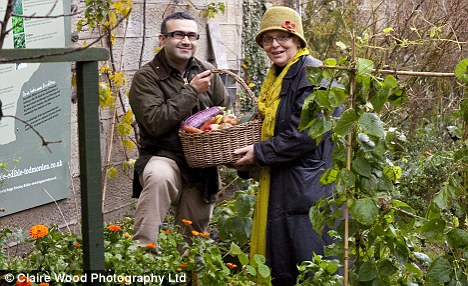
Not all of the plantings were authorized at the start. Herb bushes planted along the canal by resident Estelle Brown, a 67-year-old former interior designer, were installed without permission from British Waterways. The organization only discovered them during an inspection ahead of a visit by Prince Charles, who has been a vocal supporter of the project.
When Estelle received an email from British Waterways, she feared the worst. Instead, it read: “How do you build a raised bed? Because my boss wants one outside his office window.”
Reducing Crime and Strengthening Community Bonds
The project has produced unexpected social benefits beyond food production. Local police have reported year-over-year reductions in vandalism since Incredible Edible began. Pam Warhurst attributes this to a simple psychological shift: “If you take a grass verge that was used as a litter bin and a dog toilet and turn it into a place full of herbs and fruit trees, people won’t vandalise it. I think we are hard-wired not to damage food.”
Todmorden itself is not a wealthy enclave. A third of households do not own a car, and a fifth lack central heating. House prices range from modest terraces at around 50,000 pounds to stone villas near one million. The scheme has bridged these economic divides, bringing a varied community closer together.
Education, Local Economy, and International Interest
Incredible Edible extends well beyond the vegetable beds. The initiative includes classes in pickling, preserving, and bread-making. The local college has introduced a BTEC qualification in horticulture, aiming to create career pathways for young people who grew up surrounded by the project. The local school received a 500,000 pound Lottery grant to establish a fish farm, combining food production with practical skills training.
Local businesses have also benefited. The Bear cafe sources all ingredients from farms within a 30-mile radius, and a thriving daily market provides fresh local produce to thousands of residents.
The model has attracted attention far beyond West Yorkshire. Similar schemes have been piloted in 21 other towns across the United Kingdom, and interest has come from Spain, Germany, Hong Kong, Canada, and New Zealand. Mary Clear has spoken to an all-party group of Members of Parliament at Westminster about the approach.
Growing Food as an Act of Self-Reliance
Joe Strachan, a former American sales director who moved to Todmorden from California with his wife, captured the spirit of the project after becoming involved six months into his time in the town.
“There’s a nobility to growing food and allowing people to share it,” he said. “There’s a feeling we’re doing something significant rather than just moaning that the state can’t take care of us. Maybe we all need to learn to take care of ourselves.”
Mary Clear puts it even more simply: “What we’ve done is not clever. It just wasn’t being done.”