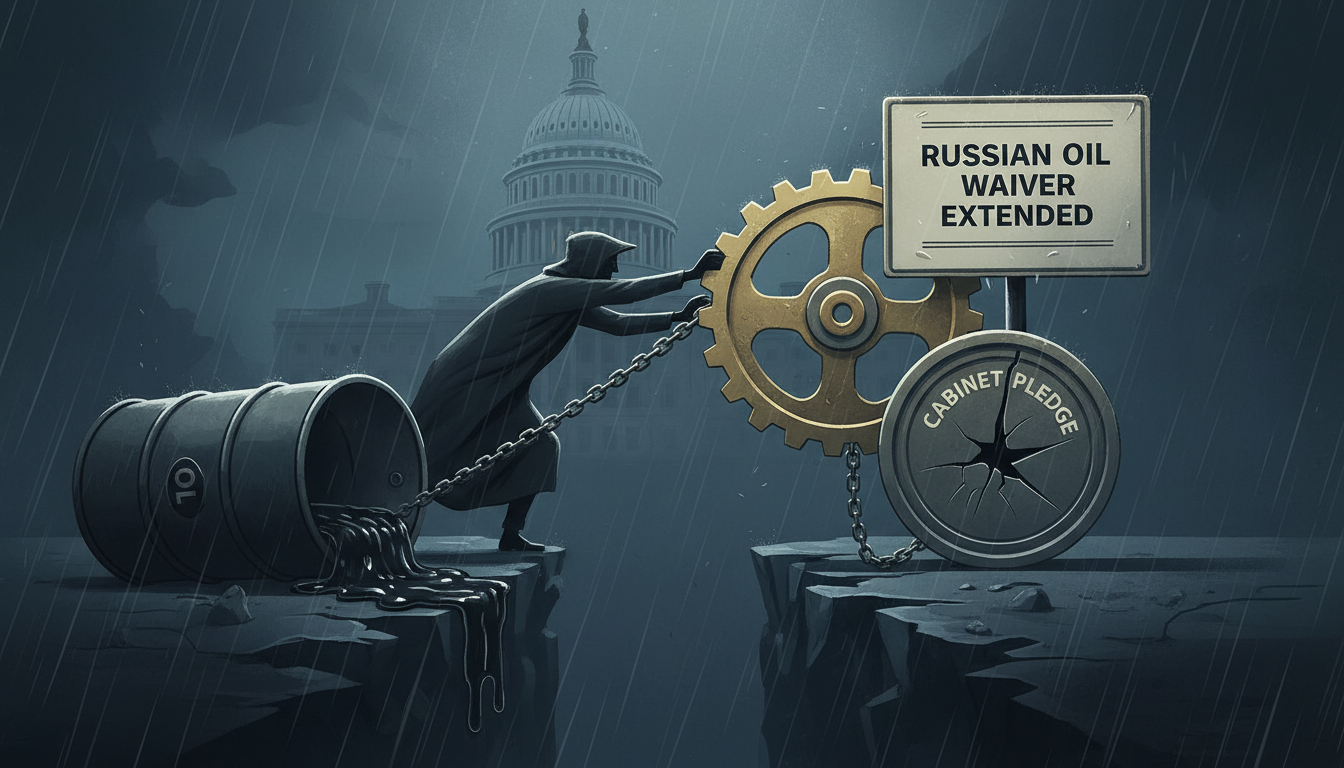
The Trump administration executed a striking policy reversal Friday when the Treasury Department extended sanctions relief for Russian oil shipments, directly contradicting Treasury Secretary Scott Bessent’s public pledge just two days earlier that no such extension would occur.
The Abrupt Policy Reversal
The Treasury’s Office of Foreign Assets Control issued a general license covering Russian crude and petroleum products already loaded onto vessels as of April 17, authorizing transactions through May 16. This waiver replaces an earlier 30-day order that took effect on March 19 and extends to critical services including safe docking, crew safety, emergency repairs, and insurance coverage.
The reversal came despite Bessent’s explicit statement to reporters on Wednesday that waivers on both Russian and Iranian oil would not be extended. The Treasury Secretary had previously characterized the initial waiver as “narrowly tailored” and claimed it would “not provide significant financial benefit to the Russian government.”
Iran Conflict Drives Energy Market Volatility
The waiver extension directly correlates to the ongoing US-Iran conflict that has disrupted global energy markets. According to the International Monetary Fund’s Kristalina Georgieva, the economic impact from the 43-day conflict is already “baked” into the economy, with energy infrastructure across the Gulf suffering extensive damage that will require years to repair.
Oil prices have exceeded $100 per barrel following Trump’s announcement of a naval blockade of the Strait of Hormuz, a critical shipping channel through which one-fifth of the world’s oil supply typically flows. American gasoline prices reached $4 per gallon on March 31, marking their highest level since 2022.
Political Backlash and Strategic Implications
Senate Democrats swiftly condemned the reversal as “shameful.” Senators Jeanne Shaheen, Elizabeth Warren, and Minority Leader Chuck Schumer issued a joint statement questioning what message the extension sends following recent Russian attacks on Ukraine. “Make no mistake, Putin has been one of the biggest beneficiaries of President Trump’s war against Iran, as Russia saw oil revenues nearly double in March,” the senators stated.
European Commission President Ursula von der Leyen criticized the decision, stating it is “not the time to relax sanctions against Russia.” Ukrainian leader Vladimir Zelensky warned the exemption “could provide Russia with about $10 billion for the war.”
Russia’s Response and Market Position
Russian officials have consistently dismissed Western energy sanctions as ineffective. Foreign Minister Sergey Lavrov previously called the waiver “meaningless,” noting that “tankers that are already at sea and heading to their destinations continue moving exactly as they did before.” He added that sanctions “do not exist for us, as well as for our conscientious, respectable partners.”
Russia has emerged as a primary beneficiary of the Iran conflict due to soaring oil prices, reaping an estimated $150 million in additional daily revenue. Kremlin spokesman Dmitry Peskov acknowledged Russia has seen “a sharp rise in demand for oil” while maintaining the country “has been and remains a reliable supplier of both oil and gas.”
Economic Warfare Behind Closed Doors
The Treasury Department’s contradictory messaging within a 48-hour period reveals the complex pressures facing energy policy during wartime. Despite Trump’s public statement that “The United States is the largest Oil Producer in the World, by far, so when oil prices go up, we make a lot of money,” industry discussions at Houston’s CERAWeek conference showed significant concern about the conflict’s long-term market implications rather than celebration of higher prices.
The waiver extension exposes the administration’s prioritization of short-term energy price stability over consistent sanctions enforcement, potentially undermining broader strategic objectives in both the Russia-Ukraine conflict and Middle East tensions.
This article draws on reporting from RT, The Hill, Business Insider, and Brookings Institution.