
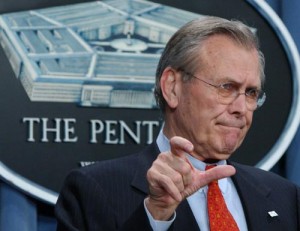
Errol Morris Takes On Donald Rumsfeld
Filmmaker Errol Morris, known for his Oscar-winning documentary The Fog of War about Vietnam-era Defense Secretary Robert McNamara, turned his camera on Donald Rumsfeld for a 100-minute interview that became The Unknown Known. The film examined one of the most consequential and controversial figures of the post-9/11 era, a man who served as the youngest Secretary of Defense at age 44 under Gerald Ford and later returned to the Pentagon under George W. Bush to oversee the invasions of Afghanistan and Iraq.
The documentary arrived against a backdrop of staggering costs from the Iraq War: more than 4,400 U.S. military deaths, 32,000 wounded, an estimated 100,000 to 500,000 Iraqi fatalities, millions of displaced civilians, and a financial cost estimated at approximately $3 trillion.
Evasion as a Form of Communication
Where McNamara had eventually accepted a measure of responsibility for Vietnam in The Fog of War, Rumsfeld offered no such concessions. Throughout the interview, he deflected questions with contradictions, redefinitions, and philosophical digressions that left the substance of Morris’s inquiries largely unanswered.
Rumsfeld appeared relaxed and self-assured on camera, maintaining an air of detachment from the consequences of policies he had helped architect. Questions about the fabricated weapons of mass destruction rationale, prisoner abuse at detention facilities, and the alleged connections between Saddam Hussein and the September 11 attacks were met with rhetorical maneuvering rather than direct engagement.
The Memo Culture and Manufactured Ambiguity
The film’s title derived from one of the countless official memos Rumsfeld generated throughout his decades in government. In a 2004 memo titled “What You Know,” he wrote about things people believe they know that turn out to be wrong. Morris used this concept as a framework for understanding how a senior government official could navigate contradictions without ever acknowledging them.
Rumsfeld’s most quoted formulation, that “the absence of evidence is not the evidence of absence,” received particular scrutiny. In the context of Iraq’s weapons of mass destruction, this kind of circular reasoning had been used to justify military action based on intelligence gaps rather than confirmed threats. The logic could be applied to justify virtually any action, since the absence of proof against a proposition was reframed as supporting it.
Accountability Without Accountability
When pressed on policy failures, Rumsfeld attributed negative outcomes to the inherent unpredictability of war and executive decision-making. The unintended consequences of conflict, in his framing, were not failures of judgment but inevitable features of operating in complex environments. This philosophical stance effectively insulated him from responsibility for specific outcomes, from the conditions at Abu Ghraib to the broader destabilization of the Middle East.
Morris’s directorial approach was notably different from a confrontational interview. Rather than challenging Rumsfeld’s statements with opposing witnesses or expert commentary, Morris juxtaposed the former secretary’s words with archival news footage from the lead-up to and aftermath of the Iraq invasion. The contrast between Rumsfeld’s composed self-assessments and the documented reality of the war’s consequences served as its own form of commentary.
Power, Self-Deception, and the Limits of Documentary Film
Morris’s primary interest appeared to be less about catching Rumsfeld in a contradiction than about exploring how individuals at the highest levels of government can maintain internal narratives that diverge from documented facts. The documentary raised questions about whether such figures eventually lose the ability to distinguish between strategic messaging and genuine belief.
The film presented a portrait of a man who appeared to sleep soundly in the conviction that his decisions were correct, even as the consequences of those decisions continued to unfold across the Middle East. Whether this represented genuine self-assurance or an impenetrable defense mechanism remained, fittingly, an unknown known.