Afghanistan dominates the global opium market, accounting for roughly 92 percent of worldwide production. What remains deeply troubling is the documented role of Western military forces in safeguarding the very poppy fields that sustain this multibillion-dollar narcotics pipeline.
Taliban Eradication and the Pre-2001 Landscape
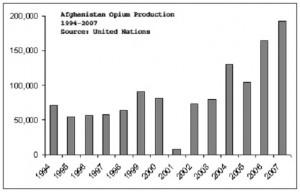
Before the events of September 11, 2001, Afghanistan played a minimal role in global opium cultivation. The Taliban government had undertaken an aggressive campaign to destroy poppy fields across the country, and by early 2001, reports indicated that the nation’s opium output had been virtually eliminated. Independent observers confirmed that the eradication effort was remarkably effective, cutting production to near-zero levels.
Post-Invasion Production Surge
Following the US-led invasion of Afghanistan in late 2001, the trajectory of opium cultivation reversed dramatically. According to data from the United Nations Drug Control Program, opium production spiked by 657 percent in 2002 alone. The timing raised immediate questions about whether the military campaign had inadvertently — or deliberately — created conditions favorable to the drug trade.
Intelligence Ties to the Afghan Drug Trade
Reporting from major outlets later revealed that Ahmed Wali Karzai, brother of then-Afghan President Hamid Karzai, had been receiving payments from the CIA for at least eight years. Ahmed Wali Karzai was identified as a key figure in the country’s opium network, often referred to as the Golden Crescent trade. Analysts noted that this arrangement suggested a deeper institutional involvement in maintaining the narcotics pipeline.
Researcher Michel Chossudovsky documented in 2007 that the Golden Crescent drug trade, initially facilitated by intelligence agencies in the 1980s, continued to operate under the protection of NATO occupation forces and British military units. The proceeds, according to his analysis, flowed overwhelmingly into Western banking institutions and corporate entities rather than remaining in Afghanistan.
Media Framing and Public Perception
Mainstream coverage of the issue often presented a different narrative. In one notable 2010 broadcast, a major US news network framed the military’s protection of poppy fields as a necessary measure to maintain local stability and avoid alienating Afghan farmers. Critics argued that this framing obscured the financial interests driving the policy, attributing farmer support to insurgent groups rather than foreign intelligence operations.
The Broader Contradiction
The situation exposed a stark policy contradiction. While thousands of Americans suffered annually from opioid-related harm — much of it traceable to Afghan-sourced heroin — US military personnel were simultaneously assigned to guard the poppy fields feeding that supply chain. At the same time, domestic cultivation of far less harmful crops like hemp remained federally prohibited. The disconnect between stated anti-drug policy and observed military operations in Afghanistan raised fundamental questions about whose interests the war on drugs truly served.