
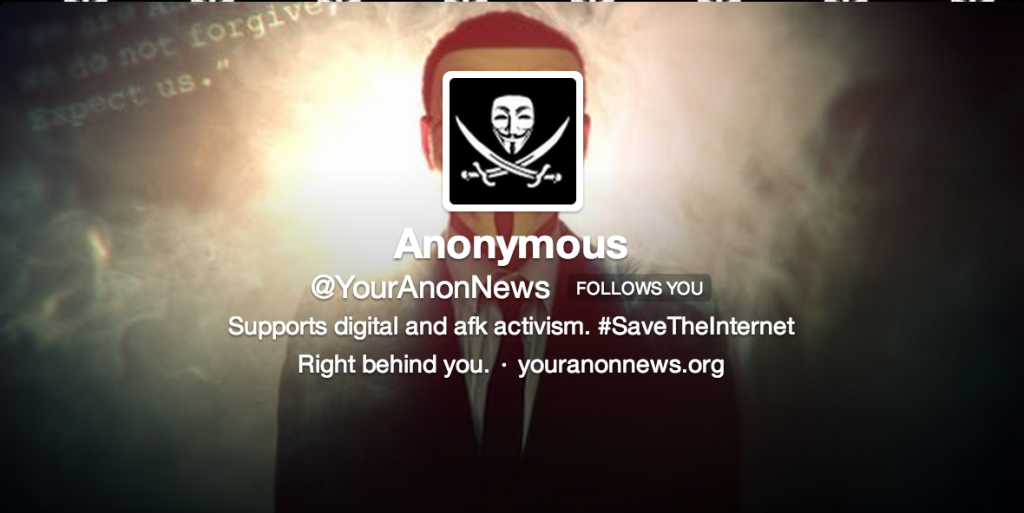
The Rise of YourAnonNews
The @YourAnonNews Twitter account, created in April 2011, grew to become one of the most influential voices associated with the Anonymous hacktivist movement, eventually amassing over 1.24 million followers. The account was primarily run by Christopher Banks, known online as Jackal, who operated from Denver. As the workload grew, Banks brought additional contributors on board, with up to 25 people having access at one point. The operation became sophisticated enough to maintain a detailed style guide.
Anonymous has always functioned more as a decentralized idea than a cohesive organization. That structural openness gave it resilience but also made it vulnerable to the kinds of internal conflicts that erupted around @YourAnonNews in 2014, when questions about missing crowdfunding money and a struggle for control of the account threatened to undermine public trust in the movement.
The Crowdfunding Campaign and the Missing Money
In early 2013, Banks and several other prominent account operators launched an Indiegogo campaign with the stated goal of creating a weekly news show, providing embedded coverage of direct actions, and building a new website to promote protest journalism. The initial fundraising target was just $2,000, but the campaign attracted 1,307 donors who contributed a total of $54,668.
Questions about the wisdom of donating to such a vaguely defined project arose immediately, and those concerns proved prescient. After deducting Indiegogo’s four percent platform fee and three percent credit card processing charges, the remaining funds were received by Banks. According to a “Truth and Reconciliation” document later published by account stakeholders, approximately $19,959 was spent on promised merchandise such as t-shirts, mugs, and stickers, as well as laptops, broadband access, and server costs.
That left roughly $34,709 unaccounted for.
New Leadership Discovers the Problem
In October 2013, Dell Cameron, a reporter with the Daily Dot who had been involved with the Anonymous movement since the Arab Spring, joined the @YourAnonNews team and quickly recognized that something was wrong. None of the promised merchandise had been shipped to donors, and there was no trace of the remaining funds.
Cameron sought legal advice, recognizing that he was assuming responsibility for an account that may have been connected to financial misconduct. He joined forces with Nicole Powers, veteran Anonymous organizer Gregg Housh, and attorney Tor Ekeland to form an informal board aimed at restructuring the account’s governance. Their plan was to transfer the intellectual property into a formal non-profit organization.
The group’s first priority was making good on the unfulfilled merchandise pledges. They raised $9,000 through private donations to cover the cost of shipping the backlog of rewards to original contributors.
The Power Struggle Erupts
Banks retained access to the @YourAnonNews account throughout this period, a situation Cameron tolerated while the board attempted to get answers about the missing funds. According to Cameron, he personally asked Banks twelve times where the money had gone. Each time, Banks refused to answer.
The situation reached a breaking point in May 2014. Cameron and Dan Stuckey, a Vice reporter who had also been brought onto the account, informed Ekeland at a meeting in New York that they intended to seize control and lock everyone else out. Ekeland talked them out of acting immediately, but in the early hours of Friday morning, Cameron went ahead with the plan, locking out Ekeland, Powers, Housh, and Banks. Cameron said the move was authorized by seven other @YourAnonNews contributors.
What followed was a chaotic period of public accusations and counter-accusations across social media. Gabriella Coleman, a professor at McGill University and a leading scholar of Anonymous, said she had never seen anything like the volume of rumors circulating online during those days.
Competing Narratives
The two sides offered fundamentally different accounts of what had led to the crisis. Cameron believed that Ekeland had been negotiating a deal with Banks that would effectively sweep the missing $35,000 under the rug while allowing Banks to continue using the account without public accountability. Cameron found this unacceptable.
Ekeland acknowledged that he had been in discussions with Banks but insisted they were only in the negotiation phase and that any agreement would have required board approval. He said Cameron was aware of this process. Ekeland flatly denied Cameron’s claim that he had been threatened over the matter, and he resigned from the board immediately after being locked out of the account.
Ekeland compared the fight over @YourAnonNews to the ring in The Lord of the Rings: “It drives people crazy, they get greedy for it, everyone wants it.”
Cameron, despite being on the opposite side of the dispute, offered a strikingly similar assessment: “At the end, this is not about Anonymous. This is about a group of people fighting over a social media account. These are grown people squabbling like kids over the equivalent of a toy in the sandbox.”
Aftermath and the Question of Trust
Facing widespread criticism for his unilateral seizure of the account, Cameron relinquished control within days. The account was handed over to a group of Anonymous members based in Denver who continued to operate it.
The publication of the Truth and Reconciliation document on Saturday provided some transparency, but it did not resolve the fundamental problem. The $35,000 remained unaccounted for, and Banks had not publicly addressed the allegations. Multiple Anonymous-affiliated accounts called for @YourAnonNews to be abandoned entirely, arguing that the brand was permanently tarnished.
Coleman took a more measured view, suggesting that the capacity for reinvention was inherent to Anonymous’s structure. Whether the account and the broader movement could recover from the scandal remained an open question, but the incident exposed a tension that decentralized movements perpetually face: the gap between the ideal of leaderless organization and the reality that influence, money, and platform access inevitably concentrate in the hands of a few individuals, creating the same power dynamics the movement was designed to resist.